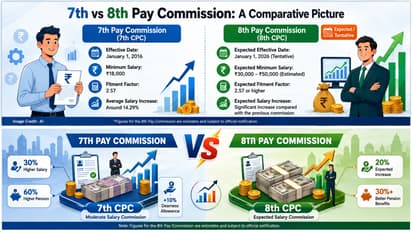
7th vs 8th Pay Commission: We break down everything from fitment factor and basic pay to DA, HRA, and implementation dates. Here's a full comparison of what could change.
The 7th Pay Commission was formed in February 2014 and came into effect in 2016. In contrast, the 8th Pay Commission was officially set up via a gazette notification on November 3, 2025. The 7th CPC submitted its report in 21 months, while the 8th CPC has 18 months to submit its report from its formation date, which means we can expect it around May 2027.
210
Who's Heading the Commissions
Former Supreme Court Justice Ashok Kumar Mathur led the 7th Pay Commission. Now, former Supreme Court Justice Ranjana Prakash Desai is heading the 8th Pay Commission.
310
The Reference Date
The 7th Pay Commission's recommendations were effective from the reference date of January 1, 2016. Similarly, the 8th Pay Commission has also set January 1, 2026, as the reference date for revised salaries.
The 7th Pay Commission had a fitment factor of 2.57. While the 8th Pay Commission's factor isn't final yet, experts predict it could be anywhere between 1.92 and 2.86. Some central government sources estimate it to be closer to the 2.28-2.46 range.
510
Minimum Basic Pay
Under the 7th Pay Commission, the minimum basic pay jumped from ₹7,000 to ₹18,000. With the 8th Pay Commission, it is estimated that the minimum basic pay could go up to anywhere between ₹34,560 and ₹51,480, depending on the final fitment factor.
610
Dearness Allowance (DA) Calculation
Currently, under the 7th Pay Commission's structure, the Dearness Allowance (DA) has reached 60%. It is expected that once the 8th Pay Commission is implemented, the DA will be reset to zero. The old DA will likely be merged into the basic pay.
710
HRA Structure
With the 7th Pay Commission, HRA rates for X, Y, and Z cities are currently 30%, 20%, and 10% respectively, because DA crossed the 50% mark. After the DA merges with basic pay under the 8th Pay Commission, the HRA will be recalculated.
810
Pension Scheme
The 7th Pay Commission focused on the National Pension System (NPS) for employees who joined after 2004. The 8th Pay Commission will incorporate the new Unified Pension Scheme (UPS) announced by the Centre, along with necessary reforms to the NPS.
910
Implementation Time
The 7th Pay Commission was implemented back in 2016. The 8th Pay Commission is currently in its consultation stage. Final recommendations are expected in 2026-27, so implementation probably won't start before 2027.
1010
Who Will Benefit
The 7th Pay Commission was applicable to about 47 lakh employees and 52 lakh pensioners. It is estimated that the 8th Pay Commission could benefit around 48.62 lakh employees and 67.85 lakh pensioners.