Why Trump Credited Asim Munir, Shehbaz Sharif for Iran Ceasefire — And What Pakistan Gains
Synopsis
US President Donald Trump has extended a ceasefire with Iran following a request from Pakistan's Prime Minister Shehbaz Sharif and military chief Asim Munir. This move positions Pakistan as a key mediator in the West Asian crisis.
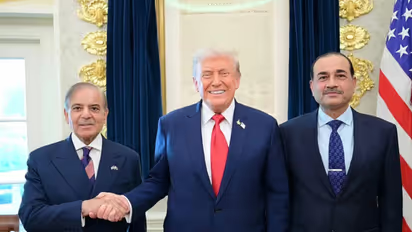
US President Donald Trump has extended the ceasefire with Iran, saying the decision came after a direct request from Pakistan’s military chief Field Marshal Asim Munir and Prime Minister Shehbaz Sharif — a move that has unexpectedly placed Islamabad at the center of one of the most delicate geopolitical crises in West Asia.
The announcement marked a major shift in Washington’s posture. Until now, Trump had repeatedly signalled that any delay in military action against Iran would depend entirely on Tehran’s willingness to return to negotiations. But in his latest statement, the US president openly credited Pakistan’s leadership for persuading him to hold back.
Trump wrote on Truth Social: “Based on the fact that the Government of Iran is seriously fractured, not unexpectedly so and, upon the request of Field Marshal Asim Munir, and Prime Minister Shehbaz Sharif, of Pakistan, we have been asked to hold our Attack on the Country of Iran until such time as their leaders and representatives can come up with a unified proposal.”
He added that while active military strikes would remain paused, American pressure on Iran would not disappear.
“I have therefore directed our Military to continue the Blockade and, in all other respects, remain ready and able.”
The statement underlined a two-track strategy — extending diplomacy while maintaining military leverage.
Pakistan’s Diplomatic Gamble
Pakistan quickly welcomed Trump’s decision, with Prime Minister Shehbaz Sharif publicly thanking the US president for giving diplomacy more time.
Sharif wrote: “On my personal behalf and on behalf of Field Marshal Syed Asim Munir, I sincerely thank President Trump for graciously accepting our request to extend the ceasefire to allow ongoing diplomatic efforts to take their course.”
He added: “I sincerely hope that both sides will continue to observe the ceasefire and be able to conclude a comprehensive ‘Peace Deal’ during the second round of talks scheduled at Islamabad.”
That public acknowledgment from both Washington and Islamabad has reinforced the perception that Pakistan is trying to reposition itself as a regional peace broker rather than merely a spectator in Middle Eastern politics.
Also Read: Trump Extends Iran Ceasefire Deadline While US Blockade Continues
Why Pakistan Stepped In
Pakistan’s intervention is not just diplomatic symbolism. Islamabad has significant strategic reasons to prevent a wider conflict between the United States and Iran.
A prolonged confrontation in the Gulf could severely damage Pakistan’s economy. The country depends heavily on imported fuel, and any disruption in shipping through the Strait of Hormuz could sharply increase energy costs. Pakistan’s fragile foreign exchange reserves and inflation pressures make regional instability particularly dangerous.
Analysts say Islamabad also wants to improve its international image.
For years, Pakistan has struggled with a reputation shaped by political instability, debt dependence and security concerns. Acting as a successful intermediary in a high-profile crisis offers a rare opportunity to present itself as a responsible global player.
According to the report, Pakistan sees the crisis as a chance to recast its diplomatic standing and potentially attract investment by demonstrating geopolitical relevance.
Asim Munir’s Expanding Role
Field Marshal Asim Munir’s role has become especially notable.
Trump has repeatedly mentioned Munir by name in recent weeks, an unusual move for a US president discussing a foreign military leader.
Earlier, Trump described Pakistan’s leadership in unusually warm terms, calling Sharif and Munir:
“Very extraordinary men.”
Munir’s growing influence reflects Pakistan’s hybrid political structure, where military leaders often shape foreign policy as much as elected officials.
Diplomatic observers believe Munir’s communication channels with both Gulf capitals and Washington made him a natural intermediary in the crisis.
Iran’s Internal Divisions
Trump’s latest remarks also pointed to instability inside Iran.
By saying the Iranian government is “seriously fractured,” Trump suggested Washington believes Tehran’s leadership remains divided over whether to negotiate or escalate.
Reports indicate some factions within Iran favour continued confrontation while others want to avoid further economic damage caused by sanctions and maritime restrictions.
That internal uncertainty appears to be one reason Trump accepted Pakistan’s request for more time rather than escalating immediately.
Blockade Still in Place
Despite the ceasefire extension, the United States has not relaxed pressure on Iran.
Trump made clear that the naval blockade around Iranian ports and shipping routes near the Strait of Hormuz remains active.
That means while bombs may not be falling for now, Tehran still faces severe economic pressure.
The continued blockade is designed to force Iran to present what US officials describe as a credible and unified peace proposal before Washington considers any further concessions.
For global markets, this means uncertainty remains.
Oil traders and shipping firms are still watching developments closely because any renewed disruption around Hormuz could send energy prices sharply higher.
What Pakistan Could Gain
If the diplomacy succeeds, Pakistan could emerge with several strategic gains:
• Greater credibility as a regional mediator
• Stronger ties with Washington
• Improved standing in Gulf capitals
• Potential economic partnerships
• More influence in future regional negotiations
For Islamabad, even being publicly acknowledged by the White House is a diplomatic win.
It allows Pakistan to project influence beyond South Asia and present itself as an indispensable interlocutor between rival powers.
Risks for Islamabad
However, the strategy carries risks. If negotiations collapse, Pakistan could be blamed for failing to deliver progress after publicly taking ownership of the mediation effort. Critics inside Pakistan have also questioned whether the country is acting as a neutral facilitator or aligning too closely with US interests.
That could create domestic political backlash if public opinion shifts against the government’s handling of the crisis.
A Bigger Diplomatic Test Ahead
The ceasefire extension has bought time, but not certainty. The next stage depends on whether Iran can present a proposal acceptable to Washington and whether Pakistan can keep both sides engaged long enough to avoid another military escalation.
For now, Trump’s decision has transformed Pakistan from a regional observer into a visible diplomatic player.
And for Islamabad, the Iran crisis may become one of the most important tests of its foreign policy ambitions in years.
Also Read: Iran Calls US Naval Blockade ‘Criminal’ Ahead of JD Vance’s Pakistan Visit
Should India Be Concerned?
The latest US-Iran ceasefire extension and Pakistan’s emerging role in the negotiations could carry important implications for India, even though New Delhi is not directly involved in the talks.
India has deep strategic and economic interests in the Gulf, particularly because a large share of its crude oil imports passes through the Strait of Hormuz, one of the world’s most sensitive shipping routes. Any prolonged tension in the region can quickly affect India’s energy security, fuel prices and shipping costs. Even with a temporary pause in military action, the continued American naval blockade means the risk of sudden disruption has not fully disappeared.
Pakistan’s visible role in helping secure the ceasefire could also draw attention in New Delhi. Islamabad’s growing diplomatic relevance in a major West Asian crisis may be viewed as a sign that Pakistan is trying to expand its strategic importance beyond South Asia. For India, that could mean watching how Pakistan uses this moment to strengthen ties with both the United States and Gulf nations.
Another factor is the Indian diaspora across the Gulf. Millions of Indian citizens live and work in countries such as United Arab Emirates, Saudi Arabia, Qatar and Bahrain. Any wider conflict in the region could affect remittances, travel routes and the safety of Indian nationals.
While there is no immediate cause for alarm, Indian policymakers are likely to monitor the situation closely. The concern for New Delhi is less about the ceasefire itself and more about whether the fragile truce can hold — because if tensions rise again, India could feel the economic and strategic fallout faster than many other countries.