Why China Stayed Silent on US-Iran Ceasefire: The Strategic Gamble Behind the Shadows | Explained
Synopsis
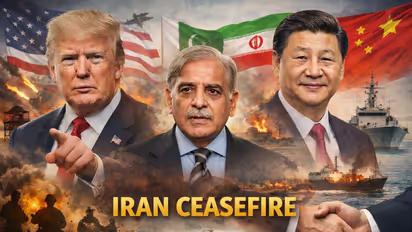
China played a silent, behind-the-scenes role in the US-Iran ceasefire, allowing Pakistan to be the public mediator. This calculated strategy helped Beijing avoid reputational risks and potential military enforcement duties. The approach also accommodated US political dynamics while protecting China's economic interests, such as oil supplies.
China’s Silent Hand in the US-Iran Ceasefire
China’s conspicuous silence during the recent United States-Iran ceasefire has triggered widespread debate among global analysts. While Pakistan publicly took center stage as the mediator, the reality appears far more layered. Beijing played a calculated yet understated role behind the scenes, carefully shaping the trajectory of negotiations without stepping into the spotlight.
As noted in the analysis, “Beijing opted for a very quiet entry into the mediation, with Pakistan ‘fronting’ the whole exercise.” This deliberate choice allowed China to influence the process without drawing direct attention or accountability. In high-stakes diplomacy, visibility often comes with reputational risk — something Beijing strategically avoided by remaining in the background.
The ceasefire itself followed nearly 40 days of intense conflict involving missile strikes, drone warfare, and disruptions to global oil supply chains. In such a volatile environment, China’s quiet involvement reflects a broader strategic philosophy: shaping outcomes without overt ownership or public recognition.
The Trump Factor and Optics of Power
One of the key reasons behind China’s silence lies in the political dynamics of the United States, particularly the leadership style of Donald Trump. Known for projecting strong, decisive leadership and claiming diplomatic wins, Trump required a narrative that placed Washington firmly at the forefront of the ceasefire.
The analysis highlights Trump’s “need to declare ‘victory’” as a major factor shaping how mediation roles were publicly portrayed. By staying out of the spotlight, China avoided disrupting this narrative while still exerting influence behind the scenes.
Interestingly, Trump himself hinted at Beijing’s involvement, saying, “I hear yes,” when asked whether China played a role in bringing Iran to the negotiating table. This acknowledgment underscores the paradox of China’s approach — even in silence, its diplomatic footprint remains visible to those closely watching global developments.
Strategic Risk Avoidance and Economic Interests
China’s low-profile diplomacy was also driven by a clear assessment of risks. Acting as a formal mediator in a conflict of this scale would have required Beijing to take on enforcement responsibilities — potentially including military or peacekeeping roles.
As the analysis points out, leading such efforts “inevitably means that the official mediator will also have to… police it eventually.” For China, which has consistently avoided direct military entanglements in the Middle East, this was a significant deterrent.
Economic considerations further reinforced this cautious approach. China is heavily dependent on Middle Eastern oil, particularly from Iran, and has a strong interest in maintaining stability in critical maritime routes such as the Strait of Hormuz. Any prolonged disruption in this region could have severe implications for its energy security and global trade networks.
By quietly supporting a ceasefire, China was able to safeguard these interests without exposing itself to the political and military burdens associated with overt mediation.
Also Read: US-Iran Ceasefire: Did China Quietly Push The Truce? Trump Hints Beijing’s Role
Pakistan in the Spotlight, China in the Shadows
While China operated behind the scenes, Pakistan emerged as the visible face of the mediation effort. Hosting the talks and facilitating dialogue allowed Islamabad to enhance its diplomatic standing on the global stage.
However, this arrangement also served China’s broader strategy. By allowing Pakistan to “front” the initiative, Beijing ensured it could influence outcomes indirectly while maintaining plausible deniability. This layered diplomatic approach involved multiple actors working through backchannels, creating a complex web of negotiations that extended beyond what was publicly visible.
China’s role, therefore, was less about dominance and more about strategic positioning — ensuring relevance without overcommitment. This aligns with its broader approach to global conflicts, where it prefers indirect engagement over overt leadership.
Global Power Play and China’s Long-Term Strategy
China’s silence also reflects its evolving ambitions as a global power. In recent years, Beijing has increasingly positioned itself as a mediator in international conflicts, seeking to expand its diplomatic influence. However, it often does so on its own terms — prioritizing influence over visibility and outcomes over recognition.
By staying in the shadows during the US-Iran ceasefire, China managed to strike a delicate balance. It contributed to de-escalation, protected its economic interests, and strengthened its image as a responsible global actor — all while avoiding the risks associated with taking center stage.
At the same time, critics argue that this approach raises questions about China’s willingness to shoulder global responsibilities. Without enforcement mechanisms or security guarantees, any ceasefire remains fragile, and the current truce continues to face uncertainties amid ongoing regional tensions.
Also Read: Is China Set to Gain From Donald Trump’s Middle East Muddle?
A New Model of Diplomacy?
The US-Iran ceasefire offers a glimpse into an evolving model of global diplomacy — one where influence is exercised quietly and outcomes are shaped through indirect channels. In complex, multi-actor conflicts involving deep-rooted political, religious, and strategic divisions, such approaches are becoming increasingly common.
China’s strategy underscores a key reality of modern geopolitics: power is not always exercised in the open. Sometimes, the most consequential actions take place behind closed doors, away from public scrutiny.
In this case, while Pakistan occupied the spotlight, China’s shadow presence played a significant role in shaping the negotiations. Its silence was not a sign of absence, but a calculated move in a high-stakes geopolitical game — one that highlights how global influence is increasingly defined not just by what is said, but by what is deliberately left unsaid.