When Mourning Became a Crime: China's 1976 Ban On Honouring Zhou Enlai
Synopsis
Zhou Enlai died on January 8, 1976, from bladder cancer. His death came at a moment of intensifying factional struggle within the Chinese Communist Party, where he had been broadly seen as a check against the Cultural Revolution's most destructive excesses.
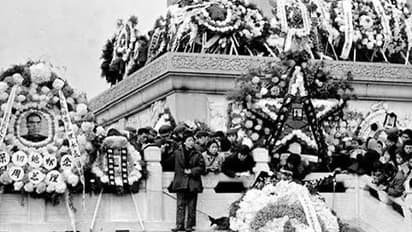
New Delhi: On the night of April 4, 1976, Chinese security forces moved through Tiananmen Square to remove what hundreds of thousands of ordinary citizens had placed at the base of the Monument to the People's Heroes: paper flowers, handwritten verses, and funeral wreaths laid in memory of Premier Zhou Enlai, who had died three months earlier. By morning, the square was cleared. By the following day, people returned with fresh offerings. For that act alone, the state moved to arrest them.
Zhou Enlai died on January 8, 1976, from bladder cancer. His death came at a moment of intensifying factional struggle within the Chinese Communist Party, where he had been broadly seen as a check against the Cultural Revolution's most destructive excesses. The official response to his passing was noticeably curtailed.
There was no extended national mourning period. State broadcasts carried a brief announcement and then moved on. Wearing black armbands, displaying photographs of the premier, and laying wreaths were practices that the leadership restricted, interpreting even those gestures as implicit criticism of the party's radical wing, the Gang of Four.
The public stored its grief. The outlet came in April, during the Qingming Festival, China's traditional period of paying respect to the dead.
On April 4, crowds began arriving at the monument to leave tributes. Estimates of attendance on that day alone reach as high as two million people, drawn from every social stratum – factory workers, students, military officers, and children of senior cadres among them. There was no organizing leadership. The gathering was spontaneous.
What the Gang of Four – the radical faction led by Mao Zedong's wife Jiang Qing, alongside Zhang Chunqiao, Yao Wenyuan, and Wang Hongwen – saw in this was not mourning. They saw a mass gathering that had taken shape outside the party's direction, one that carried in its composition an implicit rejection of their authority. The response was to order the square cleared.
Security forces removed the wreaths, poems, and flowers overnight. Those who came back the next morning to find them gone did not simply leave. Many returned with more flowers. Others refused to disperse when confronted by police. The state had made the act of replacement a provable offence. Citizens who brought fresh tributes after the removal were photographed, identified, and in many cases taken into custody.
No formal charge of sedition was required. The act of mourning itself in a public square, with flowers, after the state had specifically removed those flowers was sufficient. What the Central Committee formally labelled a "counter-revolutionary incident" on April 7 had begun as a funeral.
Regimes threatened by armed opposition have well-worn tools available: military force, emergency statutes, and accusations of treason. What the Gang of Four faced in April 1976 was not armed opposition. It was collective sorrow. The wreath that replaced the one removed the previous night was not a weapon. The handwritten poem tucked beneath it was not a manifesto. The state chose to treat both as if they were.
Historians and political scholars have since noted that the April Fifth Incident reveals something about authoritarian control that armed crackdowns tend to obscure. A government that prohibits weapons can still tolerate the fear of its citizens. A government that must prohibit grief cannot tolerate them at all. When the most dangerous thing a citizen can do is return to a monument with a flower, the ban itself becomes a statement about who holds power in fear of whom.
The incident was eventually rehabilitated. In 1978, under the political order that followed the fall of the Gang of Four, the Central Government formally declared the April Fifth demonstrations a "revolutionary movement." That reversal came two years too late for those already imprisoned, and under circumstances driven less by historical honesty than by the needs of the leadership that followed.