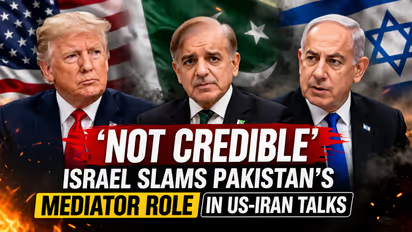
‘Not Credible’: Israel Slams Pakistan’s Mediator Role In US-Iran Talks
Synopsis
Israel has criticized Pakistan's credibility as a mediator for upcoming US-Iran peace talks in Islamabad. However, the US is proceeding with the negotiations, which aim to reinforce a fragile ceasefire. Key topics include Iran’s nuclear program and sanctions relief.
Fresh tensions have emerged around the upcoming US-Iran peace talks as Israel’s envoy strongly criticised Pakistan’s role as a mediator, calling it “not a credible player” in the high-stakes negotiations. The remarks come just days before crucial discussions between Washington and Tehran are set to begin in Islamabad, with global attention fixed on whether diplomacy can hold a fragile ceasefire together.
Israel’s Ambassador to India, Reuven Azar, expressed deep skepticism about Pakistan’s ability to facilitate meaningful dialogue between the United States and Iran. He dismissed expectations from Islamabad’s mediation efforts, stating that it would be “naive” to rely on backchannel diplomacy involving Pakistan, and questioned its neutrality in such a sensitive geopolitical conflict.
The criticism underscores widening divisions among key stakeholders even before formal talks begin. Pakistan has been actively positioning itself as a diplomatic bridge, having played a role in bringing both sides to agree on a temporary ceasefire after weeks of escalating conflict. However, Israel’s latest comments reflect lingering distrust over Islamabad’s intentions and credibility.
Despite these concerns, the United States is moving ahead with its plan to engage Iran diplomatically. A delegation led by Vice President JD Vance is scheduled to travel to Pakistan for the first round of talks on April 11. The negotiations are expected to focus on critical issues including Iran’s nuclear programme, sanctions relief, regional security, and ensuring stability in vital energy routes such as the Strait of Hormuz.
Also Read: US to Send JD Vance to Pakistan for First Iran Talks on April 11
The ceasefire itself remains fragile, with both sides accusing each other of violations. Iran has repeatedly raised concerns over continued Israeli military actions in Lebanon, while the US and Israel maintain that such operations fall outside the scope of the truce. These disagreements have added further complexity to the already delicate diplomatic environment.
Pakistan, meanwhile, has defended its role, highlighting its diplomatic outreach to multiple global players and its efforts to prevent a broader regional war. Recent reports suggest that Islamabad’s last-minute interventions helped salvage ceasefire talks that were on the verge of collapse, reinforcing its claim as a key intermediary.
Analysts warn that public disagreements like these could undermine confidence in the negotiation process even before it begins. Israel’s sharp remarks signal potential challenges ahead, particularly if key regional players remain unconvinced about the framework of the talks.
As the world watches closely, the success of the Islamabad negotiations will depend not only on US-Iran engagement but also on whether mediators like Pakistan can gain broader acceptance among all stakeholders. With tensions still high and trust in short supply, the path to a lasting resolution remains uncertain.
Also Read: Netanyahu warns Iran: Ceasefire fragile, Israel ready to resume fight