US-Iran ceasefire a surprise, but US failed in its goals: Expert
Synopsis
A surprise US-Iran ceasefire is seen as a victory in Tehran. An expert notes the US failed its goals of regime change and destroying Iran's nuclear program, expressing pessimism about the truce holding due to US and Israeli track records.
A fragile peace now prevails in West Asia after the US and Iran agreed on a two week ceasefire even as they look to sign a more long term agreement. However, the announcement of a pause in the conflict after 39 day caught many by surprise.
'US failed to achieve its goals': Tehran academic
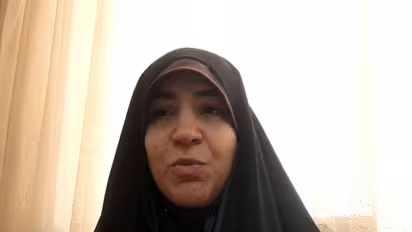
Elham Kadkhodaee, Assistant Professor at the West Asian Studies at the University of Tehran, said while Iran was prepared to carry on with resitsance the US kept on changing its goalpost, starting with regime change to targeting Iran's nuclear program. "Well, first of all, it was a surprise for everyone in Iran. We really were prepared to go on with the resistance for any amount of time that was necessary. People really were not expecting the announcement of a ceasefire. In terms of whose victory it is, if you look at the goals that were stated before the start of this war, the United States began by wanting to send help to the people who wanted to overthrow the Islamic Republic of Iran. So regime change was one of their goals. The other was their insistence on the nuclear issue; they were saying that they wanted to destroy Iran's nuclear program and get the highly enriched uranium out of Iran," she said.
Kadkhodaee said that given the fact that the US has destroyed much of Iran's infrastructure, the Islamic republic still stands in Iran. "Now, if you see, they have not managed to do any of those things. They have just assassinated some officials, killed Iranian civilians, and destroyed infrastructure. But the Islamic Republic of Iran is still firmly in power inside Iran. The highly enriched uranium is still there. And even in this talk about a ceasefire, all of those social media posts by Trump announcing that he is the victor of this conflict don't even refer to the nuclear issue anymore. It's just the Strait of Hormuz, which was open before the start of this war," she said.
Pessimism prevails in Iran over ceasefire's future
Kadkhodaee said that everyone's was very pessimistic in Iran about how this is going to go on because we don't have good memories of the Americans and the Israelis sticking to their promises. "I think that tells you a lot about who is winning this game here. I think the people of Iran feel very much proud because they have been able to defend their country. But everyone's very pessimistic here about how this is going to go on because we don't have good memories of the Americans and the Israelis sticking to their promises. Everyone is in a situation where we don't know what's going to happen, and we are completely prepared for them to break away from what they have agreed on," she said.
Strait of Hormuz remains a bargaining chip
Kadkhodaee said that the Strait of Hormuz is not open, and Iran has stated that it would allow passage of vessels with coordination with Iranian armed forces. "Well, the Strait of Hormuz isn't completely open now. Iran has stated that it would allow passage of vessels with coordination with Iranian armed forces. So there are some ifs and buts here still. And also, whether it remains open or not depends on how negotiations are going to go on, because this is just a temporary agreement to ceasefire. Then we have two weeks for Iran and the United States to discuss the issues that they have and to eventually come to a kind of a more formal and long-lasting agreement or not. I think it's too early for Trump to declare himself as having been successful in opening the strait," he said.
Kadkhodaee said that the Strait of Hormuz was open before the war, and by declaring that it is open now, US President Donald Trump solved the issue he himself created. "Again, I want to emphasize the fact that the Strait of Hormuz was already open. The only reason that Iran started controlling that geographic area was because it was being attacked by the Americans. So Trump, even if we accept that he has been successful in opening the strait, he's only solved a problem that he himself had fabricated. But I think going forward, Iran will not somehow lose its control of the strait or provide totally free passage to each and every vessel; this is going to be still a card that Iran is going to hold on to," she said.
Iran's conditions for ceasefire
Kadkhodaee further said that Iran has called for any ceasefire to include all the different countries and groups that are involved in the acts of resistance. "Yes, as we have heard, one of the main points that Iran has insisted on, even before this ceasefire was announced, is that any ceasefire should include all the different countries and groups that are involved in the acts of resistance. So a ceasefire should come for all the region, not just for Iran. That's very important for Iran," she said.
Israel's commitment to truce doubted
She said that Israel hardly sticks to any ceasefire deal. "Of course, everyone expected the Israelis to back out. They usually do not stick to any agreement. Even if they accept a ceasefire, they will violate it. That is what we have seen throughout all their history and specifically in the past two and a half years where Israel has been involved in fighting in Gaza and in Lebanon. Each time they accept a ceasefire, they find ways of passing the red line and starting conflict again," she said.
Kadkhodaee said that Israel is in a tough position now because it appears to have been a massive defeat. "So I think here again, what Israel is doing is something that was very much expected. I think Iran will have its own ways of retaliating. Iran could still go on with firing missiles at Israel. Iran could stop firing missiles at American bases in the region, but still go on with firing missiles at Israel. I think Israel is in a tough position now because if you consider all the context of what's been happening, especially what happened in Isfahan two or three days ago, it appears to have been a massive defeat for a kind of a limited ground operation for the Americans," she said.
Kadkhodaee said that Trump wants to get out of this embarrassment that he has made. "I believe that Trump really does want to get out of this embarrassment that he has made. It's going to be very difficult for the Israelis to fool him and to convince him again to get back into this conflict. This puts Israel in a difficult situation in which they might be to some extent left to their own without American backing in this conflict. And then that might force them to somehow remain faithful to a kind of a ceasefire regarding Lebanon," she said.
Trump signals diplomatic opening
Earlier today, US President Donald Trump announced a temporary halt to the "bombing and attack" campaign on Iran, proposing a two-week, double-sided ceasefire window. Trump also indicated that a 10-point proposal put forward by Iran was "workable," signalling a possible diplomatic opening between the two long-time adversaries. (ANI)
(Except for the headline, this story has not been edited by Asianet Newsable English staff and is published from a syndicated feed.)