Use SCO, BRICS to boost ties: Chinese journalist to India and China
Synopsis
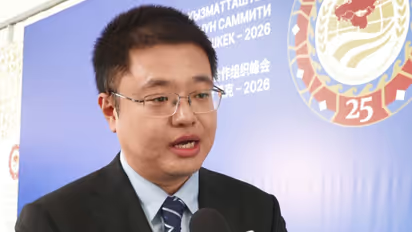
CGTN journalist Zhao Yunfei stated that India and China should leverage multilateral platforms like SCO and BRICS to enhance engagement and provide opportunities for their leaders to meet, stressing the importance of resolving differences as neighbours.
Strengthening India-China Engagement via SCO, BRICS
China Global Television Network (CGTN) journalist Zhao Yunfei on Tuesday said that India and China should use multilateral platforms such as the Shanghai Cooperation Organisation (SCO) and BRICS to strengthen engagement and pursue common interests.
Speaking to ANI on the sidelines of the 26th SCO Summit in Bishkek, Zhao Yunfei spoke on India-China ties and the upcoming BRICS Summit in India, and said the two multilateral platforms could provide opportunities for the leaders of the two countries, i.e., Prime Minister Narendra Modi and Chinese President Xi Jinping, to meet and engage.
"I think it has created multiple occasions for the two presidents to get a chance to meet. This would be really good for the relationship between China and India because we are neighbouring countries. China has always attached importance to its neighbours because we are neighbours, and then we have to settle all the differences as well as pursue the common ground all together to pursue the common wealth of the people in the region," Zhao said. "So, the SCO has really provided a platform; hopefully, BRICS will also provide a good platform for both sides," he added.
Asked about the expected confirmation of Chinese President Xi Jinping's participation in the 2026 BRICS Summit in India, Zhao said he did not have specific information on the Chinese leader's agenda. "We don't have that knowledge, but we expect there will be more information on President Xi's agenda coming along. And of course, BRICS is also very, very important because BRICS members are emerging economies of the entire world. It has created a great platform, especially for Global South countries, especially from an economic perspective in cooperation," he added.
China's SCO Priorities
Zhao also said that China's priority at the SCO would be to consolidate the outcomes of last year's Tianjin Summit, which he said had laid out a long-term blueprint for the regional organisation. "I think China would certainly want to put what has been achieved last year from the Tianjin Summit settled down, because the Tianjin Summit back here in China last year has really mapped out a clear blueprint for the SCO, especially for the next decade--10 years of planning. And that's very important for the regional organisation because you have to have a long-term plan," Zhao said.
He also highlighted the four security centres established at the 2025 Tianjin SCO Summit, saying they would help expand the scope of security cooperation within the SCO. "And also the four security centres being established at the Tianjin Summit--that is something that is upgrading the original security cooperation to a more comprehensive level to tackle the non-traditional security challenges," he said.
Significance of China-US Relations
On the possibility of President Xi travelling to the United States later this year, Zhao said the China-US relationship would remain significant for global stability, while noting that he did not have specific information on the Chinese leader's agenda. "Again, I don't have specific knowledge on his agenda, but when it comes to the United States, this is a very important, major year for China-US ties," he said.
"The exchange between the two top economies of the world would bring stability to the entire world--not only for the two countries to settle the differences, but also to give a direction for the world's development. Because when the two major powers work together, it certainly will create more stability and more potential for development--not only for the chain of industry, but also for other, let's say, Artificial Intelligence cooperation and green energy collaboration. That will also bring benefits to the world," he added.
About the Shanghai Cooperation Organisation (SCO)
The 26th SCO Leadership Summit brings together 10 member states, 15 partner countries and two observer countries to advance dialogue and cooperation on regional and global issues. With the membership of 10 countries, the Shanghai Cooperation Organisation represents about 25 per cent of global GDP.
The SCO countries are developing long-term relations of good-neighbourliness, friendship and cooperation in the spheres of mutual interest based on the universally recognised principles and norms of international law.
The main goals are to strengthen mutual trust, friendship and good-neighbourliness, promote multilateral interaction to maintain and ensure peace, security and stability in the region, jointly address new challenges and threats, encourage effective and mutually beneficial cooperation in various spheres and promote economic growth and social and cultural development. (ANI)
(Except for the headline, this story has not been edited by Asianet Newsable English staff and is published from a syndicated feed.)