US Court Rules Against Trump's Global Tariffs, Says 'Emergency Law Cannot Be Used To Impose Tariffs'
Synopsis
The US Supreme Court ruled that the International Emergency Economic Powers Act does not allow a president to impose sweeping global tariffs. The decision states Donald Trump exceeded his authority by using an emergency law meant for national crises.
The Supreme Court of the United States has ruled against President Donald Trump's power to impose tariffs, declaring that his use of emergency authority to levy broad tariffs on US trading partners was unlawful.
The US court has ruled 6-3 against Trump's sweeping global tariffs, saying the International Emergency Economic Powers Act (IEEPA) does not allow a president to impose such tariffs. Justices Clarence Thomas, Samuel Alito and Brett Kavanaugh dissented. Reporters noted one box of opinions was released, signalling multiple decisions.
Court says emergency law cannot be used for tariffs
In its major decision, the US Supreme Court ruled that Donald Trump did not have the legal power to impose sweeping global tariffs using an emergency law. The court said the International Emergency Economic Powers Act, a law meant for national emergencies, does not allow a president to set tariffs.
In the 6-3 judgment, the conservative-majority court held that IEEPA “does not authorise the President to impose tariffs.” The bench explained that if Congress had intended to give such a strong power, it would have stated this clearly in law. The decision supports earlier rulings by lower courts that found the tariffs illegal.
The ruling is seen as a strong check on presidential authority in trade matters. It clarifies that emergency economic powers cannot be stretched to cover broad tariff actions affecting global commerce.
The judgment followed arguments heard by the justices in November. Legal experts say the decision could shape how future presidents use emergency powers in economic policy.
Tariffs targeted major trading partners
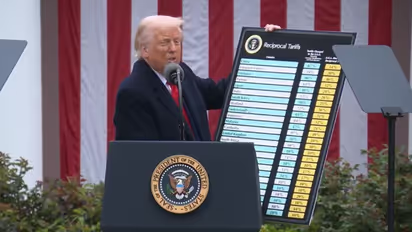
Trump had used the emergency law to place duties on nearly all US trading partners. These included so-called 'reciprocal' tariffs over trade practices Washington considered unfair. Separate duties were also aimed at Mexico, Canada and China, linked to concerns about immigration and illegal drug flows.
Sector-specific duties remain unaffected
The ruling does not affect tariffs already imposed on certain sectors, including steel, aluminium and other goods. Investigations that may lead to more sector-based tariffs are still ongoing, according to News Agency AFP.
Legal clarity on limits of emergency powers
The court stressed that emergency economic powers cannot replace normal trade laws passed by Congress. By rejecting the broad use of IEEPA for tariffs, the judgment draws a clear line on presidential authority in trade policy.
Trump defends tariffs
Before the ruling, Trump strongly defended his tariff policy while speaking at an event in the US state of Georgia. He argued that tariffs protect the economy and claimed that without them, 'everybody would be bankrupt'.
He insisted that he had the right to set tariffs as president and said the legal wording supported his actions. Trump also expressed frustration over the time taken by the court to issue its decision, saying he had been “waiting forever” for the outcome.