He Survived Cancer Twice: Who Was Hassan Kariem, Killed In Six Flags Rollercoaster Fall In Georgia?
Synopsis
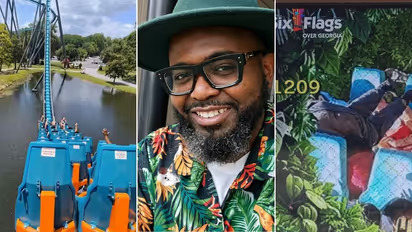
Hassan Jihad Ibn Kariem, a 42-year-old father, cancer survivor, and Atlanta school IT manager, died after being ejected from the Goliath rollercoaster at Six Flags Over Georgia. Witnesses reported seeing a loose restraint bar and Kariem striking other riders before falling to ground. Six Flags has temporarily closed nine rides across North America.
A 42-year-old man died after being ejected from a rollercoaster at Six Flags Over Georgia in the United States, with police saying he struck other riders before falling beneath the attraction. The incident occurred shortly before 4 pm local time on Monday, October 12, and an investigation is under way. The victim, identified as Hassan Jihad Ibn Kariem, was found dead beneath the ride, according to the Cobb County Police Department. Authorities have not yet released full details about how he came to be ejected or confirmed the specific rollercoaster involved. The amusement park operator has temporarily closed nine rides across the United States and Canada as a precaution following the incident.
What Happened At Six Flags Over Georgia?
Police said preliminary information gathered through interviews with witnesses and park employees indicated that Kariem was thrown from the ride and struck other passengers before falling to the ground.
Although officials have not formally identified the attraction, aerial footage showed the Goliath rollercoaster stopped midway through its track. Several witnesses also identified Goliath as the ride involved.
The ride's safety systems and the circumstances surrounding the incident are being examined. Georgia's insurance and fire safety commissioner is also reviewing the case to establish what happened, according to BBC report.
🚨🚨📰📰🚨🚨
Yesterday, around 4 p.m. at Six Flags Over Georgia, 42-year-old Hassan Jihad Ibn Kariem was riding the Goliath roller coaster with his son while his wife and daughter watched from the ground. He was ejected from his seat, struck other riders, hit the train multiple times, and fell beneath the attraction. He was found unresponsive and was later pronounced dead. Several other people were injured. Police have said preliminary interviews indicate he was ejected from the ride. The investigation is active and ongoing, involving local police, state safety officials, Six Flags, and the manufacturer, Bolliger & Mabillard. Similar hypercoasters at other Six Flags parks were temporarily closed out of caution. Goliath is a 200-foot, roughly 70 mph B&M hypercoaster that uses individual lap-bar restraints without secondary seatbelts or over-the-shoulder harnesses. It opened in 2006.
This is not an isolated moment of scrutiny for theme park rides. Separate and still-active lawsuits concern the X2 coaster at Six Flags Magic Mountain. Attorneys have filed suits alleging catastrophic brain injuries—subdural hematomas and related trauma—linked to the ride’s forces and independently rotating seats. They say they represent more than a hundred additional people who claim brain injuries of varying severity after riding it in recent years. The park permanently retired X2 in late September after it had already been closed following incidents in July, stating that while the ride had passed safety tests, the decision was the right one given the effect on guest confidence. There have also been lawsuits involving Stardust Racers at Universal’s Epic Universe alleging brain bleeds, strokes, and other serious injuries tied to restraint design and head movement under extreme forces, following a 2025 death on that ride as well.
I keep coming back to the same question after reading about these cases: is the risk really worth it? The industry numbers are clear and reassuring on the surface. Fixed-site amusement rides in North America have a serious injury rate on the order of one in roughly 15.5 million rides. Millions of people ride every year without incident. The engineering, inspections, and daily checks are real. At the same time, staff can become complacent after years of uneventful operations. Normalization of deviance is a documented pattern in high-reliability settings—small deviations from procedure slowly become accepted until something goes wrong. Mechanical systems, no matter how well designed and redundantly checked, can fail. Restraints can come undone or fail to hold under forces they were never meant to see in a particular failure mode. Human bodies are not identical; vascular conditions, prior injuries, or simply the physics of a head moving relative to a headrest under high G can produce intracranial bleeding in rare cases. When the rare event happens, the statistical safety of the industry does not comfort the people who were on that particular train.
So what is actually happening in the heads of the people who choose these rides?
Sensation-seeking is a well-studied personality dimension, first systematically described by Marvin Zuckerman. High sensation-seekers have a lower baseline of physiological arousal and stronger responses to novel, intense, or complex stimuli. They tend to score higher on measures of openness to experience and, often, extraversion. Dopamine pathways, particularly in the ventral striatum and mesolimbic system, are more reactive to reward-predicting cues in these individuals. Brain imaging studies have shown differences in resting-state connectivity and in responses to risky or novel stimuli in regions such as the amygdala, insula, and prefrontal cortex. Some research has linked higher sensation-seeking to reduced gray-matter volume in certain prefrontal areas involved in behavioral inhibition, though findings are not uniform and environment clearly matters.
There is a meaningful distinction between people who genuinely enjoy the sensation and people who are primarily there because of social pressure. The first group often describes the experience in terms of presence, flow, or a temporary quieting of ordinary mental chatter. Their heart rates and cortisol responses can show the classic pattern of high arousal that is interpreted as positive rather than aversive. They tend to seek the ride again. The second group more often reports anxiety beforehand, relief afterward, and a social narrative (“everyone was doing it,” “I didn’t want to be the one who backed out”). Their physiological response is more likely to be dominated by threat-related circuits; the amygdala and associated stress pathways are more active, and the reward prediction error is smaller or absent. Conformity research (from Asch onward) shows that people will override private judgment under peer observation, especially when the group is cohesive and the cost of dissent feels immediate. In the moment at the loading platform, the social cost of saying no can feel higher than the residual risk of the ride.
The people who love it and the people who are mainly yielding to the group are not always easy to tell apart from the outside. Both can be laughing in line. Both can post the photo. But the internal accounting is different. One is seeking a specific state of arousal and mastery over that arousal. The other is managing a social identity cost. Over repeated exposures, the first group usually shows increasing comfort and positive anticipation; the second group often continues to experience the ride as something to get through. Personality inventories, behavioral measures of risk-taking under different social conditions, and even simple questions about whether the person seeks similar experiences alone or only in groups tend to separate them reasonably well.
None of this makes the rare mechanical or operational failure less tragic when it occurs. It does suggest that the decision to get on is not a single, uniform calculation. Some people are trading a small probability of severe harm for a reliable, intense positive state that their nervous systems appear built to value. Others are trading the same small probability for temporary social ease. Both calculations can be coherent on their own terms. Both can also be revised with better information about specific rides, specific restraint designs, and specific histories of incidents.
I keep wondering whether the industry’s overall safety record is the right frame, or whether the more relevant frame is the residual risk on any particular high-intensity machine operated by particular people on a particular day, combined with the particular nervous system of the person who decides to board. The numbers say the first frame is usually the right one. The lawsuits and the occasional fatality keep reminding us that the second frame is not imaginary.
What do you actually weigh when you decide whether a ride like that is worth it for you?
— R J (@rahuljaitley) October 13, 2026
How do people enjoy this rollercoaster? 😭
The height alone is so scary for me
The man that fell off has been identified as a 42 year old Hassan Kariem, his wife and daughter reportedly watched from the ground 💔
May his soul rest in peace 🕊️ https://t.co/hFZVQ2p9OD
— Janny (@FablosJanny) October 14, 2026
🇺🇸💔 DESTIN TRAGIQUE — Hassan Kariem avait survécu à presque tout :
🔥 Un incendie de voiture avec sa fille
🎗️ Deux CANCERS
🦠 Une forme sévère du COVID-19
Mais alors qu’il profitait d’un parc d’attractions, il est MORT après être tombé de MONTAGNES RUSSES. 🎢🕊️ https://t.co/rmZKtXEFjC
— KRONIK Insights (@KRONIKInsights) October 14, 2026
Six Flags over Georgia's Goliath launched a passenger into the air
This woman witnessed it live and could not believe her eyes, clearly she was shocked by it all
The horror that all who saw it must have felt seeing someone go flying from the ride like that
On Monday, October 12, 2026, around 4 p.m., 42-year-old Hassan Jihad Ibn Kariem of Atlanta was ejected from the Goliath
Six Flags temporarily closed the Goliath and eight similar roller coasters across its other locations.
— Dangerous Thoughts (@DangerousThinkg) October 13, 2026
John King, the state's insurance and fire safety commissioner, said inspectors had examined the park's rides before the season began. He added that investigators were inspecting the attraction and conducting interviews as part of a detailed review.
Officials have not yet held a news conference to provide a full account of the incident.
Witnesses Describe Shock And Distress
Visitors waiting in line for the ride described confusion and panic after the rollercoaster returned.
Connor Thompson told CBS News that people began shouting for someone to call emergency services after reports that a passenger had fallen from the ride. He said he later noticed that a seat restraint appeared to be unlatched.
Another witness, CiCi Nelson, told CNN that she saw an empty seat and a loose safety bar when the ride returned. She also described seeing a woman covered in blood.
Nick Mendenhall, who witnessed the incident, told the Associated Press that he saw the man come out of his seat, strike another cart and then fall to the ground. He described the experience as deeply distressing.
A separate witness told NBC affiliate WXIA that souvenir photographs taken automatically during the ride may have captured the incident. However, the BBC said it had been unable to verify that claim.
Who Was Hassan Kariem?
Kariem lived in Atlanta and worked at Wesley International Academy, a public charter school, for more than 12 years. His roles included IT manager, technology teacher and robotics coach.
The school described him as a valued member of its community, praising his dedication to students and his commitment to the institution.
His family told WXIA that Kariem was a father who had survived cancer twice, with his last bout in 2018. They also said he had been involved in a car crash with his 10-year-old daughter three weeks before his death.
Outside work, Kariem enjoyed cooking, watching anime, spending time with family and friends, and creating products using laser engraving and 3D printing.
His cousin Niama Kariem paid tribute to him on Facebook, saying his life meant a great deal to many people and that his legacy extended far beyond the tragedy of his death.
Nine Rides Closed As Investigation Continues
Six Flags has expressed sadness over the incident and offered condolences to Kariem's family and friends. The company operates amusement parks, water parks and resorts across North America.
The Goliath rollercoaster opened in 2006. According to the park's website, it reaches a height of 200 feet, includes a 170-foot drop and can reach speeds of 70 miles per hour.
The latest death has raised fresh questions about amusement park safety. The investigation will examine the circumstances of Kariem's fall and whether any safety issues contributed to the incident. Authorities have yet to announce their findings.