US aligning with Israeli interests stalled peace talks, claims Iran
Synopsis
Iran's Consul General in Mumbai claims the US is aligning its strategy with Israeli interests, leading to a stalemate in peace negotiations. He alleges external pressure from Israel has hindered Washington's ability to act independently.
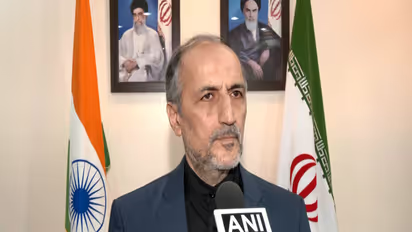
Iran's Consul General in Mumbai, Saeid Reza Mosayeb Motlagh, has suggested that the United States is increasingly aligning its regional strategy with Israeli interests, leading to a stalemate in peace negotiations. Speaking on the current diplomatic friction, Motlagh told ANI, "An interesting point to note is that the United States appears to be operating on Israel's wavelength. If the United States were truly the decision-maker, given that it had accepted the conditions, we should now have witnessed progress in peace negotiations."
US-Israel Alignment Blamed for Stalemate
The Envoy further claimed that external pressure has influenced Washington's ability to act independently in the negotiation process. "You can be certain that when the United States accepted our conditions, Israel exerted pressure on it, effectively insisting that the United States adopt Israel's demands. This implies the use of American forces in the service of Israel, the use of American taxpayers' money for Israel, and even the utilisation of the countries of the Persian Gulf in furtherance of Israeli interests," he added.
According to the Consul General, this lack of autonomy has directly hindered diplomatic progress. "All this indicates that the United States is aligning itself with Israel, and it is for this reason that Israel obstructed the process and caused the negotiations to falter," he said.
Global Repercussions and Diplomatic Deadlock
Linking these diplomatic hurdles to broader maritime and regional tensions, Motlagh highlighted the global repercussions of coercive policies. "All observed that in a waterway where the United States sought to overstep its bounds and violate the rights of the Iranian people through coercion and destruction, an attempt met with the resistance of the Iranian people, the repercussions were felt globally," the Envoy noted.
The Iranian diplomat expressed regret over the current state of international disruption, attributing it to a combination of US actions and Israeli influence. "Unfortunately, the ill-considered actions of the United States, coupled with Israeli pressure upon it, have led to the current level of global disruption and complexity. This situation runs contrary to the intentions of Iranian policymakers," he observed.
Looking ahead, Motlagh warned that the deadlock may persist unless there is a fundamental shift in Washington's stance. "With the rejection of Iran's conditions and the failure of the talks, I regret to say that this situation may continue. Nevertheless, one must wait and see whether a change in the American approach will occur, or whether it will persist in obstinacy and the imposition of its will."
Iranian Parliament Speaker Echoes Mistrust
This sentiment of deep-seated friction was further echoed by Iranian Parliament Speaker Mohammad Bagher Ghalibaf, who expressed a profound lack of confidence in the negotiating partners following high-stakes diplomatic discussions in the Pakistani capital. In a post on social media platform X, Ghalibaf outlined Tehran's cautious stance, stating that he had emphasised before negotiations began that "we have the necessary good faith and will, but due to the experiences of the two previous wars, we have no trust in the opposing side."
Reflecting on the outcome of the talks in Islamabad, he noted that the "opposing side ultimately failed to gain the trust of the Iranian delegation in this round of negotiations." Ghalibaf also expressed his gratitude to Pakistan for its role in facilitating the process and sent his regards to the people of the "friendly and brotherly country."
Negotiation Details and Sticking Points
Providing further context on the intensity of the engagement, Iran's Foreign Ministry spokesperson Esmaeil Baqaei revealed that the dialogue with US officials marked the longest round of negotiations over the past year, spanning roughly twenty-five hours of non-stop indirect messaging through Pakistani mediators. Baqaei described diplomacy as an essential tool to safeguard national interests, even when held in an atmosphere of "mistrust, suspicion, and doubt" following forty days of "imposed war" and a subsequent ceasefire.
He pointed out that recent military aggressions by the American side and the "Zionist regime" made a comprehensive agreement in a single session unrealistic. According to the spokesperson, the agenda expanded to include highly sensitive topics such as the Strait of Hormuz. While some common ground was found on Iran's ten-point proposal, Baqaei noted that differences on two or three "key issues" stalled progress.
Broader Context and Escalation
These developments come at a critical juncture, following reports that US President Donald Trump shared an article suggesting a potential naval blockade against Iran. This escalation follows the stalemate in Islamabad, where both sides remained sharply divided over Tehran's nuclear programme and maritime control. (ANI)
(Except for the headline, this story has not been edited by Asianet Newsable English staff and is published from a syndicated feed.)