The Ankara Summit: NATO's Search for Strategic Coherence
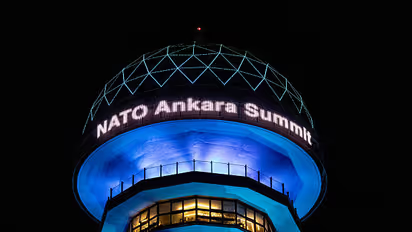
Synopsis
The 2026 NATO Summit in Ankara comes at a time when the world is watching. Predictably the formal discussions will be around defence spending, industrial capacity, military readiness and continued support for Ukraine, the summit's actual importance is elsewhere.
The 2026 NATO Summit in Ankara comes at a time when the world is watching. Predictably the formal discussions will be around defence spending, industrial capacity, military readiness and continued support for Ukraine, the summit's actual importance is elsewhere. It is indicative of NATO's effort to reframe itself according to an increasingly fragmented international order where American leadership is not an accepted truth, European allies are expected to play a bigger role, and pragmatism and ideology seem to be constantly pitted against each other.
Unlike previous summits that focused on expansionary operations, Ankara signals an alliance wrestling with structural metamorphosis. Russia remains NATO's primary challenge militarily however; the strategic conditions have become substantially more complex. The United States continues to prioritise competition with China in the Indo-Pacific while expecting European allies to take on a greater share of responsibility for regional security. The proposed enactment of the NATO’s 5 per cent defence investment benchmark should therefore be recognized not just as a financial dedication, but as an effort to reallocate strategic responsibilities across the Alliance.
Against this background, Turkey's role as summit host is being seen as particularly crucial. Few NATO members personify the Alliance's current predicaments more than Ankara. Strategically, Turkey is imperative. It controls access to the Black Sea through the Turkish Straits, it anchors NATO's southern flank, borders multiple conflict zones, holds one of the Alliance's major militaries, and has emerged as a progressively significant defence-industrial partner through its expanding indigenous capabilities. At a time when unpredictability expands from Eastern Europe to the Middle East, Turkey's geographic location has become an inimitable strategic asset.
Yet Ankara also reveals NATO's persistent political conundrum. Turkey has pursued an increasingly self-governing foreign policy, balancing relations with Russia and concurrently supporting Ukraine, increasing its influence across West Asia and the Caucasus, and frequently deviating from Western positions on regional crises. At the same time, worries surrounding democratic backsliding and constraints on political freedoms ahead of the summit emphasise the expanding rift between NATO's liberal normative identity and its strategic imperatives. The Alliance has continually exhibited that geopolitical necessity often surpasses democratic conditionality when fundamental security interests are at stake.
Ukraine, meanwhile, remains NATO's focal strategic test, not because membership is coming up, but because the war has characteristically distorted European security planning. The debate has steadily shifted from emergency military support towards long-term deterrence, defence-industrial integration and sustainable force generation. In effect, NATO is institutionalising support for Ukraine as a perpetual component of European security architecture rather than treating it as a temporary wartime possibility.
Perhaps the most significant discussions, however, concern defence production rather than defence spending. While governments have announced ambitious increases in military expenditure since Russia's invasion of Ukraine, financial promises alone cannot offset the limited industrial capacity, fragmented procurement systems and supply-chain vulnerabilities. NATO's growing stress on the industrial resilience echoes an important strategic realisation, which is that deterrence in the twenty-first century is dependent on finances as much as it is on maintained production capacity as on force posture. In prolonged geopolitical competition, industrial intensity has developed into a strategic capacity in its own right.
Finally, the Ankara Summit is less about announcing dramatic new initiatives than about acknowledging a fundamental strategic transition. NATO is advancing from an alliance focussed overwhelmingly on American military supremacy into one that seeks greater European capacity while adapting to progressively more autonomous regional powers within its own ranks. This revolution will not necessarily reduce internal disagreements, nor will it resolve longstanding questions about burden-sharing or political cohesion. Instead, it reflects a broader reality; the Alliance's future resilience could possibly depend less on consensus of political outlook than on its ability to manage strategic diversity without conceding collective deterrence.
The implication of the Ankara Summit, therefore, lies not in the communiqués it will produce but in what it reveals about NATO's evolution. The Alliance is no longer simply acclimatising to Russian aggression, but it is altering to a multipolar security environment in which power is more diffused making these alliances more transactional, and their effectiveness depends on harmonising political differences with military requirements. If in the post-Cold War scenario, it was about expanding NATO’s geography, this Ankara summit can become a moment when the Alliance began redefining its strategic identity.