Ro Khanna Predicts Massive Democratic Wave After Midterm Election Results
Synopsis
Congressman Ro Khanna anticipates a significant Democratic resurgence following US midterm results, drawing comparisons to 2008. As Democrats gain majorities, the White House prepares to use the presidential veto to navigate legislative friction.
Democratic Surge Predicted
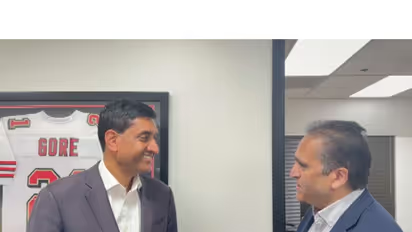
Following a stunning electoral setback for Republicans in the US midterm elections, prominent Indian-American Congressman Ro Khanna has predicted a sweeping Democratic resurgence, drawing parallels with the historic 2008 electoral wave. In a conversation with prominent Indian-American community leader and former Joe Biden administration adviser Ajay Jain Bhoturia regarding the nationwide electoral outcome, Congressman Khanna asserted, "It's going to be over 250 seats. We may get as big a majority as we had under Obama in 2008. This is a tsunami. It is a repudiation of Trump."
Highlighting the core economic anxieties that dictated voter sentiment at the ballot box, Khanna emphasised that the electorate's mandate centres primarily on cost-of-living relief and international diplomacy. "People want lower costs. They want this war ended. Why? Because if you end the war, you're going to immediately lower the cost of food, lower the cost of gas, lower the cost of diesel. That's causing home heating to go up," Khanna noted. Reiterating the legislative focus of his party moving forward, the lawmaker added, "They want us to focus on lowering costs for their families with childcare and healthcare, and that's what the Democrats are going to do..."
The Legislative Battleground
Building on this seismic shift, the newly altered balance of power in Washington has handed Democrats substantial majorities across both congressional chambers, setting the stage for direct political confrontation with President Donald Trump. Although Democrats are poised to advance an expansive legislative roadmap, roll back select executive policies and initiate rigorous parliamentary inquiries into the administration, their newfound numbers do not guarantee unhindered lawmaking authority.
President Trump retains one of the most formidable constitutional checks available to the executive branch: the presidential veto. Indicating his willingness to deploy this authority as the extent of the Democratic triumph emerged, the president shared an image on Truth Social featuring a red baseball cap emblazoned with the word "VETO". “It’s the power of veto. It’s one of the stronger powers that a president has,” Trump remarked following the electoral rout. Despite signalling readiness to push back, Trump also articulated a desire to avoid a perpetual stalemate. "I don't want to be just sitting there for two years vetoing everything," he told Politico.
Understanding the Presidential Veto
Nonetheless, with the opposition preparing aggressive policy challenges, the executive veto is poised to emerge as a central mechanism in the unfolding power struggle between the White House and Capitol Hill. Serving as a foundational constitutional safeguard designed to preserve equilibrium between the legislative and executive branches, Article I, Section 7 of the US Constitution mandates that every measure approved by the House of Representatives and the Senate must be submitted to the president before enactment. The chief executive holds a 10-day window, excluding Sundays, to sign the legislation, return it unapproved alongside official objections, or permit it to pass into law passively.
Should a regular veto be issued, the bill returns to its chamber of origin accompanied by the president's stated reservations. While Congress retains the constitutional authority to override a veto and enact the legislation regardless, doing so demands a stringent two-thirds supermajority in both the House and the Senate, a significantly higher threshold than the simple majority required for initial passage. Given that the Democrats' expanded majorities fall short of this two-thirds requirement, and considering that historical precedent shows only a minor fraction of presidential vetoes successfully overturned, the mechanism serves as a potent legislative roadblock.
In addition to regular rejections, the executive branch maintains the authority to execute a pocket veto. Under this provision, if a bill remains unsigned during the prescribed 10-day review period while Congress enters an adjournment, the legislation automatically lapses without effect. Unlike standard vetoes, a pocket veto cannot be overridden by lawmakers, requiring them to restart the legislative process entirely by reintroducing the measure in a subsequent session.
Beyond direct rejections, the White House can leverage the threat of a veto to compel lawmakers to amend proposed bills ahead of final votes. The administration can also signal its official stance via Statements of Administration Policy (SAPs), which formally detail executive support or opposition and frequently incorporate explicit veto warnings. Meanwhile, even absent successful statutory enactments, Democrats retain alternative avenues for holding the executive branch accountable. Utilising their congressional majorities, lawmakers possess the capacity to launch investigations, summon administrative officials, issue formal subpoenas and subject government expenditures and policies to intense scrutiny.