PM Modi, Swiss President talk Ukraine; Bern lauds India's peace stand
Synopsis
India reiterated its call for dialogue to resolve the Ukraine crisis during talks between PM Modi and Swiss President Guy Parmelin. The Swiss leader praised Modi's 'not an era of war' stance and India's commitment to a peaceful solution.
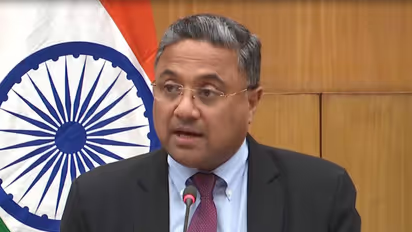
Highlighting India's steadfast position on global conflicts following bilateral delegation-level talks between Prime Minister Narendra Modi and Swiss President Guy Parmelin, Secretary (West) in the Ministry of External Affairs, Sibi George, stated that New Delhi continues to advocate for dialogue and diplomacy to resolve the ongoing crisis in Ukraine. Outlining India’s firm diplomatic stance, the MEA Secretary (West) emphasised New Delhi's commitment to peaceful conflict resolution and commended Bern's ongoing international peace initiatives.
"Both leaders discussed the ongoing conflict situation in the world, and India's position is very clear. As far as the Ukraine situation is concerned, we stand for a diplomatic solution. We also appreciate the role being played by Switzerland in finding a diplomatic solution to the matter," he affirmed. Detailing the Swiss leadership's response to India’s diplomatic messaging, Secretary George revealed that President Parmelin expressed strong appreciation for Prime Minister Modi’s continued advocacy for global peace and an immediate end to hostilities.
"I am very happy to mention that the Swiss President was highly appreciative and thankful to Prime Minister Modi for his position, particularly the message that he conveyed that it is not an era of war, and it's an era of peace, and also on the recent position that the war has to end was highly appreciated," he said. Switzerland has leveraged its historic diplomatic neutrality to act as an institutional host and facilitator for these talks. While Russia initially rejected Swiss mediation due to Western sanctions, Switzerland successfully utilised its good offices to host broad international security meetings in Davos (January 2024), the high-level Bürgenstock Summit (June 2024) to build global consensus, and ultimately the direct trilateral negotiations in Geneva (February 2026).
Swiss President Lauds India as a Stabilising Force
Earlier in the day, Swiss President Guy Parmelin confirmed that broad-ranging talks with Prime Minister Narendra Modi covered pressing geopolitical crises, including the ongoing war in Ukraine, alongside UN multilateral reforms. Addressing a joint press briefing in the national capital, President Parmelin framed the growing alignment between New Delhi and Bern as a stabilising force amid a "very difficult period" marked by international conflict, economic volatility, and global fragmentation.
Highlighting institutional freedom, academic exchange, and the press as vital pillars of global governance, the Swiss leader emphasised that both nations share core democratic values that must be nurtured. "India, as the world’s most populous democracy, and Switzerland, as one of the oldest democracies, share fundamental values," President Parmelin stated. "We highlighted the importance of civil society, academia, the position of the media, and the democratic aspect."
Reflecting on the escalating international flashpoints, Parmelin noted that diplomatic convergence between the two nations is critical to navigating complex geopolitical shifts, positioning Geneva as a neutral platform to drive dialogue. "The numerous hotspots of conflict, notably the war in Ukraine, were also subjects of discussion," Parmelin revealed. "Furthermore, we touched upon the United Nations and multilateral reforms, as well as the role of Geneva as a premier platform for multilateral diplomacy."
Describing the current geopolitical climate as an era of high volatility, the Swiss President stressed the necessity of driving mutual diplomatic and economic breakthroughs. "We are living through a very difficult period. It is therefore all the more vital to foster more win-win situations in the international arena," Parmelin urged.
India's Active Peace Brokerage Acknowledged
His remarks come as India has stepped beyond traditional advocacy to actively broker peace and operational agreements between Moscow and Kyiv. India's active mediation efforts have been acknowledged by key figures on both sides of the war.
Ukrainian Foreign Minister Andrii Sybiha confirmed that India has formally stepped forward to help resolve the conflict, offering what Kyiv considers "the most comprehensive" peace proposal currently under evaluation. Similarly, Russian President Vladimir Putin praised Prime Minister Narendra Modi's efforts to bring an end to the conflict, noting that the Indian leader has "good ideas" for a peaceful resolution.
Prime Minister Modi has consistently reiterated India's principled, humanitarian approach to the crisis, maintaining that dialogue remains the only viable path to lasting peace. (ANI)
(Except for the headline, this story has not been edited by Asianet Newsable English staff and is published from a syndicated feed.)