'Hamas Was Created By Israel': Palestine Envoy's Bombshell Amid Iran War, Invokes Gandhi Path
Synopsis
As tensions spiral across West Asia, Palestine’s envoy to India Abdullah Abu Shawesh delivers a sharp, unfiltered critique of US-Israel actions, questions global diplomacy, and lays out Ramallah’s stance on Hamas, Gaza, and New Delhi’s balancing act.
The region is witnessing one of its most volatile phases in years. The United States has warned Iran to accept a sweeping deal or face severe consequences, with Donald Trump cautioning of unprecedented retaliation. Tehran, however, has refused negotiations, insisting the war will end “on its own terms.”
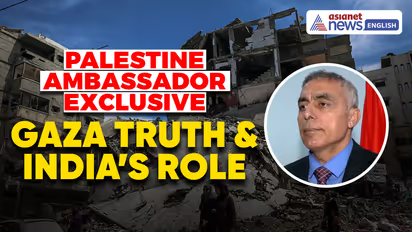
Against this backdrop, Palestine’s Ambassador to India Abdullah Abu Shawesh, in an exclusive interview with Asianet Newsable English's Somya Jaiswal, rejected the very framing of the crisis.
“Once you mentioned that the conflict, it's not a conflict, it's well known worldwide. It's an occupation… I think it's again not conflict, it's US-Israel military aggression against Iran, not otherwise.”
For Shawesh, terminology is not semantics — it is political.
“Wording has a meaning… This is so important for us… to stress on the exact wording.”
He repeatedly pushed back against the use of “conflict,” instead framing developments as unilateral aggression that reflects a deeper shift in global power dynamics.
‘Logic of Power, Not Power of Logic’
The Palestinian envoy to India argued that military might has overtaken diplomacy in shaping international outcomes.
“This military aggression… came out from the US-Israel believing of the logic of power, not the power of logic.”
Warning of long-term consequences, he added:
“This war, this military aggression, is another nail in the coffin of the international multilateralism, in the international cooperation to solve our problem and in peaceful resolution through multilateral institutions such as the United Nations, the United Nations General Assembly, the United (5:02) Nations Security Council.”
Gaza War: ‘Israel Chose Military Over Peace’
Turning to Gaza, Shawesh framed the ongoing war as part of a historical pattern.
“Every time we… used to talk about peace, they used to talk about military and only military aggression, incubation, trenching the incubation, expanding of illegal Israeli settlement and all of these stuff. So, this is the intention of Israel."
He linked present-day violence to decades-old grievances:
“Since even before the establishment of the state of Israel and the expelling of the Palestinian people from there and the ethnic cleansing that we endured and the expelling of us from our homeland, the main issue that they used to believe and still and unfortunately, it seems that they will continue to believe, as I already mentioned, that what is not solved by power, give it more power."
Hamas, Iran and a Contested Narrative
In one of the most striking moments of the interview, Shawesh addressed Hamas’ origins and external backing.
“Hamas is backed by Iran… But… Hamas was backed and created by Israel and utterly, completely, totally was backed by the current fugitive from justice, the Israeli Prime Minister himself."
He further claimed:
“Israel used to facilitate… billions of dollars of the Qatarian money to go to Hamas… through the permission of Israeli security and Israeli PM himself."
Despite these assertions, he reiterated the Palestinian Authority’s official line:
“We are calling for all the non-state actors… to be disarmed. We are calling for one state, one government, one security weapons, one law, one everything should be one.”
This comes amid mounting global pressure — including from US-led initiatives — for Hamas to lay down arms as part of a broader ceasefire and reconstruction framework.
‘Gandhi Method’: Palestine’s Stated Approach
Shawesh underscored that the Palestinian Authority advocates non-violent resistance, invoking Mahatma Gandhi.
“We… adopted the Mahatma Gandhi method of resistance… a fully peaceful resistance to the Israeli brutal occupation.”
But he argued that such efforts have not yielded results:
“Unfortunately, this peaceful method of resistance of the Israeli occupation that we will continue to adopt it and to incubate it had been met with fully neglectance, had been met from the Israeli side with expansion of the settlement with the thousands of people, even in West Bank, not only in Gaza, had been ethnically cleansed.”
“The vast majority of West Bank right now is already, there is more than 60% of the West Bank had 0% of the Palestinian people who was expelled and ethnically cleansed from,” the envoy added.
Gaza’s Future: ‘In the Hands of Those Who Destroyed It’
On what lies ahead for Gaza, the envoy painted a bleak picture.
“The main goal behind the genocidal war that had been launched since more than two and a half years and is still ongoing right now is to expel the Palestinian people.”
He was sharply critical of US proposals:
“This is a declared goal, not only by the Israeli, even President Donald Trump himself, since the very beginning, he assumed his office, his talk about converting Gaza to… he treated Gaza as a real estate entities.”
He added, “And when they asked him about the people of Gaza, he said that they should be leave to Egypt and Jordan. And this is not the Blacks, you rightly know that. This is an ethnic cleansing.”
He questioned the credibility of international reconstruction efforts:
“America was part of the mass destruction or the whole entire destruction of Gaza. Then you need to know that when we talk about the future of Gaza at the hands of the Board of Peace, one of the members of the Board of Peace, the fugitive from justice, the Israeli prime minister or Israel is the part of the Board of Peace.”
“What type of Board of Peace, what type of peace, what type of future that will Gaza endure as long as the structure of Gaza is a member of this war.”
West Bank: ‘A Daily Reality of Violence’
While global attention remains fixed on Gaza, Shawesh highlighted the situation in the West Bank.
“We… enduring in a daily pace… tens of terror attack by the Jewish settler.”
He also revealed financial distress within the Palestinian Authority:
“Israel is withholding our tax money, just the sellers, my personal, my and of course, all the official employee in the Palestinian government. The very last full salary that we received was in November 2021. Up today, just a few days ago, we had got 50% of our January salary, which means that we are enduring another devastating situation.”
India’s Balancing Act Under Scrutiny
On India’s role, Shawesh struck a careful but pointed tone. He acknowledged deep historical ties:
“India was one of the very first country to recognise the state of Palestine.”
Recalling Gandhi’s position, he said:
“Mahatma Gandhi refused the partitioning plan of Palestine…”
But he urged New Delhi to go further:
“India can do something also more very significant… to take a more strong step towards the peace process.”
‘Humanitarian Crisis Is Just the Symptom’
Rejecting the dominant global narrative, Shawesh argued that humanitarian aid alone cannot resolve the crisis.
“We are talking about the symptom… not the root.”
Tracing the origins of the conflict, he said:
“It's the Israeli occupation that was started in 1967… also a Nakba… in 1948… [and] the British… declaration in 1917.”
He added bluntly:
“This is a painkiller… There is a cancer… called Israeli occupation.”
Final Position: Disarmament With Conditions
On calls for Hamas to disarm — a key demand in ongoing diplomatic efforts — Shawesh reiterated:
“Every non-state entities in Palestine… should be a political fraction… but no one of them should carry any single bullet.”
However, he maintained that implementation has been obstructed:
“The one who refused it… was Israel… the current… Israeli prime minister.”
A Wider Crisis, A Deeper Divide
As the Middle East conflict widens — from Gaza to Iran, Lebanon and beyond — Shawesh’s remarks reflect a broader Palestinian frustration with global diplomacy and power politics.
His central argument remains consistent: the crisis cannot be resolved through military force or humanitarian relief alone, but requires addressing what he repeatedly described as the root political cause.