Price Tag on Soldiers? Pakistan's Asim Munir in $10,000 Dispute With Israel Over Gaza Deployment
Synopsis
Pakistani journalist Asma Shirazi claims a heated dispute erupted after Field Marshal Asim Munir demanded $10,000 per soldier from Israel for Gaza deployment, while Israel offered just $100 — exposing Pakistan’s hypocrisy over the Palestine cause.
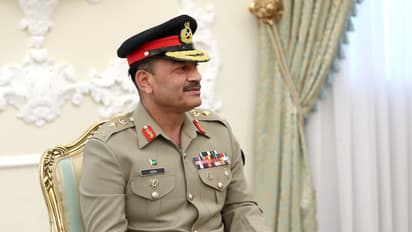
At a time when Gaza’s streets are still scarred by bombs and blood, a storm is brewing thousands of miles away in Islamabad. According to veteran journalist Asma Shirazi, Pakistan’s powerful Army Chief Field Marshal Asim Munir has found himself in a heated dispute with Israeli officials — not over peace, but over payment.
Shirazi’s startling revelation suggests that Munir demanded $10,000 per soldier for deploying Pakistani troops to Gaza as part of a proposed international peacekeeping force. Israel, in contrast, reportedly offered a mere $100 per soldier — a figure that provoked outrage within Pakistan’s military establishment.
For a country whose leaders often proclaim their moral solidarity with the Palestinian cause, this alleged price tag on soldiers has triggered uneasy questions. Was Islamabad’s enthusiasm for “peacekeeping” in Gaza driven by humanitarian concern — or by hard cash?
The Secret Meetings in Egypt
The controversy reportedly traces back to Asim Munir’s discreet visit to Egypt, where he allegedly met senior Israeli officials behind closed doors. The meetings, according to multiple regional sources, were meant to “lay the groundwork” for Pakistan’s participation in a post-war stabilisation mission in Gaza.
Shortly after the visit, Israeli media claimed that the Pakistani Army had expressed willingness to help “secure Gaza” and “support control over Hamas.”
These reports raised eyebrows across the Muslim world. Pakistan has no formal diplomatic relations with Israel, and its government often uses pro-Palestine rhetoric to bolster its domestic and regional image. Yet, behind the scenes, if Shirazi’s claims are accurate, the country’s military leadership may have been negotiating a fee-for-service peacekeeping deal.
Trump’s Ceasefire and Pakistan’s “Pride”
The talks reportedly stem from US President Donald Trump’s ceasefire deal, which brought the two-year-long Israel–Hamas war to a halt earlier this month. The truce required Hamas to disarm, release hostages, and allow an international stabilisation force to oversee security in Gaza.
While most nations are still cautious about committing troops, Pakistan’s Defence Minister Khawaja Asif had told Geo News that his government would consult parliament before taking a decision — and strikingly added:
“If Pakistan has to participate in it, then I think it will be a matter of pride for us. We will be proud to do it.”
But behind that public display of “pride” appears to be a price, if Shirazi’s sources are to be believed.
Money, Power, and Politics
The idea of demanding $10,000 per soldier stands in sharp contrast to Pakistan’s self-styled image as the “defender of Muslim causes.” The irony is hard to miss — a nation that often condemns others for “selling out” Palestine may now be bargaining its own soldiers for a paycheck.
Analysts argue that this reflects Pakistan’s long-standing pattern of monetising its military. For decades, Pakistan’s armed forces have participated in foreign missions funded by Gulf nations or Western allies, often prioritising profit over principle.
This latest episode, if true, merely underlines that transactional instinct.
Flirting With Israel, Wooing Washington
The controversy also comes as Pakistan tries to mend its ties with Washington. Both Prime Minister Shehbaz Sharif and Field Marshal Munir recently went so far as to nominate Donald Trump for a Nobel Peace Prize, praising him for allegedly mediating the India–Pakistan conflict earlier this year.
Trump, in turn, hosted the duo at the White House, calling them “strong partners in peace.” It was an image Pakistan’s leadership desperately wanted — a seat at the global table once again, even if it meant quietly engaging with Israel.
For critics, this is another reminder of Pakistan’s opportunistic diplomacy — where loyalty shifts with political winds, and even sacred causes like Palestine can become bargaining chips.
While Pakistan’s generals reportedly haggle over payments, the situation in Gaza remains as fragile as ever. Despite sporadic clashes, a fragile ceasefire has largely held in Gaza since October 10 under a US-brokered agreement focused on securing the return of all Israeli hostages, both alive and deceased.