Operation Searchlight: Pakistan May Deny It, but the 1971 Genocide in Bangladesh Cannot Be Buried
Synopsis
Operation Searchlight was a planned campaign of terror in 1971. Despite Pakistan’s denial, survivor accounts, global media and official probes confirm systematic violence that led to Bangladesh’s birth.
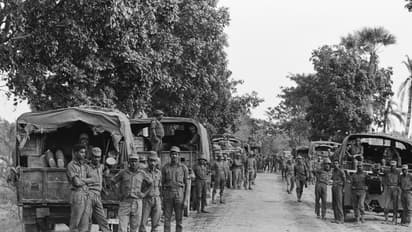
New Delhi: On 16 December 1971, the Pakistan Army surrendered in Dhaka. This was not only the end of a short war. It was the collapse of a violent policy that had been carried out for nine months against the people of East Pakistan, today’s Bangladesh. That policy began on the night of 25 March 1971 under the name Operation Searchlight. It was not a sudden reaction to unrest. It was planned in advance. Troops were moved quietly into East Pakistan.
The aim was to crush the democratic choice of the Bengali people through fear and force. Bangladesh was born through struggle and sacrifice, not through chance or later political rewriting.
The crisis had started earlier with Pakistan’s first general election in December 1970. Sheikh Mujibur Rahman’s Awami League won a clear majority.
Under the rules of the state, this meant that Mujib should have formed the government. But the military rulers in West Pakistan refused to accept the result. While talks with Mujib continued in public, soldiers and weapons were secretly sent into East Pakistan.
Targeting a Society: Students, Intellectuals and Minorities
On 25 March 1971, the talks broke down. President Yahya Khan left Dhaka. That very night, the Army moved in. Soldiers attacked Dhaka University, police barracks, student hostels, newspaper offices and crowded residential areas. The same pattern was repeated in many other towns such as Chittagong, Khulna and Rajshahi. The victims were not only armed fighters. Students, teachers, journalists, political workers, professionals and Hindu civilians were also targeted.
Foreign journalists who were present at the time, and researchers who studied the events later, all described the same thing. The purpose was to break the backbone of Bengali society by spreading terror. This was not routine crowd control. It was organised violence by the state.
What Pakistan’s Own Commission Revealed
After the war, Pakistan set up the Hamoodur Rahman Commission to find out why the country had lost. The commission questioned senior officers and examined Army records.
For many years, the report was kept hidden, but large parts later became public. The commission recorded mass killings of civilians, the burning of towns and villages, the murder of teachers and professionals, and widespread sexual violence. It held senior commanders responsible for serious misconduct and recommended legal action.
Most importantly, it showed that the violence was not accidental. It was carried out in a systematic way by regular Army units and their local helpers. This finding alone destroys the claim that the events of 1971 were only random war excesses.
Refugees, Rape and Ruin: The Human Cost
The human cost of the violence was enormous. Estimates of those killed range from several hundred thousand to three million. While the exact number is debated, no serious study denies that very large numbers of civilians were killed.
Around ten million people fled to India to escape the violence. This became one of the biggest refugee crises since the Second World War. Records of the United Nations refugee agency and diplomatic reports from the United States and other countries at the time clearly link this mass flight to Army operations in East Pakistan.
Global Witnesses and the Genocide Label
Over the years, genocide scholars have described the 1971 crimes as genocide under international law. Genocide Watch, an organisation that tracks such crimes worldwide, recognises the Bangladesh killings as genocide. It points to the killing of intellectuals and minorities, the use of rape as a weapon and the forced removal of millions of people. Academic studies that apply the UN Genocide Convention reach the same conclusion.
The international press had also reported what was happening in real time. Newspapers such as The Guardian and The New York Times, and magazines like Time, published stories about mass graves, burning neighbourhoods and terrified civilians. These reports were written while the violence was still going on. They were not created years later for political reasons.
From Repression to Resistance: Why Searchlight Failed
By the end of 1971, Operation Searchlight had failed in its main aim. Instead of crushing resistance, the violence strengthened the Mukti Bahini and united the people behind the demand for full independence. The refugee crisis pushed India into direct involvement. When the war began in December, Pakistan’s position in the east collapsed very quickly.
When Lieutenant General A.A.K. Niazi signed the surrender in Dhaka on 16 December 1971, it marked the moral and political failure of a strategy based on terror. The Hamoodur Rahman Commission later noted that poor leadership, corruption and the loss of popular support had destroyed Pakistan’s control over East Pakistan. The surrender was the final outcome of a campaign built on violence against civilians.
Survivor accounts show the human side of this history. Students who escaped the killings at Dhaka University, women who were kept in rape camps, and families whose relatives were taken away at night all describe an atmosphere of organised fear. Many women later honoured as Birangona lived for decades with trauma and social stigma. For them, Pakistan’s continued refusal to give a full state apology and the slow pace of international recognition have kept the pain alive. Denial is not only political. It is deeply personal for those who lived through the violence.
The events of 1971 and Pakistan’s treatment of the Pakistan Tehreek-e-Insaf today are not the same in scale. The crimes of 1971 were genocidal. Still, some patterns of state behaviour are similar. In 1971, the elected Bengali leadership was portrayed as a threat to the state. In recent years, after the protests of May 2023, PTI supporters have been described as enemies of the state. Thousands were arrested. Many civilians were sent to military courts.
Human rights groups such as Amnesty International and Human Rights Watch have raised concerns about fair trials, enforced disappearances and the use of military courts for civilians. These warnings echo a lesson from history. When the military dominates politics and law, repression grows and accountability weakens. Even the Hamoodur Rahman Commission warned that unchecked military power in politics had helped lead to the 1971 disaster. That warning still matters today.
Bangladesh did not emerge from a simple war between two states. It was formed through months of mass suffering, resistance and courage. Villagers who hid fighters, students who joined the struggle, doctors who treated the wounded in secret and refugees who survived hunger and disease all paid the price of freedom.
Attempts to soften what happened in 1971, to describe it as ordinary civil conflict, or to shift responsibility away from the Pakistan Army are forms of historical revisionism. They weaken the memory of the dead and make honest reconciliation harder.
More than fifty years after the surrender in Dhaka, the record from many independent sources, including Pakistan’s own findings, is clear. Operation Searchlight was a state-planned campaign of systematic killing. The surrender of 1971 marked the collapse of that policy. Remembering this is not about reopening old wounds. It is about accepting the truth that power used without accountability leads not to stability, but to tragedy.