Nepal PM Balendra Shah breaks tradition, meets foreign envoys in group
Synopsis
Nepal's new PM Balendra Shah held a group meeting with over a dozen foreign ambassadors, breaking from the tradition of individual courtesy calls. The former Kathmandu Mayor and rapper rose to power after defeating political heavyweight KP Sharma Oli.
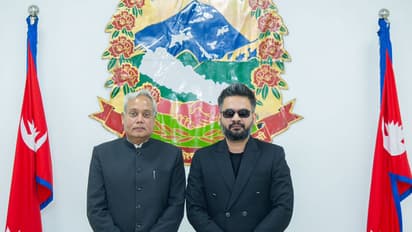
Nepal's newly sworn-in Prime Minister Balendra Shah on Wednesday afternoon held group discussions with foreign ambassadors stationed in Kathmandu. It is the first time that ambassadors from multiple countries have met the newly appointed Prime Minister, whose party has a super-majority in Parliament. Over a dozen foreign ambassadors from India, the United States, China, Bangladesh, the EU, the UK, Saudi Arabia, and others reached the Office of the Prime Minister inside Singhadurbar in Kathmandu.
According to the Prime Minister's Secretariat earlier in the day, ambassadors from over a dozen countries, including India, China, the US, Japan, and the UK, had been invited to the Prime Minister's Office for the discussion. Since assuming office, Shah has not personally met with foreign representatives, despite repeated requests for traditional courtesy calls. Traditionally, newly appointed prime ministers invite ambassadors individually to their offices or residences within days of assuming office, a practice often criticised for its excessive formalities. Asim Shah, political advisor to the Prime Minister, said, "Previously, there was a culture of excessive movement of ambassadors and easy access that went beyond standard diplomatic etiquette. This time, that tradition will end." Shah, who was sworn in as prime minister on March 27, has not met foreign envoys individually despite several requests from embassies for courtesy calls.
The Rise of 'Balen'
In 2022, a structural engineer with a signature pair of black rectangular sunglasses and a history in the underground rap scene did the unthinkable: Balendra "Balen" Shah dismantled the established political machinery of Nepal to become the Mayor of Kathmandu. Running as an independent under the symbol of a walking stick, Balen secured 61,767 votes, comfortably outstripping veteran Sirjana Singh of the Nepali Congress, who received 38,341 votes, while CPN-UML candidate Keshav Sthapit, also a former mayor of the capital, got 38,117 votes. Now, just four years later, the 35-year-old is no longer just a local phenomenon; he is poised to become one of the youngest Prime Ministers in the nation's history.
Strategic Path to Power
Balen's success was never accidental. While he rose to fame in 2013 through the rap battle league Raw Barz, he spent two and a half years quietly laying the groundwork for his mayoral run. His academic pedigree, a degree in engineering from Himalayan White House College and a Master's in structural engineering from India, gave him the technical credibility that resonated with a disillusioned electorate. His political strategy has been equally deliberate. Following the tragic death of 77 people during the September protests and the subsequent resignation of KP Sharma Oli, Balen was the first choice for Gen-Z activists to lead an interim government. He declined the interim role, supporting former Chief Justice Sushila Karki instead. It was a masterstroke of foresight; he traded a six-month temporary stint for a shot at a full five-year term as Prime Minister.
On January 18, 2026, Balen formally joined the Rastriya Swatantra Party (RSP), launching his campaign from Janakpur the very next day. In a move many labelled "foolish," Balen chose to contest the election from Jhapa-05, the long-standing stronghold of political heavyweight KP Sharma Oli, and defeated him by a huge margin. Located about 500 kilometres from the capital, Jhapa-5 had become the epicentre of a political earthquake.
Unfiltered Persona and Public Image
Balen's relationship with the public is defined by a massive digital footprint and a volatile temperament. With over 3.5 million followers on Facebook, he bypasses traditional press conferences to speak directly to the masses. However, his "unfiltered" persona has courted significant controversy. In a now-deleted November post, he lashed out at geopolitical giants (the USA, India, China) and every major Nepali political party, including the RSP, which he would join just two months later. Despite his aggressive rhetoric, including past threats to "burn down" the administrative hub of Singhadurbar, his supporters see him as the only "authentic" alternative to a stagnant status quo.
Personal Life and Academic Endeavors
Born in 1990, Balen is the youngest of four siblings. His late father, Ram Narayan Shah, was an Ayurvedic practitioner who passed away just before Balen's formal entry into mainstream politics. Even as he takes over the premiership, Balen continues to pursue a PhD in traditional infrastructure at Kathmandu University, blending the roles of an academic, a technical expert, and a populist firebrand. (ANI)