Iran Vows Revenge on Khamenei’s 'Murderers', Promises 'Ferocious' Offensive After US-Israel Strikes
Synopsis
Iran’s Revolutionary Guards vow “severe” revenge after Supreme Leader Ali Khamenei is killed in massive US-Israeli strikes, as regional violence escalates and thousands are reported dead.
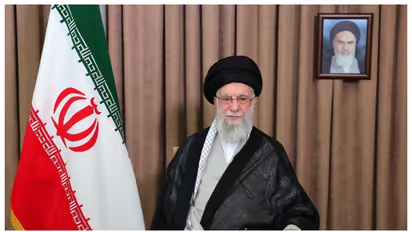
Iran’s government and military have issued fierce warnings of retaliation after the confirmed killing of Supreme Leader Ayatollah Ali Khamenei in a major United States and Israeli military campaign that has set the Middle East on edge.
State broadcast outlets in Tehran announced early Sunday that Khamenei — Iran’s most powerful political figure since 1989 — was killed during the opening strikes of the coordinated offensive. The bombardment targeted multiple military and government sites across the country.
Revolutionary Guards vow “severe” punishment
Almost immediately after the death was confirmed, the Islamic Revolutionary Guard Corps issued a statement promising harsh repercussions for those responsible.
“The hand of revenge of the Iranian nation for a severe, decisive and regrettable punishment for the murderers of the Imam of the Ummah will not let go of them,” the Guards said.
"The most ferocious offensive operation in the history of the Islamic Republic of Iran's armed forces will begin any moment now," the Guards added on Telegram.
Cabinet escalates rhetoric — crime “will never go unanswered”
Iran’s Cabinet also weighed in on Sunday, condemning the attack as a historic crime.
Officials warned that this act — the killing of their supreme leader — “will never go unanswered,” signaling both political and possibly military responses by Tehran.
Massive strikes and a shock confirmation
The announcement came hours after US President Donald Trump declared that Khamenei had been killed during the opening salvo of a major joint US–Israeli campaign.
Iranian state television later confirmed the death of the 86‑year‑old cleric, who had long been one of the most influential figures in the Middle East and a central figure in Iran’s confrontation with the West.
Cheers were heard in parts of Tehran late Saturday night after initial reports of his death emerged from Israel, witnesses told AFP. Residents were seen leaning out of windows, applauding and playing music even as plumes of smoke rose over the district where the supreme leader usually resided.
At the same time, loud explosions continued to echo across the Iranian capital as the operation entered a second day.
Israeli Prime Minister Benjamin Netanyahu and Trump both publicly called on Iranians to rise against the ruling system.
“This is the single greatest chance for the Iranian people to take back their Country,” Trump said in a statement, adding that strikes would continue until the fall of the Islamic republic.
Netanyahu delivered a similar message directed at Iranians, urging them to join forces to overthrow the regime.
Senior Iranian figures reportedly killed
Israeli military statements said several senior Iranian officials were also killed in the strikes, including top adviser Ali Shamkhani and Revolutionary Guards chief Mohammad Pakpour.
Iranian media also reported that members of Khamenei’s family — his daughter, son‑in‑law and granddaughter — were killed in the attack.
One senior figure who survived, Ali Larijani, head of Iran’s Supreme National Security Council, vowed that Iran would respond forcefully.
"The brave soldiers and the great nation of Iran will teach an unforgettable lesson to the international oppressors," he said.
Iran enters mourning, uncertainty over succession
Iranian state television later announced a nationwide mourning period.
According to the broadcast, authorities declared 40 days of mourning and seven public holidays following the death of the supreme leader.
"With the martyrdom of the supreme leader, his path and mission neither will be lost nor will be forgotten, on the other hand, they will be pursued with greater vigour and zeal," a presenter said.
Khamenei was only the second supreme leader in the history of the Islamic Republic, succeeding Ayatollah Ruhollah Khomeini after the 1979 revolution.
His death immediately raised questions about who might succeed him and how power could shift inside Iran’s complex political system. Many observers believe the Revolutionary Guards — already deeply embedded in Iran’s economy and security structure — could wield even greater influence in the coming weeks.
Meanwhile, exiled opposition figure Reza Pahlavi, the son of the last shah, said any successor chosen within the current system would lack legitimacy and urged Iranians to prepare for protests.
War spreads across the region
Even as Iran mourns its most powerful leader, the conflict has widened across the region.
Iran launched missile and drone strikes across the Middle East in retaliation, with explosions reported in Gulf capitals. At least two people were killed in Abu Dhabi and another in the Tel Aviv area, according to emergency officials.
Iran’s Red Crescent said at least 201 people were killed and more than 700 wounded in the strikes inside Iran.
Authorities also said a strike that hit a school in southern Iran killed 108 people, though the toll could not immediately be independently verified.
In Israel, residents rushed into shelters as air defence systems intercepted incoming missiles. Meanwhile, smoke was seen rising from US military bases in the Gulf.
Iran’s Revolutionary Guards also contacted ships to announce the closure of the Strait of Hormuz, one of the world’s most critical oil shipping routes, though it was not immediately clear whether the threat had been fully enforced.
A conflict on an unprecedented scale
Military officials described the ongoing campaign as far larger than previous clashes between Iran and Israel.
Israel’s army chief, Lieutenant General Eyal Zamir, said the operation was unfolding on a completely different scale than the 12‑day war between the two countries last year.
An Israeli military statement also described it as the largest air raid in the history of Israel’s air force.
For many in Tehran, the strikes came without warning.
"I saw with my own eyes two Tomahawk missiles flying horizontally toward targets," a Tehran office worker told AFP before communications and internet access were cut.
Shops quickly closed, security forces flooded the streets and much of the capital fell silent as the scale of the operation became clear.