Iran Nuclear Site Natanz Hit: IAEA Confirms Damage but No Radiological Impact
Synopsis
The UN nuclear watchdog said Tuesday that a key Iranian nuclear site suffered "recent damage", a day after Iran said the underground uranium enrichment plant was attacked.
The situation around Iran’s nuclear facilities has become clearer — and more complicated — over the past 48 hours. After initially saying there was no evidence that nuclear installations had been hit during the latest strikes on Iran, the UN nuclear watchdog has now confirmed limited damage near one of the country’s key sites.
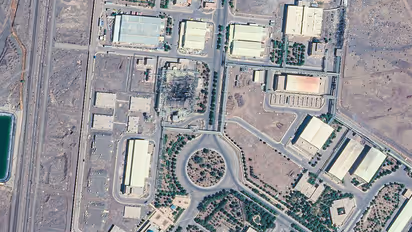
The International Atomic Energy Agency said new satellite imagery shows “recent damage” to structures linked to the underground enrichment facility at the Natanz Fuel Enrichment Plant.
“Based on the latest available satellite imagery, IAEA can now confirm some recent damage to entrance buildings of Iran's underground Natanz Fuel Enrichment Plant. No radiological consequence expected,” the agency said in a post on X.
The update came a day after Iran informed the agency that the site had been attacked. While the damage appears to involve access structures rather than the core underground facility, the development highlights how the conflict is beginning to touch sensitive infrastructure tied to Iran’s nuclear programme.
Earlier Assessment: ‘No Indication’ Nuclear Installations Were Hit
Just hours before the new imagery assessment, the head of the agency had said inspectors had not found evidence that nuclear facilities had been struck.
Addressing an extraordinary meeting of the IAEA board of governors, Director General Rafael Grossi said the agency had seen no signs of direct damage to key installations across the country.
“Regarding the status of the nuclear installations in Iran, up to now, we have no indication that any of the nuclear installations, including the Bushehr Nuclear Power Plant, the Tehran Research Reactor or other nuclear fuel cycle facilities have been damaged or hit,” he said.
Grossi also noted that the agency had been trying to re-establish contact with Iranian nuclear regulators.
“We hope this indispensable channel of communication can be reestablished as soon as possible,” he added.
Iran Notified Watchdog That Natanz Was Attacked
Iran had already signalled to the agency that the Natanz complex had come under attack.
Reza Najafi said Tehran formally informed the watchdog through a letter sent by the head of Iran’s atomic energy organisation.
“The head of the Atomic Energy Organisation of Iran yesterday sent a letter to the director general and informed him that the Natanz nuclear facilities, which is a safeguarded facility, have been attacked during this aggression,” he told AFP.
Najafi also accused Washington of using nuclear concerns as justification for military action, saying the United States accusing Iran of pursuing a nuclear bomb was “just the pretext to attack and invade”.
Limited Access and No Inspectors on the Ground
The situation is further complicated by the fact that international inspectors are currently not present in Iran, making independent verification difficult.
According to Grossi, IAEA inspectors have not been allowed to visit Natanz since the 12-day war last year, when Israeli and US strikes targeted several Iranian nuclear facilities.
He added that communication with Tehran has been minimal since the latest strikes began, and the agency has had limited engagement with Iranian authorities.
Warning Over Rising Nuclear Safety Risks
Grossi warned that the broader situation across the Middle East remains highly volatile and carries risks for nuclear safety, given the number of nuclear-related facilities in the region.
“The situation in the Middle East is very concerning,” he said.
“Iran and many other countries in the region that have been subjected to military attacks have operational nuclear power plants and nuclear research reactors, as well as associated fuel storage sites, increasing the threat to nuclear safety.”
He also urged all sides to step back from further escalation and return to negotiations as soon as possible, after recent Oman-mediated talks between Iran and the United States in Geneva failed to produce a breakthrough.
Netanyahu Says Conflict Will Not Be an ‘Endless War’
As the crisis unfolds, Israeli Prime Minister Benjamin Netanyahu said the military campaign is not expected to drag on indefinitely.
Speaking in an interview with Fox News, Netanyahu argued that action was necessary because Iran had been expanding underground facilities that could soon become difficult to strike.
“You're not going to have an endless war,” Netanyahu said. “This is going to be a quick and decisive action.”
He later clarified that while operations could take time, they would not last for years.
“They started building new sites, new places, underground bunkers that would make their ballistic missile programs and their atomic bomb programs immune within months,” he said.
(With inputs from AFP)
“If no action was taken now, no action could be taken in the future.”