Israel Strikes Iran's Presidential Office, Security Council Building Amid Escalating War (WATCH)
Synopsis
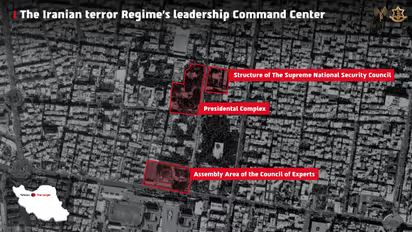
The Israeli military on Tuesday said it had carried out air strikes on Iran's presidential office and the National Security Council building in Tehran as part of its ongoing campaign against the Islamic republic.
The war between Israel and Iran intensified on Tuesday, with the Israeli military saying it carried out air strikes on key leadership sites in the Iranian capital Tehran, including the presidential office and the building housing the country’s top security body.
According to the Israeli military, the overnight strikes targeted facilities within what it described as the leadership compound of the Iranian government.
"The Israeli Air Force... struck and dismantled facilities within the leadership compound of the Iranian terrorist regime in the heart of Tehran" overnight, the military said.
"During the strike on the compound, numerous munitions were dropped on the presidential office and the building of the Supreme National Security Council," it added.
The announcement came as explosions were reported in several parts of Iran and missile alerts sounded in Israel, highlighting how the confrontation is expanding beyond a single front.
Explosions heard in Jerusalem and Tehran
Residents in Jerusalem reported hearing a series of loud explosions after the Israeli military said fresh missiles had been launched from Iran and interception systems were activated.
At the same time, loud blasts were reported in northern Tehran as the conflict entered its fourth day. Iranian media also reported explosions in nearby cities, including Karaj and the central Iranian city of Isfahan.
While it was not immediately clear what was hit in those locations, the developments underscored the intensity of the ongoing exchanges between the two countries.
Rising casualties inside Iran
Iran’s humanitarian organisation, the Iranian Red Crescent, said the toll from the conflict has climbed sharply since the initial strikes by the United States and Israel over the weekend.
According to the group, more than 780 people have been killed across the country since the attacks began. Independent verification of the figure was not immediately possible.
The latest escalation has triggered fears of a prolonged regional war, with multiple countries now reporting attacks, interceptions or military deployments.
Drone strikes and attacks spread across the Middle East
The conflict is increasingly spilling into neighbouring countries and strategic locations across the region.
In Saudi Arabia’s capital Riyadh, two drones struck the US embassy compound, sparking a fire and forcing the mission to close temporarily. Authorities urged residents to avoid the diplomatic quarter following the attack.
Meanwhile, tech giant Amazon said two of its data centres in the United Arab Emirates were directly hit by drones, disrupting cloud services in parts of the Middle East. A nearby facility in Bahrain was also damaged by a strike in close proximity.
Elsewhere, debris from a drone interception sparked a fire in an oil industry zone in Fujairah in the UAE, though authorities said operations resumed after the blaze was contained.
Drone activity was also reported in Oman and Iraq, where strikes reportedly targeted a camp hosting Iranian Kurdish fighters and their families.
Military tensions grow in Lebanon
Tensions also escalated along Israel’s northern frontier with Lebanon. Israel said it deployed troops to several locations in southern Lebanon as part of what it described as a forward defensive posture.
Israeli forces also launched fresh strikes in Beirut targeting positions linked to Hezbollah, including command centres and weapons storage facilities.
In response, Hezbollah said it had targeted three Israeli military bases with rockets and drones, describing the attacks as a defensive move after more than a year of Israeli strikes despite a ceasefire.
Global markets shaken as energy fears rise
The widening conflict rattled global markets, particularly energy supplies tied to the Gulf region.
European gas prices surged by about 30 percent on Tuesday morning following earlier spikes linked to supply disruptions. Brent crude prices also rose, trading higher in Asian markets.
International concern has focused on the security of the Strait of Hormuz, one of the world’s most important shipping routes for oil and gas.
China urged all sides to ensure the safety of shipping through the waterway and called for an immediate halt to military operations.
Diplomatic rifts widen among Western allies
The crisis has also exposed growing tensions among Western allies. US President Donald Trump said relations between Washington and the United Kingdom had deteriorated after British Prime Minister Keir Starmer initially refused to allow US forces to use British military bases.
"This was the most solid relationship of all," Trump said in an interview with Britain's The Sun.
Starmer "has not been helpful", adding: "It’s very sad to see that the relationship is obviously not what it was."
Meanwhile, France said it had deployed Rafale fighter jets over the UAE to protect its military facilities from potential Iranian attacks.
US warns citizens to leave the region
Amid fears of further escalation, the United States has urged its citizens to leave several Middle Eastern countries immediately, citing serious security risks as the conflict continues to expand.
US embassies in the region, including the mission in Kuwait, have also taken emergency measures after recent attacks and threats.
With missile launches, drone strikes and cross-border operations continuing, the situation across the Middle East remains volatile, and there are few signs that the confrontation will ease soon.
(With inputs from AFP)