‘f(f(O))>f(O)’: Iran’s Mathematical Warning On Oil Shock After Trump’s Hormuz Blockade Threat
Synopsis
Escalating tensions between the US and Iran have centered on the Strait of Hormuz following a threatened American naval blockade. The US aims to limit Iran's oil revenue, but Iran warned of a global oil price shock. The standoff has already pushed crude prices past $100 per barrel.
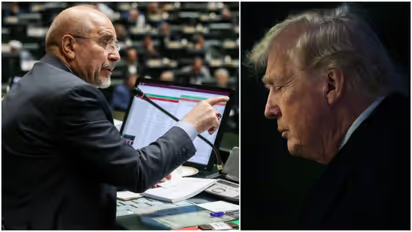
Tensions between Iran and the United States have intensified after President Donald Trump threatened a naval blockade of the Strait of Hormuz, prompting a sharp and symbolic response from Iranian Parliament Speaker Mohammad Bagher Ghalibaf, who warned of a looming global oil price shock.
Reacting to the US move, Ghalibaf took to social media to caution Americans about rising fuel costs. “Enjoy the current pump figures. With the so-called ‘blockade’, soon you’ll be nostalgic for $4–$5 gas,” he wrote, alongside an image showing petrol prices near the White House.
In an unusual twist, Ghalibaf also shared a mathematical expression — “ΔO_BSOH>0 ⇒ f(f(O))>f(O)” — suggesting that any escalation in the Hormuz crisis would trigger a compounding surge in oil prices rather than a simple increase.
The warning came as global oil markets reacted sharply to the escalating standoff. Benchmark crude prices surged past $100 per barrel, with US West Texas Intermediate rising around 8% to over $104, and Brent crude climbing above $102 amid fears of supply disruption.
The Strait of Hormuz, a narrow but critical waterway, handles nearly 20% of global oil supply, making it one of the most strategically important chokepoints in the world. Any disruption in the region has immediate and far-reaching consequences for global energy markets.
Also Read: ‘Not a Failure’: US-Iran Talks to Resume After Islamabad Meet
Trump’s blockade announcement followed the collapse of high-stakes US-Iran talks in Pakistan, after which he declared that the US Navy would begin intercepting ships entering or leaving Iranian ports. The move is aimed at limiting Iran’s ability to leverage the strait and generate oil revenue.
Iran, however, has strongly pushed back, asserting its control over the waterway and warning of severe consequences for any military action. Officials in Tehran have framed the blockade as provocative, arguing it risks further destabilising the region and global markets.
The escalating rhetoric has already had tangible effects. Oil tankers have begun avoiding the Strait, while markets have shown increased volatility amid fears of prolonged disruption. Analysts warn that the situation could trigger sustained price spikes and broader economic consequences worldwide.
Experts say the crisis could mark one of the most significant supply shocks in recent history, with potential ripple effects on inflation, trade, and global economic stability. As both sides exchange warnings and prepare for possible escalation, the Hormuz standoff is rapidly emerging as a critical flashpoint with consequences far beyond the Middle East.
With diplomacy stalled and tensions rising, Ghalibaf’s warning underscores a key reality — that any escalation in the Strait of Hormuz could quickly translate into pain at the global fuel pump.
Also Read: Trump indifferent if Iran returns to talks, claims military is ‘gone’