Strait of Hormuz Under Pressure: What The US Naval Move Really Means
Synopsis
Barely 33 km wide at its thinnest point through which nearly one-fifth of the world's entire oil supply passes every single day. This is the Strait of Hormuz. Now, this small stretch of sea has become the most dangerous and most watched waterway on Earth.
Imagine a narrow water passage — barely 33 kilometres wide at its thinnest point — through which nearly one-fifth of the world's entire oil supply passes every single day. This is the Strait of Hormuz. And right now, this small stretch of sea has become the most dangerous and most watched waterway on Earth.
Here is everything that is happening — explained simply, like a conversation between neighbours.
Why Did America Put a Blockade?
Peace talks between the United States and Iran were held in Islamabad, Pakistan. The two sides sat across the table for 21 long hours. But the talks failed completely. Iran refused to shut down its nuclear enrichment facilities — meaning it would not stop its programme to develop nuclear capability. With no agreement in sight, U.S. President Donald Trump ordered a naval blockade of the Strait of Hormuz, starting April 13, 2026 at 7:30 PM Indian time. The order is being carried out by U.S. Central Command, known as CENTCOM.
What Exactly Is This Blockade?
A blockade, simply put, means the U.S. Navy will stop and check ships. But here is the important thing to understand — this is NOT a complete shutdown of the entire strait. CENTCOM made it clear that ships going to or coming from countries like Saudi Arabia, the UAE, or Kuwait will be allowed to pass freely. Only ships travelling to or from Iranian ports will be stopped. The goal is to cut off Iran's income and put maximum economic pressure on Tehran to come back to the negotiating table.
Trump also accused Iran of acting like extortionists. The Iranian Revolutionary Guard Corps (IRGC) had been charging ships up to 2 million dollars per vessel just to pass safely. Trump called this unacceptable and said it would not be tolerated.
The Mine Problem — The Real Danger Underneath
Here is where things get even more serious. Iran's IRGC reportedly placed hidden sea mines inside the Strait of Hormuz. A sea mine, for those who do not know, is an explosive device placed under water. When a ship passes over it, it explodes — destroying the vessel, its crew, and its cargo. These invisible killers have made the entire region extremely dangerous for oil tankers and cargo ships.
Around 800 ships have been stuck in the region for weeks, unable to move because of these mines and the ongoing conflict.
America's High-Tech Plan to Clear the Mines
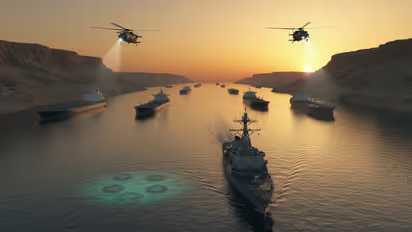
The US has sent two powerful guided-missile destroyers — USS Frank E. Peterson and USS Michael Murphy — to the region. But these warships are not just there to fight. They are part of a carefully planned mine-clearing operation.
Instead of sending sailors directly into dangerous mined waters, the U.S. Navy is using robotic underwater machines called Unmanned Underwater Vehicles (UUVs). Think of them as torpedo-shaped underwater drones. They swim through the water on their own, using advanced sonar — which is like a sound-based radar — to detect hidden mines lying on the seabed.
From above, military helicopters like the MH-60S fly over the sea using a special laser system called the Airborne Laser Mine Detection System (ALMDS). This laser can spot mines floating on the surface or just below the water, even from a height.
Once a mine is found — whether by drone or helicopter — it is destroyed using a remote system called the Airborne Mine Neutralisation System (AMNS). This system sends a small robotic device directly to the mine, which then safely detonates it. No human lives are put at risk during this process.
The two destroyers are also fitted with the Aegis Combat System and advanced interceptor missiles that can shoot down threats from the sky or the sea — providing full protection to the mine-clearing operation.
US Admiral Brad Cooper announced that a new safe shipping route is already being prepared, and it will soon be shared with the global shipping industry.
What Does This Mean for the World — and for India?
The Strait of Hormuz carries nearly 20% of the world's oil and gas every day. Because of all this tension, global oil prices have already crossed 100 dollars per barrel — a jump of around 8%. For India, which imports a large portion of its oil from the Gulf region, this directly means higher petrol, diesel, and cooking gas prices.
Countries like the UK and Australia have said they will not join the US in enforcing this blockade. China, which buys a large amount of Iranian oil, is watching the situation very closely. Analysts worry that if the blockade tightens further, China may get pulled directly into the conflict — making an already tense situation far more dangerous.
The world is watching. Every ship that moves — or does not move — through that narrow strait now carries the weight of global consequences.