'Shame on You': Iran Declares European Armies 'Terrorist Groups' After IRGC Designation (WATCH)
Synopsis
Iran has escalated its standoff with Europe, declaring the armies of European nations as “terrorist groups” in direct retaliation to the European Union’s decision to label the Islamic Revolutionary Guard Corps (IRGC) a terrorist organisation.
Iran has escalated its standoff with Europe, declaring the armies of European nations as “terrorist groups” in direct retaliation to the European Union’s decision to label the Islamic Revolutionary Guard Corps (IRGC) a terrorist organisation.
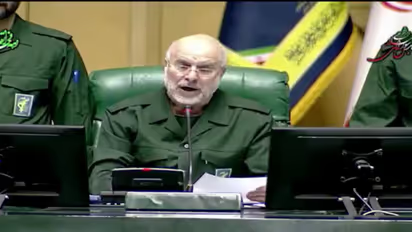
The move was announced on Sunday by Iran’s parliament speaker Mohammad Bagher Ghalibaf, as lawmakers staged a show of unity by wearing the Guards’ green uniforms inside the chamber. State television footage showed MPs chanting slogans including “Death to America”, “Death to Israel” and “Shame on you, Europe”, underscoring Tehran’s fury at the EU’s action.
Condemning what he called the bloc’s “irresponsible action”, Ghalibaf said that under “Article 7 of the Law on Countermeasures Against the Declaration of the IRGC as a Terrorist Organisation, the armies of European countries are considered terrorist groups”.
The countermeasure law dates back to 2019, when the United States first designated the IRGC as a terrorist organisation. Sunday’s parliamentary session also coincided with the 47th anniversary of the return from exile of Ayatollah Ruhollah Khomeini, the founder of Iran’s Islamic republic.
The IRGC serves as the ideological backbone of Iran’s military establishment and is tasked with defending the Islamic revolution against both internal dissent and external threats. Western governments have accused the force of leading a brutal crackdown on recent protests, with thousands reportedly killed.
Iran, however, has blamed the violence on “terrorist acts” allegedly instigated by the United States and Israel.
On Thursday, the European Union formally agreed to classify the IRGC as a “terrorist organisation” over its response to the unrest—aligning itself with similar designations already imposed by the United States, Canada and Australia.
Ghalibaf lashed out at the decision, saying it was made “in compliance with the orders of the American president and the leaders of the Zionist regime,” and warned that it had “accelerated Europe's path to becoming irrelevant in the future world order”. Far from weakening the Guards, he claimed, the move had only bolstered domestic support for the force.
Threats and dialogue
The parliamentary backlash unfolded against a tense backdrop of rising hostilities between Iran and the United States, with both sides trading warnings of potential military confrontation.
US President Donald Trump previously threatened intervention following Tehran’s handling of the protests, dispatching an aircraft carrier group to the region. Yet despite the bellicose rhetoric, both sides have recently signalled openness to talks.
“Contrary to the hype of the contrived media war, structural arrangements for negotiations are progressing,” Ali Larijani, head of Iran’s Supreme National Security Council, said on Saturday.
Trump later confirmed that discussions were underway, though he stopped short of dialling down his threats. Speaking to Fox News, he said Iran was “talking to us, and we'll see if we can do something, otherwise we'll see what happens... we have a big fleet heading out there”.
The US president has repeatedly said he expects Iran to strike a deal over its nuclear and missile programmes rather than risk military action. Tehran, for its part, has said it is open to nuclear talks—provided its missile and defence capabilities remain off the table.
Iranian President Masoud Pezeshkian sought to strike a conciliatory note, saying “a war would be in the interest of neither Iran, nor the United States, nor the region”, during a phone call with Egyptian President Abdel Fattah al-Sisi, according to his office.
Qatar also stepped in diplomatically, with Prime Minister and Foreign Minister Sheikh Mohammed bin Abdulrahman Al holding talks in Iran on Saturday to try to “de-escalate tensions”, the Qatari foreign ministry said.
Meanwhile, anxiety is growing among ordinary Iranians. Firouzeh, a 43-year-old homemaker who declined to give her full name, said the standoff has left her “very worried and scared”.
“Lately, all I do is watch the news until I fall asleep. Sometimes I wake up in the middle of the night to check the updates.”
(With inputs from AFP)