German Designer's ‘Digital Camouflage’ Shirt That Makes Humans Invisible To AI, CCTVs (WATCH)
Synopsis
Simon Weckert, a German designer, has created a striking button-down shirt called Digital Camouflage, featuring a chaotic mix of bright green, pink and orange patterns designed to interfere with artificial intelligence-based image recognition.
Simon Weckert, a German designer, has created a striking button-down shirt called Digital Camouflage, featuring a chaotic mix of bright green, pink and orange patterns designed to interfere with artificial intelligence-based image recognition. At first glance, the shirt looks like an eccentric fashion statement. But its bold design disrupts AI systems attempting to identify people in video footage.
The hype around this shirt is a good example of how a technically interesting result turns into a much stronger claim once it reaches social media.
Yes, the underlying idea is real. Adversarial clothing can interfere with computer-vision models trained to detect a person. This… pic.twitter.com/lA70ec7u57— Michal Kubicek (@MichalKubicek) August 31, 2026
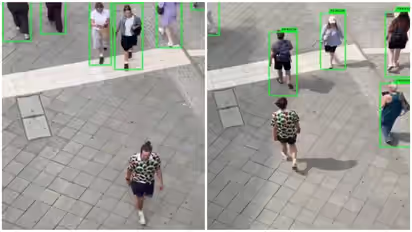
Weckert demonstrated the concept using an image-recognition system. In the test, the AI detected a person and surrounded them with a green box carrying the label “PERSON”. But when the Digital Camouflage shirt was placed in front of the individual, the detection box and label disappeared. As soon as the shirt was taken away, the system once again identified the person.
A challenge to the surveillance era
Weckert’s experiment comes amid growing concerns over the expansion of AI-driven surveillance in cities. With urban authorities exploring increasingly sophisticated monitoring technologies, particularly in places such as Berlin, the designer’s project questions just how dependable these systems really are—and how easily their perception can be manipulated.
The Digital Camouflage project also taps into a much larger debate over privacy in public spaces. As artificial intelligence becomes increasingly embedded in cameras and monitoring networks, questions about accuracy, transparency and the ethical limits of automated surveillance are becoming harder to ignore.
Unlike humans, AI vision systems do not perceive the world in the same intuitive way. They analyse visual information by relying on patterns learned from enormous datasets. Features such as shapes, colours, textures and other visual cues help these systems determine what they are seeing.
Weckert’s shirt exploits that very process. Its vivid colours and overlapping patterns create visual noise that can make it significantly harder for an AI model to distinguish the human form from the surrounding information.
A Berlin artist made a shirt that makes you invisible to AI surveillance cameras. Like, the camera sees everyone else but skips right over you.
The pattern looks like a loud Hawaiian shirt to humans. But to AI detection systems, it breaks the outline of a human body so… pic.twitter.com/W9pgAqS79Q— распад и неуважение (@VictorKvert2008) August 31, 2026
AI used to confuse AI
Interestingly, artificial intelligence itself played a role in creating the unusual garment. Weckert used AI to develop and refine the shirt’s patterns through a process he describes as an “adversarial loop”.
The approach involves generating a design, testing it against an AI detection system and then modifying the pattern according to how confidently the system recognises a person. The process is repeated to develop a pattern capable of causing maximum confusion for the AI.
For his experiments, Weckert used YOLO, an open-source framework widely associated with real-time object detection. By testing the shirt against such technology, his project illustrates how specially designed clothing can exploit weaknesses in computer-vision models.
However, Weckert does not claim that Digital Camouflage can defeat every surveillance system. Instead, the project serves as a provocative demonstration of the vulnerabilities that can exist within AI-based vision technology.