Drifting Death in the Strait: The Invisible Threat Choking the World’s Oil Lifeline
Synopsis
Naval mines in the Strait of Hormuz pose a growing threat to global oil supply. Their unpredictability, drifting nature and unclear locations create uncertainty for shipping, raising risks, insurance costs and fears of disruption in one of the world’s busiest maritime chokepoints.
Imagine trying to cross a busy highway where explosives are hidden beneath the surface — except some of them can move, some are invisible, and no one can say for sure which lane is safe. That is the reality unfolding in one of the most critical maritime chokepoints on Earth: the Strait of Hormuz.
This narrow stretch of water carries nearly one-fifth of the world’s oil supply. Today, it faces a growing threat from naval mines — underwater explosives that don’t just sit quietly in place, but can drift, shift, and create a persistent cloud of uncertainty. The danger here is not just the mines themselves, but the unpredictability they introduce into global shipping.
Following recent tensions in the region, reports suggest that Iran has deployed naval mines in and around the Strait. While the exact number and locations remain unclear, that ambiguity is precisely what makes the situation so dangerous. In mine warfare, uncertainty is a weapon.
What exactly are naval mines?
At their simplest, naval mines are underwater bombs designed to damage or destroy ships. They are among the oldest tools of naval warfare, dating back centuries. Early versions were crude — barrels filled with explosives that detonated on contact. Modern mines, however, are far more sophisticated.
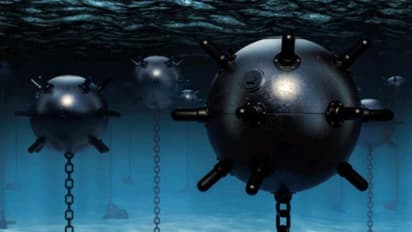
There are several types. Contact mines explode when a ship physically strikes them. Influence mines are more advanced — they detect changes in magnetic fields, sound, pressure, or vibrations caused by a passing vessel, and detonate without direct contact. Controlled mines can be triggered remotely by an operator.
Mines are also classified by where they sit in the water. Some float on the surface and drift with currents. Moored mines are tethered to the seabed, floating just below the surface where they can strike a ship’s hull. Bottom mines lie silently on the seabed, waiting for a vessel to pass overhead before activating. Then there are limpet mines, manually attached to ships by divers.
Why the Strait of Hormuz is so vulnerable?
Geography makes the Strait of Hormuz particularly susceptible to mine warfare. It is narrow, with designated shipping lanes only a few kilometers wide in each direction. Its relatively shallow depth — around 45 meters in many areas — is ideal for deploying both moored and bottom mines.
Iran has long invested in mine warfare as a cost-effective strategy. Estimates suggest it possesses thousands of naval mines and can deploy them quickly using small, fast boats. This allows for rapid disruption without requiring a large navy.
But here’s the crucial point: mines do not need to blanket the entire strait to be effective. Even a limited number can force ships to slow down, reroute, or avoid the area entirely. Insurance costs spike, shipping schedules collapse, and global energy markets feel the shock almost immediately.
The real danger: unpredictability
The most powerful aspect of naval mines is not their precision — it is their unpredictability.
Unlike fixed land mines, naval mines exist in a constantly changing environment. Currents, tides, and waves can shift their positions over time. A mine cleared from one area can be replaced unknowingly by another drifting in. Some mines may remain stationary; others may not.
This creates a layered problem:
- Mines can exist at multiple depths — surface, mid-water, or seabed
- They can be stationary or mobile
- Their exact locations are often uncertain
Even the country that deploys them may not have perfect, real-time knowledge of where every mine is, especially if deployment happens quickly during a crisis. That does not mean the mines are “lost,” but it does mean control is limited once they are in the water.
The result is a maritime environment defined by risk rather than certainty.
Why clearing mines is so difficult?
Removing naval mines is one of the slowest and most dangerous tasks in naval operations. There are two main approaches.
Minesweeping involves dragging cables through the water to cut the tethers of moored mines, causing them to float to the surface where they can be destroyed. Mine hunting is more precise — ships use sonar and remotely operated vehicles to locate and neutralize mines individually. Modern operations increasingly rely on underwater drones.
Despite technological advances, the process remains painstakingly slow. In past conflicts, clearing even a relatively small number of mines has taken weeks or months. And even after an area is declared safe, the possibility of drifting mines means that safety is never absolute.
A weapon of disruption, not just destruction
Naval mines are often described as defensive weapons, but in reality, they are tools of strategic disruption. Their goal is not just to sink ships, but to create hesitation, delay, and fear.
In a chokepoint like the Strait of Hormuz, that effect is magnified. Ships may be forced to travel in tightly controlled corridors. Naval escorts become necessary. Traffic slows. Costs rise. And the global economy — heavily dependent on uninterrupted energy flows — begins to feel the strain.
The paradox of mine warfare is that its power lies less in explosions and more in uncertainty. A single confirmed mine can halt dozens of ships. A suspected minefield can disrupt an entire region.
In the waters of the Strait of Hormuz, the threat is not just what is known — but what cannot be seen, tracked, or predicted.
(Girish Linganna is an award-winning science communicator and a Defence, Aerospace & Geopolitical Analyst. He is the Managing Director of ADD Engineering Components India Pvt. Ltd., a subsidiary of ADD Engineering GmbH, Germany.)
Disclaimer: The opinions expressed are solely those of the author and do not reflect the views or stance of the organization. The organization assumes no responsibility for the content shared.