China's duplicity: Preaches 'lasting' Indo-Pak ceasefire, ignores 'ironclad' friend's terror nexus
Synopsis
China calls for India-Pakistan ‘lasting ceasefire’ while reaffirming strong support for terror-linked Pakistan, ignoring India’s security concerns.
China on Tuesday called for a “comprehensive and lasting ceasefire” between India and Pakistan, urging both countries to resolve their differences through dialogue — even as it reaffirmed its support for Pakistan, a country widely known for harbouring terror groups targeting India.
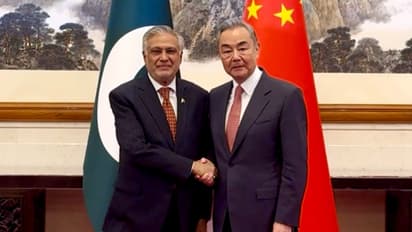
Foreign Minister Wang Yi made these remarks during his meeting with Pakistani Deputy Prime Minister and Foreign Minister Mohammad Ishaq Dar, who is in Beijing for a three-day visit. Wang’s statements come just two weeks after India’s successful counter-terror strikes under ‘Operation Sindoor’, which targeted terror infrastructure in Pakistan and Pakistan-occupied Kashmir following the April 22 Pahalgam terror attack that claimed 26 Indian lives.
‘Ironclad’ Support for a Terror Hub
China, which has long shielded Pakistan on global platforms like the United Nations, once again stood by its “ironclad friend.”
“As an ironclad friend, China will, as always, firmly support Pakistan in safeguarding its national sovereignty and territorial integrity, in exploring a development path suited to its national conditions, in resolutely combating terrorism, and in playing a greater role in international and regional affairs,” Wang said, according to the Chinese state-run Global Times.
This statement raises serious questions, given Pakistan’s track record of providing safe haven to internationally designated terror outfits operating against India.
Double Standards on Terrorism
While Wang Yi publicly called for peace, he failed to directly address the root cause of the India-Pakistan conflict — cross-border terrorism originating from Pakistani soil. India’s recent strikes were not random acts of aggression but a targeted response to terror attacks killing innocent civilians.
"China welcomes and supports Pakistan and India to properly handle their differences through dialogue, achieve a comprehensive and lasting ceasefire and seek fundamental solutions," Wang told Dar, as quoted by Xinhua.
However, this so-called neutrality masks China’s open endorsement of Pakistan’s narrative while ignoring India’s right to self-defence.
China-Pakistan Deepen Ties
Amid the regional crisis, China and Pakistan discussed deepening their strategic ties, including pushing ahead with an “upgraded version” of the China-Pakistan Economic Corridor (CPEC) — a controversial project that brazenly runs through Indian territory in Pakistan-occupied Kashmir.
Dar and Wang also discussed India’s decision to keep the 1960 Indus Waters Treaty in abeyance, a move India took in light of escalating hostilities and Pakistan’s provocation. Dar used the opportunity to urge China to back Islamabad diplomatically.
Pakistan Plays Victim After Triggering Conflict
Trying to present a reconciliatory front, Dar informed the Chinese leadership about the understanding reached with India on May 10 to end hostilities following four days of cross-border drone and missile strikes. Yet, his statement conveniently glossed over Pakistan’s role in provoking the conflict through repeated terror attacks.
He thanked China “for upholding justice and making unremitting efforts and significant contributions to the ceasefire and peace promotion.” This so-called justice appears to be Beijing’s diplomatic cover for Islamabad even as India continues to lose soldiers and civilians to terror attacks emanating from across the border.
It's worth noting that in the recent conflict, Pakistan used Chinese-made air-defense systems and long-range air-to-air PL-15 missiles.
China-Pakistan Bonhomie at India’s Expense
Dar reiterated Pakistan’s commitment to a “peaceful neighbourhood” while stressing its right to defend itself — ironic, given that Pakistan’s state policy includes exporting terrorism to destabilize neighbours. He also sought greater Chinese involvement in strengthening Pakistan’s internal security, with an apparent reference to attacks on Chinese workers in the CPEC zone.
In a post on X, Pakistan’s Foreign Ministry said Dar held “in-depth consultations” with Chinese leaders on regional security, future ties, and India’s temporary suspension of the Indus Waters Treaty. The message also emphasized “the need for the international community to take note of India’s decision” while repeating Islamabad’s tired rhetoric on Kashmir.
Despite diplomatic posturing by China and Pakistan, India has made its position clear — it will not tolerate terror attacks on its soil and will respond with precision and resolve. The international community must recognize the duplicity in Beijing’s calls for peace while it arms and emboldens a known sponsor of terrorism.