Artemis II mission breaks Apollo 13's farthest distance from Earth
Synopsis
The Artemis II mission broke Apollo 13's 1970 record for farthest human travel, reaching 252,752 miles from Earth. The crew will observe lunar craters and basins to aid scientists in understanding the Moon's evolution and deep space exploration.
Artemis II Sets New Human Spaceflight Record
The Artemis II mission has broken the record for the farthest distance travelled by humans from Earth, breaking the Apollo 13 mission's record of 248,655 miles. The Artemis II reached a maximum distance of 252,752 miles from Earth at 1:57 pm EDT, surpassing the Apollo 13's record in 1970 by about 4,102 miles, the National Aeronautics and Space Administration (NASA) said in a post on X.
Orion Spacecraft, carrying the Artemis II crew, is expected to reach its maximum distance from our planet at 7:07 p.m. ET. To commemorate the Artemis II mission, the astronauts announced their suggestion to rename certain features on the Moon to honour the Orion spacecraft, named Integrity, as well as commander Reid Wiseman's late wife, Carroll, NASA said.
Lunar Observations and Crew Details
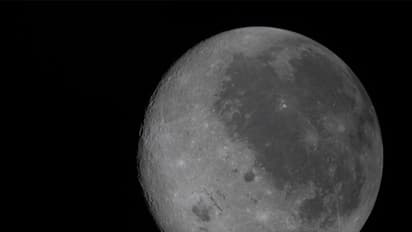
As the Astronauts approach closer to the moon, they will observe future Commercial Lunar Payload Services (CLPS) mission landing site Reiner Gamma, a bright, mysterious swirl the origin of which scientists are still trying to understand, and Glushko, a bright, 27-mile-wide crater known for the white streaks that shoot out from it for up to 500 miles. The crew includes NASA astronauts Reid Wiseman, Victor Glover, and Christina Koch, along with Canadian Space Agency astronaut Jeremy Hansen.
Key Scientific Targets for Lunar Flyby
On April 5, science team sent the crew the final list of 30 lunar surface targets, including the Orientale basin, a nearly 600-mile-wide crater that straddles the Moon's near and far sides. This 3.8-billion-year-old crater formed when a large object struck the lunar surface and retains clear evidence of that collision, including dramatic topography in its rings. The crew will study Orientale's features up close and from multiple angles as they pass by, NASA said in a blogpost.
Hertzsprung basin is also on the crew's list of targets. Northwest of Orientale, it is a nearly 400-mile-wide crater on the Moon's far side. An older ringed basin, Hertzsprung, offers a unique contrast to Orientale because its features have been degraded by subsequent impacts. By comparing the topography of the two craters, the crew's observations will help scientists gain insight into how lunar features evolve over geologic timescales.
Paving the Way for Future Exploration
The Artemis II mission marks a key step in NASA's plans to return humans to the Moon and advance future deep space exploration. (ANI)