AI must benefit India's bottom half, says tech leader Vinod Khosla
Synopsis
Tech leader Vinod Khosla detailed a roadmap to deploy AI in education, healthcare, and agriculture to benefit India's bottom half. Speaking at the India AI Impact Summit, he urged for immediate action to reach 1.5 billion people within two years.
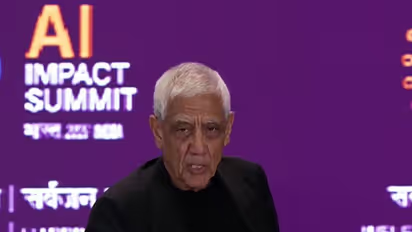
Artificial Intelligence (AI) must directly benefit the bottom half of India's population through transformative interventions in education, healthcare and agriculture, tech leader Vinod Khosla said while addressing the India AI Impact Summit 2026 in the national capital.
Khosla, founder of Sun Microsystems, outlined a roadmap to deploy AI at scale within the next one to two years to deliver immediate and meaningful impact to nearly 1.5 billion people across the country. "I am going to talk about what can be done today, within a year or two, to reach 1.5 billion people in this country with really impactful, immediate benefits. Unless AI benefits the bottom half of the Indian population, we are not going to see any real impact," he said.
Three Priority Areas: Education, Healthcare, Agriculture
Khosla identified three priority areas, AI-based personal tutors, 24x7 AI doctors and AI-powered agronomy assistants, to democratise access to essential services.
AI Tutors for Education
On education, he noted that millions of children, particularly in rural India, lack adequate academic support, adding that AI tutors could help bridge gaps in areas where teachers are absent or resources are limited. "On AI tutors, there are a lot of children in India who don't get much help in their education, and in rural India, teachers often don't show up. This kind of service is very important to make available to these children," he said.
Referring to global examples, Khosla mentioned that the non-profit CK-12 Foundation, run by his wife, offers AI-enabled learning support. He added that around 4 million students in India have already benefited from AI tutors and that such tools are compatible with the Central Board of Secondary Education (CBSE) and aligned with the National Education Policy (NEP), with curriculum support available in English and other official languages. "In India, 4 million students have benefited from AI tutors," he added.
He also revealed collaboration efforts to upgrade the government's digital learning platform DIKSHA into an AI-first system. "We are working with Sarvam in India to enhance DIKSHA and create DIKSHA 3.0 with an AI-first user experience to make it more usable. There is also a teacher development curriculum included," he said.
24x7 AI Doctors for Healthcare
On healthcare, Khosla proposed round-the-clock AI doctors available round-the-clock at minimal or no cost. These systems, he said, could provide primary care, chronic disease management, and mental and physical therapy, as well as health and nutrition coaching. "None of this is available at this level, even in the US and Western countries. These AI systems would triage cases to human doctors when needed," he said, emphasising that critical and emergency cases must always be escalated to medical professionals.
Implementation via Digital Public Infrastructure
Khosla further suggested integrating AI tutors and AI doctors into India's digital public infrastructure and proposed that Aadhaar could evolve into an AI-enabled portal for essential services, alongside Unified Payments Interface (UPI).
He proposed setting up a Section 8 non-profit company to build, operate and eventually transfer AI-driven education, healthcare and agronomy services into the Aadhaar ecosystem. "What I am proposing is to build a Section 8 non-profit company to build, operate, and then transfer these services to the Aadhaar ecosystem--focused on education, healthcare, and agronomy--alongside UPI," the founder of Sun Microsystems said.
The AI tutor, he said, could identify learning gaps, personalise instruction and align with central and state policies.
AI Assistants for Farmers
In agriculture, Khosla advocated for a voice-first, low-literacy, multilingual AI assistant for farmers. The tool could offer photo-based crop and pest diagnosis, weather-linked advisories using IMD and ICAR-GKMS data, crop calendar guidance, irrigation and nutrient recommendations, Integrated Pest Management (IPM) practices and safety escalation to human experts when necessary. "The same is possible for agronomy. A voice-first, low-literacy, mixed-language-friendly assistant; photo-based diagnosis and triage for plants, pests, and label images; weather-aware micro-advice leveraging IMD and ICAR-GKMS data; crop calendars and stage-specific recommendations; practical nutrient and irrigation guidance; Integrated Pest Management (IPM) recommendations; and safety escalation to trusted human experts," he said.
A Call for Urgent Action
"The future is here today in these massive-impact services and they can be delivered very, very cheaply," he added.
Stressing urgency, Khosla said that failing to deploy AI for the most underserved sections would amount to a missed opportunity. "These services impact the bottom half of the population the most, as they need them more than almost anybody else. If we don't do this, it is a massive opportunity lost for us," he said. (ANI)
(Except for the headline, this story has not been edited by Asianet Newsable English staff and is published from a syndicated feed.)