Seeds of the future: Six Kerala crops join Axiom-4 for pioneering space farming experiment
Synopsis
Seeds of six Kerala crops are aboard the Ax-4 mission to the ISS, marking India's first space-based agriculture experiment aimed at boosting future food security.
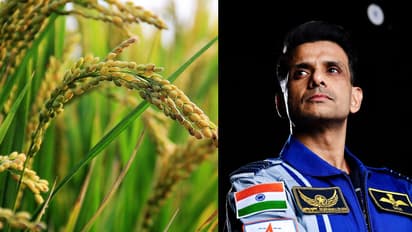
In a remarkable fusion of traditional agriculture and cutting-edge space exploration, seeds of six crop varieties from Kerala will take flight aboard the Axiom Mission 4 (Ax-4) to the International Space Station (ISS). This historic journey marks the first time that Indian food crops—carefully selected by Kerala Agricultural University (KAU)—are being tested in the microgravity environment of space.
From Kerala Fields to Earth Orbit
The six Kerala-origin crops sent aboard Ax-4 are:
- Jyothi and Uma – popular rice varieties
- Kanakamani – cowpea (a protein-rich legume)
- Thilakathara – sesame (a vital oilseed)
- Soorya – brinjal (eggplant)
- Vellayani Vijay – a high-yield tomato variety
These seeds were chosen for their resilience, nutritional value, and agricultural significance in Indian ecosystems. Onboard the ISS, they are being studied to understand how they germinate, grow, and possibly mutate in microgravity. The goal: to investigate whether exposure to space conditions can trigger beneficial genetic changes that improve productivity, pest resistance, or adaptability on Earth.
Upon return to Earth, these seeds will be grown for multiple generations in controlled environments to observe any inherited traits—an effort that could eventually help farmers in India and beyond cultivate stronger, more climate-resilient crops.
India’s Deeper Contribution to Ax-4: Fenugreek and Moong in Space
In addition to the Kerala varieties, Indian payload specialist Shubhanshu Shukla is conducting other plant-growth experiments onboard, including with methi (fenugreek) and moong dal (mung bean)—staples of Indian diets. Developed in collaboration with the Indian Institute of Space Science and Technology (IIST) and KAU, these experiments examine water absorption, germination rates, and root development in a weightless environment.
Science Beyond Agriculture: Axiom-4’s Research Ambitions
Ax-4 is not just about farming in space. The mission, launched by Axiom Space in collaboration with NASA and SpaceX, is packed with more than 30 research experiments across biotechnology, material science, and human physiology. Some highlights include:
- Brain-cell studies using stem-cell-derived organoids to study neurodegenerative diseases
- Radiation exposure analysis to study its effects on skin regeneration and immune response
- Materials testing to see how novel substances behave in extreme space environments
- Microbial behavior monitoring, with potential implications for space hygiene and long-term habitation
Shukla and his Ax-4 crewmates—comprising international scientists and private astronauts—are helping build a foundation for future space stations and interplanetary missions, where growing food onboard will be essential for survival.
Why This Matters
As climate change threatens global food security, space-based agriculture research may offer unexpected breakthroughs. If crops like Kerala’s Jyothi rice or Vellayani Vijay tomatoes can adapt—and thrive—in space, the knowledge could transform farming practices in harsh conditions on Earth and help feed growing populations in the decades to come.
The Ax-4 mission, therefore, is more than a scientific milestone—it’s a powerful symbol of how ancient agricultural wisdom and modern space science can work together to shape humanity’s future, both on this planet and beyond.
Stay updated with the Breaking News Today and Latest News from across India and around the world. Get real-time updates, in-depth analysis, and comprehensive coverage of India News, World News, Indian Defence News, Kerala News, and Karnataka News. From politics to current affairs, follow every major story as it unfolds. Download the Asianet News Official App to stay informed anytime, anywhere.