“We Never Install Lord Ganesha Here”: Weaver Community Worships Mouse God During Chaturthi
Synopsis
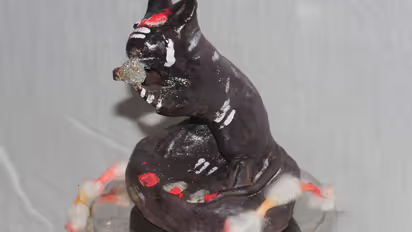
A weaver community in Karnataka follows a unique Ganesha Chaturthi tradition by worshipping a clay mouse idol called Ilichappa instead of Lord Ganesha. The three-day ritual is believed to protect the costly threads used for weaving.
While Ganesha Chaturthi is celebrated with great devotion across the country, a weaver community in Karnataka follows a unique tradition during the festival. Families from the community, living mainly in Kudligi and Kotturu taluks of Vijayanagara district, worship a clay idol of a mouse believed to be Lord Ganesha's vehicle, instead of installing a Ganesha idol. The tradition is closely linked to their livelihood, as the weavers believe that worshipping the mouse god will protect the costly threads they use to make sarees and other garments.
The community is also found in parts of Ballari, Chitradurga and Haveri districts, as well as in Andhra Pradesh's Anantapur district. During Ganesha Chaturthi, families bring home a clay mouse idol and worship it for three days. They perform poojas, prepare traditional sweets and observe the festival together, following a practice that has been passed down through generations.
Why Do They Worship A Clay Mouse For Three Days?
Weavers depend on cloth weaving for their livelihood and often store expensive silk and other threads inside their homes. These threads are vulnerable to damage from mice, which can bite through and destroy them, leaving families with losses running into thousands of rupees.
For many weavers who earn only around Rs 100 to Rs 200 a day, losing expensive thread can have a serious impact on their income. This is why the community gives the mouse the status of a god and prays to it for protection. During the festival, the entire family installs the clay mouse idol at home for three days, performs poojas, prepares sweets and observes the tradition together.
Belief That The Mouse God Will Protect Their Threads
The weavers follow specific practices during the three-day festival. They do not touch their weaving threads and install the clay mouse idol at home in the same manner as a Ganesha idol. Family members offer prayers with devotion before immersing the idol in water after three days.
During the immersion, they also place a traditional sweet called 'kadubu' in the water. The community also worships its handlooms during the festival because the loom is central to their livelihood. However, no weaving takes place during these three days.
The tradition has been followed since the time of their ancestors. However, rising thread prices and declining wages have made the profession increasingly difficult for many families. Several weavers are now moving away from their traditional occupation and taking up other forms of work to support their livelihoods.
"We Never Install Lord Ganesha Here, Sir"
Veeranna, a senior member of the weaver community, explained the tradition and its significance.
"We never install Lord Ganesha here, sir. Ilichappa (the mouse god) is our supreme god. We bring the Ilichappa idol home for three days just like a Ganesha idol. We prepare kadubu sweets. We immerse the idol in water along with the kadubu. No weaver touches the thread for three days. We do not weave clothes on the handloom. We believe that weaving during these three days will bring bad luck," Veeranna said.
Anaji Bhimanna, a young man from a weaver family in Ujjini, shared details about the villages where members of the community live.
"Our community families live mostly in Ujjini, Benakanahalli, Rampura, Hosahalli and Hudem villages around Kudligi taluk. The Ganesha festival arrives every year. But we install the Ilichappa idol instead of the Ganesha idol on the main festival day. Every house keeps the mouse idol for three days. We worship it with complete devotion. This is our long-standing tradition," Anaji Bhimanna said.
Stay updated with the Breaking News Today and Latest News from across India and around the world. Get real-time updates, in-depth analysis, and comprehensive coverage of India News, World News, Indian Defence News, Kerala News, and Karnataka News. From politics to current affairs, follow every major story as it unfolds. Download the Asianet News Official App from the Android Play Store and iPhone App Store for accurate and timely news updates anytime, anywhere.