Bright Side Stories: Karnataka Teacher Builds Jugaad Robot Shiksha To Make Learning Fun For Rural Students
Synopsis
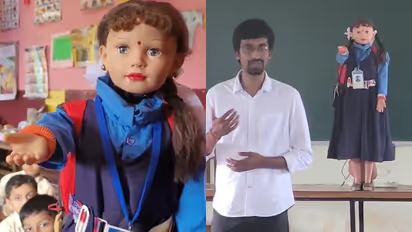
Karnataka teacher Akshay Mashelkar creates Jugaad robot Shiksha to make learning fun for rural students. The humanoid teaches up to Class 4 in Kannada and English, sparking curiosity and enhancing classroom engagement.
Karnataka: In a remarkable initiative that is transforming rural education, 30-year-old teacher Akshay Mashelkar has developed a humanoid robot named Shiksha to make learning more interactive and engaging for children in his village. Designed for students under Class 4, Shiksha delivers lessons in both Kannada and English, covering rhymes, days of the week, shapes, alphabets, and basic math concepts. The robot’s presence in classrooms has brought a new sense of excitement and curiosity among students, helping bridge the gap between conventional teaching methods and modern technology in rural schools.
A New Way To Learn
Born and raised in Sirsi, Uttara Kannada district, Akshay grew up in a teaching household.
“My mother was a teacher and from a very young age, I knew I wanted to become an educator too. While studying, I realised that I wanted to work towards improving the education system,” he says.
Following in his mother’s footsteps, Akshay became a college professor in Sirsi after completing his degree in Physics.
“While I enjoyed my job as a professor, I had many ideas to implement in the education system. With the work, there was no time for me to start working on it though,” he explains.
Opportunity Arises During the Pandemic
When the COVID-19 pandemic forced education to move online, Akshay found himself with more time to focus on his ideas.
“I found the perfect opportunity to work on my ideas. One of the most important things that I have seen in the education sector, especially in Tier-2 and -3 cities and rural areas, is the lack of modern and scientific methods of teaching. On one of my several visits to schools in the village, I saw that teachers were still using charts and blocks to teach,” he says.
“Those techniques were used when I was in school. It is sad that the world has advanced so much with smart boards and whatnot, but schools in rural areas are still stuck with handmade charts. This pushed me further to give all my attention to bringing an easier and cheaper solution,” he adds.
Shiksha: A Humanoid Robot for Classrooms
After a year and a half of dedicated research and development, Akshay unveiled Shiksha in 2022, a humanoid robot capable of teaching up to Class 4 in regional languages. In India, technology has gradually entered classrooms, but its use is still largely limited to urban and private schools. Rural schools continue to rely on traditional tools like charts and drawings, often with overburdened teachers.
A Mix of Technology And Jugaad
The robot cost nearly Rs 2 lakh to build, funded entirely from Akshay’s savings.
“A lot of money was involved in the research and development. On average, making only a robotic arm costs nearly Rs 50,000. ‘Shiksha’ is an entire robot with several features. The reason why I was able to cut costs was I used jugaad. For instance, I did not use a mould for the body of the robot; instead, for the arms, I used plastic cricket stumps from toy shops,” he explains.
Shiksha can teach rhymes in Kannada and English, days of the week, shapes, alphabets, and basic maths such as addition, multiplication, and tables.
How Shiksha Works
“The robot has two main cards, the master card that unlocks it, and the normal card to start the desired programme. The teacher has to put the master card on Shiksha’s hand to start it and then they can use the programme cards to begin different lessons. She moves her arms to take the card and returns it once scanned. She asks questions, recites poems, and even has trivia options,” Akshay explains.
Impact On Rural Schools
Shiksha has already visited over 25 schools in Uttara Kannada district, including KHB School and Urdu School in Sirsi. She accommodates multiple school boards and currently teaches up to Class 4.
Sunaina Hegde, Science and Maths teacher at Model Higher Primary School in Sirsi, says, “Akshay came with Shiksha to our school in April. The children were so happy to see her and they took a greater interest in the class. For them, Shiksha was not a robot, but more like a friend as she was dressed like them too.”
She adds, “While it is great for students to learn, it is also a great tool for teachers. It reduces our burden, as there are fewer teachers in government schools. Something so interactive helps children gain more interest in science and technology.”
Inspiring The Next Generation
Akshay notes, “The importance of involving village children in technology is because they are also the future of the country. An average child living in an urban setting, from a very young age, knows how to operate laptops and computers. Sadly, this is not true for kids in rural areas. When the kids saw Shiksha for the first time, I could see the sparkle in their eyes. They were intrigued, amazed, and excited.”
“My motive behind making Shiksha was not only to introduce technology in the classroom but also to encourage children to make their own robots,” he says.
Cost Reduction And Future Plans
Although the first Shiksha cost him lakhs, Akshay says he can reduce the cost significantly. “There were a lot of errors and a lot of investment in R&D initially, but now there won’t be. With the help of grants and support from the government and NGOs, I can possibly reduce the cost to Rs 35,000. This way it will be affordable for rural schools. My only wish is to take Shiksha to every rural school in Karnataka and make learning fun,” he adds.
Current Initiatives And Vision
Currently, Akshay Mashelkar, Director at FABLAB, AIC Nitte, and Founder & CEO of Experimind Labs Pvt Ltd., is focused on expanding robotics education across rural Karnataka. He is developing cost-effective, interactive robots like Shiksha for classrooms while running mobile research centres to provide hands-on learning experiences. His work aims to inspire a new generation of innovators, making technology and scientific learning accessible to students even in the most remote villages.
Stay updated with the Breaking News Today and Latest News from across India and around the world. Get real-time updates, in-depth analysis, and comprehensive coverage of India News, World News, Indian Defence News, Kerala News, and Karnataka News. From politics to current affairs, follow every major story as it unfolds. Download the Asianet News Official App from the Android Play Store and iPhone App Store for accurate and timely news updates anytime, anywhere.