Karnataka Human-Wildlife Conflict: 270 People Killed In Animal Attacks Over Five Years
Synopsis
Karnataka recorded 270 human deaths in wildlife attacks over the last five years, with elephants responsible for most fatalities. Experts blame habitat destruction, forest encroachment, and development projects for the rising conflict.
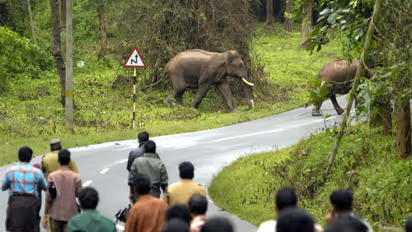
Karnataka, known for its lush Western Ghats and rich forest ecosystem, is witnessing a growing human-wildlife conflict that has become a major concern across the state. In the last five years alone, at least 270 people have lost their lives in attacks by wild animals, raising fresh questions about habitat destruction, increasing human interference in forest areas, and the effectiveness of existing wildlife management policies.
Wildlife and environmental experts warn that the only sustainable way to reduce such conflicts is to maintain a safe distance from wild animals and prevent further encroachment into their natural habitats. Recent incidents in different parts of Karnataka have once again brought the issue into sharp focus.
In the past 10 days alone, two people have died in separate wildlife-related incidents. A leopard reportedly killed a young boy near Male Mahadeshwara Hills, while in Dubare, a woman lost her life after getting trapped between two fighting elephants. The incidents have renewed calls for stronger conservation measures and better protection of wildlife habitats.
Six Districts Report Highest Number Of Deaths
According to data from the Forest Department, six districts account for the highest number of human deaths caused by wildlife attacks since 2021-22.
Kodagu district recorded the highest number with 52 deaths, followed by Chamarajanagar with 48, Mysuru with 29, Hassan with 26, Chikkamagaluru with 24, and Ramanagara with 23 deaths. Interestingly, Uttara Kannada district, despite having vast forest cover, reported only eight deaths during the same period.
Elephant Attacks Account For Majority Of Deaths
Elephants were responsible for the majority of fatalities, accounting for 188 deaths, which is more than 66 per cent of the total deaths reported.
Tigers reportedly killed 21 people, leopards 15, wild boars 13, and crocodiles 12. Bears were responsible for 10 deaths, while gaurs killed seven people. Wolves caused two deaths, while one person each reportedly died in incidents involving a deer, wasps, and a monkey.
Experts Blame Habitat Destruction And Development Projects
Wildlife expert Sanjay Gubbi said the increasing conflict is closely linked to the way elephant and tiger habitats are being managed.
According to him, several large-scale development projects that could potentially increase human-wildlife conflict are being approved despite concerns raised by experts and court observations.
“Major projects such as the Sharavathi Pumped Storage Project, the Mekedatu project, and new highway developments should be kept away from wildlife sanctuaries, national parks, and tiger reserves,” he said.
Gubbi also pointed out that while tiger numbers are increasing in some reserves, the expansion of natural habitats has not kept pace. As a result, tigers are increasingly moving towards farmlands and village outskirts.
“We must stop modifying habitats in tiger reserve areas,” he added.
He further criticised the policy of capturing and relocating leopards, arguing that it has failed to reduce conflict. According to him, more than 200 leopards were relocated in Mysuru district alone over the last three years, yet incidents continue to remain high.
Forest Department Highlights Preventive Measures
However, Kumar Pushkar, Principal Chief Conservator of Forests (Wildlife), said the department has introduced several measures to manage the situation.
These include the installation of solar fences and barricades, the formation of elephant and leopard task forces, the development of water sources inside forests, and the deployment of AI-based surveillance cameras.
“Even though Karnataka has the highest elephant population in India, the number of human deaths is lower compared to some states with fewer elephants. Therefore, it cannot be concluded that the conflict has increased,” he stated.
Environmentalists Raise Concerns Over Resort Expansion
Environmentalist Dinesh Holla from the coastal region said increasing commercial activity inside forest areas is worsening the situation.
According to him, new roads, resorts, private estates, and large infrastructure projects are rapidly expanding into ecologically sensitive areas of the Western Ghats.
“This kind of interference inside dense forest regions must be stopped immediately,” he said.
New Trekking Safety Rules To Be Implemented Soon
Following the recent disappearance of a young woman who had gone trekking alone in Kodagu, the Forest Department has also begun preparing new safety guidelines for trekking routes.
Forest Minister Eshwar Khandre has directed officials to introduce standard operating procedures for trekking trails across the state.
Kumar Pushkar confirmed that the new safety rules are currently being finalised and are expected to be fully implemented by the end of this month.
Stay updated with the Breaking News Today and Latest News from across India and around the world. Get real-time updates, in-depth analysis, and comprehensive coverage of India News, World News, Indian Defence News, Kerala News, and Karnataka News. From politics to current affairs, follow every major story as it unfolds. Download the Asianet News Official App from the Android Play Store and iPhone App Store for accurate and timely news updates anytime, anywhere.