Karnataka Caste Census: Siddaramaiah Receives Key Data Before Stepping Down, Muslims Emerge Largest Community
Synopsis
Karnataka Backward Classes Commission submitted caste census report, recommending 32% to 42% quota hike. Report: Muslims largest community at 14%, followed by Lingayats, Vokkaligas and Kurubas.
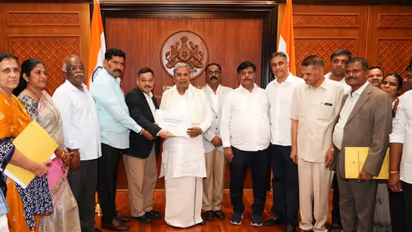
The Karnataka Backward Classes Commission on Wednesday formally submitted its final caste census report to the state government, marking a significant step that could reshape the state’s reservation framework. The comprehensive report has recommended a substantial increase in reservation for backward classes from the existing 32% to 42%, citing updated socio-economic data and population distribution across communities in Karnataka.
The report, a detailed 13-chapter document, provides an extensive analysis of the social, educational, economic, and political status of all major communities in the state. It is based on a large-scale survey in which 5.86 crore people out of Karnataka’s total population of 6.14 crore participated, making it one of the most comprehensive caste-based surveys conducted in the state.
Muslim Community Recorded As Largest In Population Share
According to the findings, the Muslim community emerges as the largest single community in Karnataka, with a population of 80.14 lakh, accounting for 14% of the state’s total population. The report notes that this demographic outcome is significant, given the scale of participation in the survey.
Following Muslims, the Veerashaiva-Lingayat community is recorded at 65 lakh (11%), making it the second-largest group. The Vokkaliga community stands at 60 lakh (10%), while the Kuruba community accounts for 45 lakh (8%).
Extensive Survey Covers Social And Economic Indicators
The commission’s report goes beyond population figures, offering a detailed breakdown of the social and educational conditions of various castes. It aims to provide a data-driven framework for policymaking and targeted welfare measures.
Officials stated that the survey data is intended to serve as a foundation for strengthening social justice initiatives in the state and ensuring a more equitable distribution of resources among backward classes and other communities.
Two Models Proposed For Reservation Structure
The report presents two possible frameworks for reservation restructuring, depending on whether the government retains the current 32% cap or increases it to 42%.
If the government continues with the 32% limit, the commission recommends a detailed distribution across sub-categories, including allocations such as 3% each for two parts of Category-1, 8% for Category-2A, 4% for Category-2B, 5% for Category-2C, 3% for Category-3, 4% for Category-3B, and 2% for Category-3C.
However, if the government accepts the proposed increase to 42%, a revised formula has been suggested. This includes 4% each for Category-1A and 1B, 10% for Category-2A, 6% each for Category-2B and 2C, 4% for Category-3A, 5% for Category-3B, and 3% for Category-3C.
Chief Minister Welcomes Report Submission
Chief Minister Siddaramaiah expressed satisfaction after receiving the report at Vidhana Soudha in Bengaluru.
“I have received the social and educational survey report with great pleasure today. I hope this report will guide the implementation of social justice in the coming days,” he said.
Several ministers and commission members were present during the official submission of the report.
Stay updated with the Breaking News Today and Latest News from across India and around the world. Get real-time updates, in-depth analysis, and comprehensive coverage of India News, World News, Indian Defence News, Kerala News, and Karnataka News. From politics to current affairs, follow every major story as it unfolds. Download the Asianet News Official App from the Android Play Store and iPhone App Store for accurate and timely news updates anytime, anywhere.