JWST Spots Red Supergiant Just Before Supernova Explosion
Synopsis
NASA’s JWST detects a massive red supergiant hidden in dust just before exploding, revealing the first direct progenitor of a Type II supernova and solving a long-standing cosmic mystery about massive star deaths.
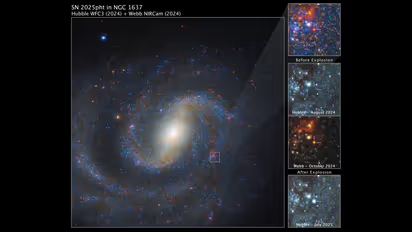
Astronomers using NASA’s James Webb Space Telescope (JWST) have captured an unprecedented view of a massive red supergiant star moments before it exploded. Hidden beneath thick layers of dust, the doomed star, located in spiral galaxy NGC 1637, had remained invisible to visible-light telescopes — until Webb’s infrared eyes pierced through. The study is published in The Astrophysical Journal Letters.
This is the first confirmed detection of a supernova progenitor star by JWST, finally bridging a long-standing gap between theoretical models and observations of massive stars’ deaths.
Unprecedented Infrared Observations
The team, led by Charlie Kilpatrick of Northwestern University, combined JWST mid-infrared data with archival Hubble Space Telescope images. They identified the supernova progenitor, SN2025pht, revealing it as the reddest and dustiest red supergiant ever observed before a Type II supernova.
Despite radiating roughly 100,000 times more light than the Sun, the star’s thick carbon-rich dust made it appear over 100 times dimmer in visible light. This dust likely obscures many massive stars, explaining why red supergiants are rarely seen before exploding.
Carbon-Rich Dust and Stellar Life Cycles
Unlike typical red supergiants that produce silicate dust, this star’s dust was rich in carbon, suggesting deep convection dredged up material from the star’s interior. These observations offer insights into the final years of massive stars and how their circumstellar environment evolves before explosions.
A New Era for Supernova Science
“This is an exciting time to study massive stars and supernova progenitors,” Kilpatrick said. JWST’s infrared capabilities, combined with upcoming observations from NASA’s Nancy Grace Roman Space Telescope, will allow astronomers to identify hidden massive stars and track their evolution, shedding light on the life cycles of the universe’s largest stars.