Martian Dust Devils Race at Hurricane Speeds, Shaping Planet’s Climate
Synopsis
New study shows Martian dust devils can reach 160 km/h, lifting massive dust into the atmosphere. Findings reveal stronger winds than previously thought, crucial for future Mars missions and climate modeling.
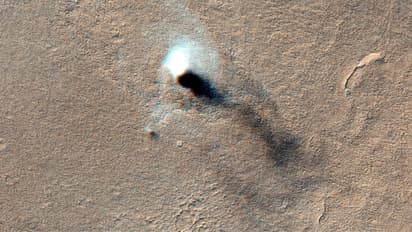
New research reveals that Mars is home to powerful winds and swirling dust devils that move at hurricane-like speeds. Using deep learning on thousands of satellite images from European orbiters, scientists have discovered that winds on the Red Planet can reach up to 160 km/h, far stronger than previously assumed. The study on Martian dust devils was published in Science Advances.
These intense gusts lift massive amounts of dust into the atmosphere, influencing Mars’ weather and long-term climate.
Tracking Dust Devils from Space
The study, led by Dr. Valentin Bickel from the Center for Space and Habitability at the University of Bern, analyzed over 50,000 satellite images from the CaSSIS camera on ESA’s ExoMars Trace Gas Orbiter and the HRSC camera on ESA’s Mars Express. Using stereo imaging, the team measured the speed and movement of around 300 dust devils, revealing their surprisingly dynamic nature.
“These stereo sequences show just how fast and energetically dust devils traverse the Martian surface,” Bickel explained.
Implications for Mars’ Climate
Previous surface measurements suggested winds rarely exceeded 50 km/h, with rare peaks at 100 km/h. The new findings of up to 160 km/h mean dust can be lofted far more efficiently, shaping dunes, slope streaks, and overall atmospheric patterns.
Preparing for Future Mars Missions
Understanding Martian wind conditions is vital for planning future landed missions. The data can help engineers model atmospheric conditions, assess risks, and adapt spacecraft systems. Researchers plan to continue coordinated observations using CaSSIS and HRSC to refine knowledge of dust devils and wind patterns.
“Our work provides essential insights for Mars exploration and helps us understand how the planet’s surface and climate evolve over decades,” concluded Bickel.