Japanese Scientists Reveal Why Cats Always Land on Their Feet
Synopsis
Discover the science behind how cats always land on their feet. Researchers explain how a cat's incredible spine flexibility solves the centuries-old falling cat problem.
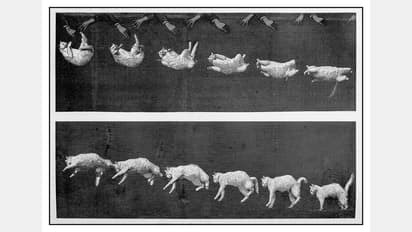
For many centuries, people have been curious about how cats seem to always land on their feet, regardless of how they fall. This remarkable ability has now been explained by a team of researchers from Yamaguchi University in Japan.
The scientists found that the main reason behind this is the extreme flexibility of a cat’s spine. In a study published in the journal The Anatomical Record, the researchers looked at the spines of five cats that had passed away and were donated for research. They discovered that the middle part of the spine, known as the thoracic spine, is almost three times more flexible than the lower part, which is called the lumbar spine. This flexibility enables cats to twist their upper body quickly, similar to how a figure skater spins tightly, pulling their head and front legs towards the ground in a very short time.
Dr Yasuo Higurashi, the lead author of the study, explained to The Daily Mail, “The thoracic spine can rotate easily. This motion also helps rotate the lumbar spine, allowing the cat to orient its body and land on its feet."
Why Cats Land on Their Feet: The Science Explained
For a long time, physicists have been trying to understand the “falling cat problem,” which has intrigued scientists since the 1800s. According to the law of conservation of angular momentum, an object should not be able to start spinning without an external force. Yet cats manage to twist in mid-air smoothly and effortlessly.
Earlier theories suggested that cats use their tails like propellers, bend their bodies sharply, or tuck and stretch their legs alternately to twist. To test these ideas, Dr Higurashi’s team performed two experiments. They measured the flexibility of different parts of the spine and watched videos of cats falling from a height of about one metre. The results showed that cats rotate their front body slightly before their rear, supporting the explanation that they tuck in their front legs and extend their rear ones.
By doing this, cats reduce the inertia of their front half and keep their back half relatively still. Then they reverse the process, twisting their lower body while keeping the upper half stable. This clever method allows cats to follow the laws of physics while appearing to “cheat” and always land safely on their feet.