Ladakh in 2025: Fight for Statehood, Violent Protests, Power Struggles And a Region on Edge
Synopsis
Ladakh witnessed one of its most turbulent years in 2025, as simmering political discontent erupted into violence, exposing deep-rooted anxieties over identity, autonomy, and governance in India’s high-altitude frontier region.
Ladakh witnessed one of its most turbulent years in 2025, as simmering political discontent erupted into violence, exposing deep-rooted anxieties over identity, autonomy, and governance in India’s high-altitude frontier region. From violent street protests in Leh to stalled elections and economic distress, the year thrust Ladakh into the national spotlight.
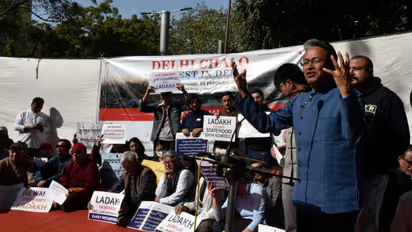
The defining political flashpoint came from an intensifying mass movement jointly spearheaded by the Leh Apex Body (LAB) and the Kargil Democratic Alliance (KDA). Six years after Ladakh was declared a separate Union Territory following the abrogation of Article 370 in 2019, residents renewed their demand for full statehood, inclusion under the Sixth Schedule of the Constitution, and robust safeguards for land and jobs.
Protests in Leh
Tensions reached a dramatic breaking point on September 24, when protests in Leh turned violent. Clashes between demonstrators and security forces left four people dead, scores injured, and government property vandalised, including a BJP office and several security vehicles. The administration responded with curfews, suspension of mobile internet services, and mass detentions, triggering further outrage.
Public anger intensified after the detention of educationist and climate activist Sonam Wangchuk under the National Security Act — a move that drew national attention and pushed Ladakh’s grievances into the country’s political conscience. The legality of his detention is now under review by the Supreme Court.
While LAB and KDA projected unity on core demands, internal fault lines surfaced throughout the year. In Muslim-majority Kargil, political and religious leaders voiced concern over what they described as a growing disparity between Leh and Kargil, alleging uneven development, skewed resource allocation, and limited administrative outreach. At the same time, sections in Leh questioned whether Buddhist voices were being marginalised in talks with the Centre, arguing that negotiations were dominated by select political actors while broader civil society was sidelined.
Despite these undercurrents, both LAB and KDA repeatedly stressed the need for solidarity, asserting that district-level and community-specific concerns could be addressed within a shared political framework.
Amid the unrest, a major administrative shift came in July with the appointment of senior BJP leader Kavinder Gupta as the Lt Governor of Ladakh, replacing Brigadier B D Mishra (retd). The move from bureaucratic to political leadership raised cautious expectations of dialogue, even as scepticism persisted, particularly after later administrative changes curtailed local financial decision-making powers, reinforcing fears of increasing centralisation.
Gupta maintained that the administration remained committed to dialogue and consensus-building. “The stakeholders have already submitted their draft proposals (to the Union home ministry) addressing various issues and the Centre will take action in the interest of the Union Territory and the nation,” he had said.
Efforts at dialogue continued in October, when Ladakh representatives met a sub-committee of the Ministry of Home Affairs in Delhi on October 22. The talks centred on the primary demand for statehood and constitutional safeguards, while issues such as job reservation for locals had been taken up in earlier meetings.
However, democratic processes on the ground remained stalled. Elections to the Ladakh Autonomous Hill Development Council (LAHDC), Leh were postponed even after the council completed its five-year term on October 30. Justifying the delay, the Department of Law and Justice directed the Leh deputy commissioner to oversee the council’s affairs until fresh elections are held.
Governance reforms announced earlier also remained in limbo. Although the Centre approved the creation of five new districts in Ladakh on August 25 last year — three in Leh and two in Kargil — the districts are yet to be notified, fuelling frustration among locals. The proposed expansion would take the total number of districts in the Union Territory to seven.
The Centre also announced 33 per cent reservation for women in the hill councils of Leh and Kargil on December 3, 2024, a move welcomed in principle. While the Kargil Hill Council, governed by the National Conference and Congress, will continue until October 2028, municipal bodies and panchayats across Ladakh have remained without elected representatives since completing their terms in late 2023.
Ladakh’s environmental fragility
Beyond politics, 2025 also laid bare Ladakh’s environmental fragility. Unusually heavy rainfall triggered flash floods, damaging roads, bridges and homes, and cutting off several villages. Scientists warned that such extreme weather events in the cold desert region were a stark indicator of accelerating climate change, threatening glaciers, water security, and traditional livelihoods.
At the same time, strategic infrastructure development gathered momentum. The Border Roads Organisation completed and upgraded multiple high-altitude roads and mountain passes, strengthening connectivity for remote settlements and enhancing military logistics along the Line of Actual Control with China. These projects underlined Ladakh’s growing strategic importance — while also sharpening concerns over environmental degradation.
In an attempt to revive tourism, the Ladakh Festival 2025 was held in Leh, showcasing the region’s rich cultural heritage, traditional sports, and handicrafts. Yet political uncertainty, climate anxiety, and the lingering impact of the Pahalgam terror attack continued to cast a shadow over the sector’s recovery.
(With inputs from agencies)
Stay updated with the Breaking News Today and Latest News from across India and around the world. Get real-time updates, in-depth analysis, and comprehensive coverage of India News, World News, Indian Defence News, Kerala News, and Karnataka News. From politics to current affairs, follow every major story as it unfolds. IMD cities weather forecastsRain Cyclone Asianet News Official App