Who Was Madvi Hidma? Inside the Rise and Fall of India's Deadliest Naxal Commander
Synopsis
Top Maoist commander Madvi Hidma — mastermind of some of India’s deadliest Naxal attacks — was killed in an Andhra Pradesh encounter. His death, along with wife Raje and four others, is seen as the “last nail in the coffin” of the Bastar insurgency.
For over two decades, the name Madvi Hidma carried a sense of dread across Chhattisgarh’s Bastar region — a name whispered in forests, decoded in intelligence briefings, and feared by the country’s most battle-hardened forces. On Tuesday morning, as security personnel closed in on a Maoist hideout in the Maredumilli forest of Andhra Pradesh’s Alluri Sitaramaraju district, that long and bloody chapter finally came to an end.
Chhattisgarh Police called it “the last nail in the coffin” of a movement that has steadily lost its core. Among the six Naxalites killed in the encounter were Hidma, his wife Raje, and four others — a moment that, for security agencies, symbolises the collapse of the last major pillar of the insurgency.
Chhattisgarh Deputy Chief Minister Vijay Sharma called the development a historic milestone. “We have received information that Maoist leader Hidma is among the cadres killed on the Andhra Pradesh-Chhattisgarh border. It is a very important development,” he told reporters in Raipur.
From a Remote Bastar Village to the Maoist Apex
To understand why this killing matters, one has to understand who Hidma really was.
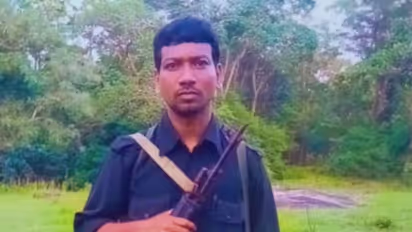
Hidma hailed from Puvarti village in Sukma district, a region long considered the heart of the Maoist movement. For years, his age and appearance remained a mystery, until a recent photograph surfaced earlier this year.
His Maoist journey began in the late 1990s, when he joined the banned outfit as a ground-level organiser. But it was his involvement in major attacks that pushed him to the top of India’s most-wanted lists.
He soon rose to lead the feared People’s Liberation Guerrilla Army (PLGA) Battalion No. 1, regarded as the strongest military formation of the Maoists in Dandakaranya, which spans Andhra Pradesh, Odisha, Telangana, Maharashtra, and Bastar.
Inside the organisation, he earned a reputation for precision and cruelty. His unit, armed with sophisticated weapons and guarded by a four-layered security ring, was described by police as “impenetrable” for years.
Known for his mastery of guerrilla warfare, Hidma always moved with an AK-47, while his large unit carried advanced weapons. A four-layer security cordon in the dense forests kept him out of reach of security forces for years.
Last year, he was elevated to the Maoists’ Central Committee, the highest decision-making body of the CPI (Maoist).
The Man Behind Some of India’s Deadliest Ambushes
Hidma came into national focus after the 2010 Tadmetla attack, where 76 security personnel were killed — one of the biggest losses in India’s anti-Maoist operations. He had worked closely with senior Maoist commander Papa Rao on the operation.
Over the years, his name recurred after every major ambush in Bastar. He also served on the Dandakaranya Special Zonal Committee (DKSZC), which masterminded several deadly attacks in south Bastar.
From there, his name surfaced repeatedly:
- 2013 Jhiram Valley attack (Darbha, Bastar) This ambush wiped out the senior leadership of the Congress in Chhattisgarh.
- 2017 Burkapal ambush Twenty-four CRPF personnel were killed.
In each of these attacks, investigators traced the planning, the deception, the choice of terrain — back to Hidma.
A Fugitive Losing Ground
Despite his impenetrable defence, the Maoist commander’s movements narrowed in recent years. Intensified anti-Naxal operations, especially in Maoist core zones, began eroding his protective cover.
For the first time in years, Hidma was forced to flee deeper into forests along the Chhattisgarh–Telangana and Chhattisgarh–Andhra Pradesh borders to escape the tightening security dragnet.
Officials said the sustained pressure had mounted not just on Hidma, but on several top Maoist leaders.
Hidma’s wife Raje was not a shadow presence; she was an active part of PLGA Battalion No. 1 and reportedly participated in almost every major Maoist strike. Her death in the encounter is expected to further disrupt communication and leadership linkages within the organisation.
A Leadership Crumble: The Ninth Central Committee Member Eliminated
Hidma’s death continues the pattern of senior Maoist leadership being taken down across states. With Tuesday’s encounter, nine Central Committee members have now been killed this year in Chhattisgarh, Jharkhand, and Andhra Pradesh.
Among the most prominent was: Nambala Keshav Rao alias Basavaraju, 70 General Secretary and the top-most operative of the CPI (Maoist), killed in Chhattisgarh.
Security forces confirmed that five Central Committee members were killed in Chhattisgarh, two in Jharkhand, and two in Andhra Pradesh this year.
A senior Chhattisgarh Police officer framed the significance bluntly: “Hidma had acquired a heroic image among his cadres, and his elimination is a major step towards eliminating Maoism from the Bastar region.”
With the fall of a commander who symbolised the Maoists’ military strength, the insurgency stands weaker than ever. But whether this marks the end of the conflict — or the beginning of a new phase — remains a question only the forests of Bastar can answer.
Stay updated with the Breaking News Today and Latest News from across India and around the world. Get real-time updates, in-depth analysis, and comprehensive coverage of India News, World News, Indian Defence News, Kerala News, and Karnataka News. From politics to current affairs, follow every major story as it unfolds. IMD cities weather forecastsRain Cyclone Asianet News Official App