From Clinic to Conspiracy: How Dr Shaheena Helped Fund and Recruit for a Terror Network
Synopsis
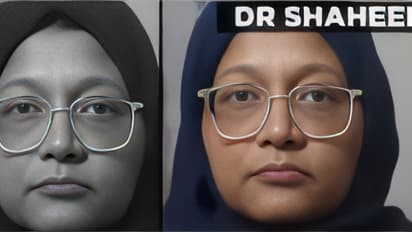
Dr Shaheena, a 40-year-old homeopathic doctor from Faridabad, allegedly used her clinic as a front to fund and recruit for a terror network. Investigators say she channelled money to extremist groups, radicalised youth online.
Police arrested a Lucknow-based doctor, named Shaheena, in a major Faridabad terror probe. Authorities say she led Jaish-e-Mohammed’s women recruitment in India, helped fund the cell and used medical and NGO channels to hide activities. The raids found huge quantities of explosives and weapons. Investigations link her to other accused doctors and to the car blast near Delhi's Red Fort.
Who is Shaheena and what's her role
Police have named Dr Shaheena as a key suspect in a large terror module busted around Faridabad and the Delhi-NCR region. Officials say she is a Lucknow-based woman doctor who organised recruitment for a women’s wing of Jaish-e-Mohammed and helped raise money and move material for the group. Her arrest has alarmed intelligence agencies because it points to radicalisation among educated professionals.
Arrests and the big seizure in Faridabad
A joint operation by Jammu & Kashmir police, Haryana police and central agencies led to multiple arrests, including Shaheena and several doctors. Police said they recovered a massive haul of explosives and weapons from rented premises in Faridabad. The total recovered material has been reported in media as about 2,900 kg of explosive-making material, along with firearms, timers and other bomb-making items. Officials have described the module as interstate and transnational.
What police allege Shaheena did
According to investigators, Shaheena was tasked with setting up and leading Jaish's female recruitment wing in India. She is accused of:
- Overseeing recruitment of women into what police say was a Jaish women's brigade.
- Using medical, welfare and NGO links to communicate with handlers and move funds and supplies.
- Helping to raise and arrange money, police estimate the group pooled around Rs 35-40 lakh for operations, much of it allegedly arranged through Shaheena’s networks.
Being in close contact with other accused doctors, including a Pulwama-based doctor named Muzammil and an alleged driver named Umar, who are central to the probe.
Links to Jaish-e-Mohammed and a women's wing
Security sources told reporters that Jaish-e-Mohammed is the external group behind the module. Media reports say the group has formally set up a women’s wing called Jamaat-ul-Mominat and has been trying to recruit in India. Police allege Shaheena played a leading role in that drive and handled recruitment and training of female members for psychological and operational roles. The creation of such wings is of concern because it widens the pool of potential operatives.
The Al-Falah connection and professional cover
Investigators say several accused were linked to Al-Falah University and nearby medical colleges. Police believe some members used their professional status as doctors to avoid suspicion. Officials say Shaheena and others used medical welfare activities and NGO channels as a cover to pass encrypted messages and move small sums of money without drawing attention. This 'white-collar' angle, where educated professionals are allegedly used to hide activities, is seen as a worrying new trend.
How Shaheena was traced and detained
Sources say Shaheena was arrested after coordinated work by police teams in multiple states. Her name surfaced during questioning of other detainees and through digital trails. She was reportedly flown to Srinagar for custodial interrogation so investigators there could question her about links to handlers in Jammu & Kashmir and possible role in planning. Officials are checking call records, bank transfers, and travel histories to map her movements and the network she allegedly ran.
The alleged funding and logistics network
Police sources claim the module pooled funds of approximately Rs 35-40 lakh. Investigators are tracing how the money moved. Authorities say some transfers went through reputed welfare channels and medical charity accounts. Timers, remotes, walkie-talkies and hundreds of kilograms of chemicals were seized, and investigators are examining purchase records, courier movements and CCTV footage to establish procurement routes. If true, the mix of professionals, fake NGOs and regular civilian channels would point to a more sophisticated model of terror logistics.
The possible link to the Delhi Red Fort blast
Police are probing links between the Faridabad stash and a high-intensity car blast near Delhi's Red Fort. Officials suggest the module’s members were awaiting target details and could have been preparing devices. Security sources say one of the alleged drivers connected to the group was being checked for ties to the vehicle used in the Delhi blast. Investigators are still building proof and cautioned the probe is ongoing.
Reaction from officials and security agencies
Haryana leaders and police called the seizures 'very serious'. The state's energy, transport and labour minister said those responsible “will not be spared”. Faridabad police confirmed recoveries of ammonium nitrate and other materials, and described the operation as ongoing. Central agencies, NIA, NSG and FSL, are reported to be assisting in forensic and technical analysis. Officials say they will probe cross-border links, funding routes and encrypted communication channels.
What the accused say and due process
Some arrested individuals reportedly told interrogators that they were chosen because 'no one suspects doctors'. These are allegations at present. Investigators must now prove in court that Shaheena and others knowingly supported a terror module. Everyone arrested is entitled to legal rights and a fair trial. Police statements form part of a case file that will be tested in court. Media reports are based on official sources and the probe is continuing.
The arrest of Dr Shaheena has added a worrying new face to the terror threat: the idea that trusted professionals could be used to hide and run violent networks. If the charges are proven, the case will show how extremist groups adapt by recruiting across society. If they are not, investigations must still answer how such large quantities of explosives were gathered in civilian areas. For now, the probe continues and the country watches closely.
(With inputs from agencies)
Stay updated with the Breaking News Today and Latest News from across India and around the world. Get real-time updates, in-depth analysis, and comprehensive coverage of India News, World News, Indian Defence News, Kerala News, and Karnataka News. From politics to current affairs, follow every major story as it unfolds. IMD cities weather forecastsRain Cyclone Asianet News Official App