US labour program suspension a challenge and opportunity for India: Kharge
Synopsis
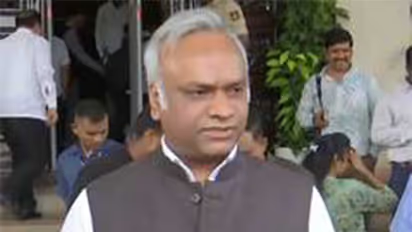
Karnataka Minister Priyank Kharge said the US suspension of its Permanent Labour Certification Programme for IT firms is a challenge for the outsourcing model but also an opportunity, as it may shift more high-value tech work back to India.
'Complex Consequences, Potential Opportunities': Priyank Kharge
Karnataka Minister for IT, Priyank Kharge on Friday said the US government's suspension of the Permanent Labour Certification Programme for major IT outsourcing companies could have complex and far-reaching consequences for India, potentially creating opportunities for the country's technology sector.
In a post on X, Kharge said the move could pose challenges for the traditional Indian IT outsourcing model, including higher operating costs in the United States, difficulties in retaining skilled employees and reduced flexibility in deploying Indian professionals on-site. "The US government’s suspension of the Permanent Labour Certification Programme for major IT outsourcing companies, a critical step through which foreign workers, including H-1B visa holders, pursue employment-based green cards, could have consequences for India that are both complex and potentially far-reaching," Kharge said in a post on X.
However, he said the implications for India as a technology hub could be different, with restrictions on moving Indian engineers to the US potentially leading to more high-value work being shifted to India. "If moving Indian engineers to the United States becomes more difficult and expensive, more high-value work may increasingly move to where the talent already is available," he said.
Kharge said the development could accelerate the expansion of Global Capability Centres (GCCs) in Indian cities and bring more global research and development, engineering and product-related mandates to the country. "This could accelerate the expansion of Global Capability Centres, bring more global R&D, engineering and product mandates to Indian cities, increase domestic demand for senior technology talent and strengthen India’s position not merely as the world’s IT service providers, but as a global centre for product development, AI, deep technology and innovation," he added.
He also said the move could increase domestic demand for senior technology professionals and strengthen India's position as a global centre for product development, artificial intelligence, deep technology and innovation. "For the traditional Indian IT outsourcing model, this is clearly a headwind. It could mean higher operating costs in the United States, greater difficulty in retaining skilled employees and reduced flexibility in deploying Indian professionals onsite," Kharge said in his post.
Highlighting the potential opportunities for India, he said, "If moving Indian engineers to the United States becomes more difficult and expensive, more high-value work may increasingly move to where the talent already is available."
Kharge, however, stressed the need for India to be better prepared to capitalise on the potential shift in global technology operations. "But, we need to be more prepared," he said.
Congress Targets PM Modi Over US Visa Curbs
Earlier, Congress leader Pawan Khera on Thursday targeted Prime Minister Narendra Modi over US visa restrictions affecting Indian professionals, alleging that the Prime Minister was allowing US President Donald Trump to “bully” him instead of taking a firm stand in dealing with Washington.
In a post on X, Khera said the high fees for H-1B visas had already prompted American companies to reconsider hiring Indian professionals, while the suspension of the PERM programme for major Indian IT companies had made it more difficult for them to sponsor Indian employees for permanent residency in the United States. “The exorbitant H-1B fees have already made American companies think twice about hiring Indian professionals. Now, by suspending the PERM programme for major Indian IT companies, the Trump administration has made it harder for Indian companies operating in the US to sponsor Indian professionals for permanent residency,” Khera said.
Nasscom Responds to Suspension
Following the US government's temporary suspension of several major technology companies from filing new applications under the Permanent Labour Certification (PERM) programme, the National Association of Software and Service Companies (Nasscom) said immigration and skilled talent mobility were two distinct issues and should not be viewed through the same lens.
In an official statement, Nasscom said the US Department of Labour's decision affected a specific immigration pathway, while Indian technology companies had significantly reduced their dependence on H-1B visas over the years, expanded local hiring and built a strong domestic workforce in the United States. "The U.S. Department of Labor has today announced the temporary suspension of certain IT companies, including Indian technology companies operating in the U.S., from filing new applications under the Permanent Labor Certification (PERM) programme. While the decision affects a specific immigration pathway, Nasscom has consistently maintained that immigration and skilled talent mobility are two distinct issues and should not be viewed through the same lens," the statement said.
"The H-1B visa programme has historically played an important role in addressing short-term skill gaps in the US and it will continue to be used to address short term talent gaps. However, over a number of years, Indian technology companies have significantly reduced their dependence on H-1B visas, while steadily expanding local hiring and building a strong domestic workforce in the U.S," the statement added.
Nasscom added that Indian technology companies worked with a majority of Fortune 500 companies in the US, enabling them to innovate and grow while generating more local jobs. It said the number of employees transitioning from H-1B visas to permanent residency through the PERM process was relatively limited.
The industry body also said Indian technology companies operated across more than 80 countries and had consistently demonstrated their commitment to complying with local laws and regulatory requirements."We are confident that they will continue to adhere to applicable regulations in the US as well," it said.
US Labour Department Announces Suspension
Earlier, US Labour Secretary Keith Sonderling announced the US Government is suspending from the Permanent Labour Certification Program some of the largest IT outsourcing firms in the world, which include Cognizant, Infosys, Tata, Wipro, HCL, and Capgemini. The US Labour Department attributed the suspension to multiple active federal investigations, even as it also suspended US tech majors Microsoft and Adobe from the program.
The US Labour secretary further said the department would not accept new applications or process pending permanent labor certification applications involving the companies."We will not accept any new or process any pending permanent labor certification applications involving these companies," Sonderling said.
Sonderling said the companies named had collectively sought millions of foreign workers and received hundreds of thousands of H-1B visa approvals and permanent labour certifications."Since 2009, just these companies alone have requested almost 3 million foreign workers. They received over 230,000 H1B Visa approvals and over 100,000 permanent labor certifications that's hundred and thousands of jobs that were taken from a American workers," the Labour Secretary said.
The announcement comes after the US Department of Homeland Security proposed new fees for F-1 nonimmigrant students seeking to participate in Optional Practical Training (OPT), describing the measure as an effort to protect American workers and strengthen the integrity of the immigration system. (ANI)
(Except for the headline, this story has not been edited by Asianet Newsable English staff and is published from a syndicated feed.)Stay updated with the Breaking News Today and Latest News from across India and around the world. Get real-time updates, in-depth analysis, and comprehensive coverage of India News, World News, Indian Defence News, Kerala News, and Karnataka News. From politics to current affairs, follow every major story as it unfolds. IMD cities weather forecastsRain Cyclone Asianet News Official App