TN CM Vijay chairs meet to oppose delimitation, DMK & AIADMK skip
Synopsis
Tamil Nadu CM C Joseph Vijay chaired a meeting of MPs to oppose the Centre's delimitation plan. Attendees demanded that TN's 39 Lok Sabha seats be preserved, while major parties like DMK and AIADMK boycotted the session.
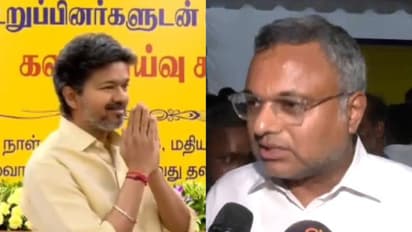
Tamil Nadu Chief Minister C Joseph Vijay on Saturday chaired a key meeting of state MPs to build a united front against the Centre's proposed delimitation exercise, even as major regional parties DMK and AIADMK did not attend it. Held at Kalaivanar Arangam, the consultation brought together around 21 lawmakers from Lok Sabha and Rajya Sabha, mainly from Congress, VCK, CPI, CPI(M), MDMK, and IUML. The leaders were unanimous: any population-based redrawing of constituencies that reduces Tamil Nadu's political weight will be opposed strongly.
'Tamil Nadu's Representation Must Be Preserved'
Speaking on the consensus reached during an all-party meeting convened by Chief Minister Vijay, Congress Lok Sabha MP Karti Chidambaram asserted that the state's parliamentary representation must remain completely untouched. "This is an issue beyond party politics. This is an issue that concerns Tamil Nadu's rights and Tamil Nadu's representation in the Parliament of India. Tamil Nadu can't be diminished in the Parliament of India. Tamil Nadu's place in the Parliament of India must be preserved. Any delimitation, whatever might be that formula, whether it is based on population or a uniform increase, will diminish our role in Parliament, and that can't be allowed." Chidambaram told reporters.
He appealed to all parties to "rise above party politics" and speak in one voice for Tamil Nadu's rights, noting that the meeting had settled on a clear demand. "We discussed the repercussions of delimitation, in whichever manner it takes place. We are very clear that we want the Parliament to be frozen at 543 and Tamil Nadu's representation to be guaranteed at 39," he said.
Chidambaram shared that of Tamil Nadu's MPs from both Houses, about 21 attended and were unanimous that the state's seat share could not be altered. "Our representation in the Parliament can't be diminished. Any kind of alteration and delimitation, either on the basis of population or on a proportionate increase, will be resisted. We want the Parliament to be frozen at 543, and the distribution among the states to be preserved as it is, which means Tamil Nadu will have 39 members in a house of 543," he said, adding that a larger Parliament would be an "ineffective Parliament" and would not serve the state well.
DMK, AIADMK Criticised for Absence
Congress MP Jyothimani backed this sentiment, expressing that boycotting parties would stand with the cause. "We have deeply discussed all the issues concerning the delimitation, like how it will be destructive to Tamil Nadu as well as to India. This should be stopped at any cost. That's the commitment we are all having today... Hope that a better sense prevails across all political parties... Hope they (DMK and AIADMK) will understand the gravity of the situation, and they will also come along with all of us," she said.
Congress MP Praveen Chakraborty criticised the DMK and AIADMK for skipping the meeting despite their long history in power in the state. "It was very disappointing that the party that governed the state for 6 terms and the party that governed the state for 5 terms did not participate in a meeting called by the chief minister to defend the rights and freedom of the people of Tamil Nadu," he said.
"Our demand is very clear: we do not want any change either in the total number of seats or in the share of Tamil Nadu's seats. We do not want any change. So, there is nothing called fair delimitation. The only delimitation is no delimitation," he said.
Congress MP Vishnu Prasad echoed the criticism, noting that the DMK, which has ruled Tamil Nadu roughly six times, and the AIADMK, which has also governed the state, stayed away from the meeting along with alliance partners PMK and DMDK. "If the delimitation comes into force, if the bill is passed, then definitely our voice, our representation in the Parliament will be reduced... Rahul Gandhi, as well as the CM, told very clearly that this delimitation bill should not be entertained and it should be objected to in the first place. But unfortunately, today DMK and AIADMK are absent, and other alliance partners like PMK and DMDK are absent. Their priorities may be different. They are not bothered about the people of Tamil Nadu," he said.
Fears of 'Demographic Penalty'
The meeting was called by CM Vijay to bring together Lok Sabha and Rajya Sabha MPs from Tamil Nadu to discuss the Union government's proposed delimitation exercise, which has raised concerns in several southern states about a potential decrease of parliamentary presence tied to population-based redrawing of constituencies. The DMK, AIADMK, and PMK opted to stay away from the gathering. DMK earlier questioned the TVK government's stance on delimitation and the absence of a clear agenda for the discussion.
The fierce pushback from Tamil Nadu stems from deep-rooted fears regarding the upcoming delimitation exercise, which is tied to post-2026 census data. For decades, southern states like Tamil Nadu and Kerala have successfully implemented national population control and family planning guidelines. In contrast, several northern states have experienced higher population growth rates. Under a strict population-based seat allocation model, southern states worry they will be heavily penalized for their demographic success. States with surging populations stand to gain a disproportionately higher share of Lok Sabha seats, while southern states face a relative dilution of their political voice and federal leverage in Parliament.
To safeguard federal equity, Tamil Nadu parties across the political spectrum are demanding that the total strength of the Lok Sabha be frozen at its current capacity of 543 seats, preserving the historical allocation formula that safeguards representation for progressive, population-stable states. Southern states, particularly Tamil Nadu and Kerala, have long voiced deep apprehension over post-2026 delimitation based on current population metrics. Because southern states successfully implemented national family planning and population control directives over the last five decades, their relative population share has grown more slowly than that of several northern states. Under a strict population-proportional seat-allocation model, southern states face a severe "demographic penalty"--meaning they stand to lose parliamentary seats and federal political leverage. To prevent this imbalance, Tamil Nadu's political class uniformly demands that: The total strength of the Lok Sabha be frozen at its current cap of 543 seats. The existing state-wise seat distribution (such as Tamil Nadu's 39 Lok Sabha MPs) remain completely untouched.
Out of Tamil Nadu's 57 total MPs (Lok Sabha and Rajya Sabha combined), 36 MPs opted to stay away. The ruling Dravida Munnetra Kazhagam (DMK)--which holds 22 Lok Sabha MPs and 8 Rajya Sabha MPs --alongside the principal opposition All India Anna Dravida Munnetra Kazhagam, PMK and DMDK completely boycotted the session. (ANI)
(Except for the headline, this story has not been edited by Asianetnews Editorial staff and is published from a syndicated feed.)Stay updated with the Breaking News Today and Latest News from across India and around the world. Get real-time updates, in-depth analysis, and comprehensive coverage of India News, World News, Indian Defence News, Kerala News, and Karnataka News. From politics to current affairs, follow every major story as it unfolds. IMD cities weather forecastsRain Cyclone Asianet News Official App