Tejas Dropped It, Ghatak Needs It: The Second Life of DRDO's Kaveri
Synopsis
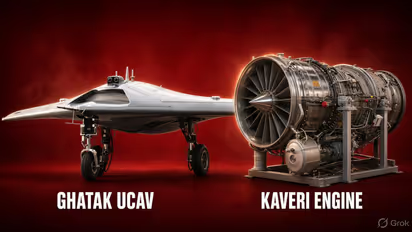
The Kaveri dry engine achieved a peak thrust of 48.5 kilonewtons during high-altitude trials in Russia, surpassing its 46 kilonewton target. Developed by DRDO’s Gas Turbine Research Establishment, this afterburner-free version offers enhanced fuel efficiency and lower thermal signatures.
In the summer of 2004, a team of Indian engineers returned home from Russia carrying a heavy disappointment. Their Kaveri jet engine had failed its high-altitude tests, ending hopes of powering the first production Tejas fighters. For the next two decades, the name Kaveri became associated with delays, setbacks and wounded pride. This week, a leaner member of the same engine family was reported back from the same country with the kind of result those engineers had waited more than twenty years to hear.
The Kaveri dry engine has completed trials at two Russian establishments — the Central Institute of Aviation Motors and the Gromov Flight Research Institute. It did not merely pass. Against a reported target of about 46 kilonewtons of thrust, it recorded a peak of 48.5 kilonewtons. Thrust is simply the push that drives an aircraft forward. A thrust of 48.5 kilonewtons is roughly equal to the force produced by the weight of five tonnes — about five small cars. For the Gas Turbine Research Establishment (GTRE) in Bengaluru, the DRDO laboratory that kept the programme alive through its darkest years, the result is a long-awaited vindication.
Why travel all the way to Russia? The air at great heights is thin and extremely cold. An engine that performs perfectly on the ground can struggle at altitude, much like a trekker gasping for breath on a Himalayan pass. India currently lacks a facility capable of carrying out the complete range of such high-altitude engine testing. So, the Kaveri was first tested in chambers that recreate the low temperatures and reduced air pressure. It was then tested in the open sky, reportedly mounted on an Il-76 transport aircraft in place of one of its regular engines.
The word "dry" simply means that this version of Kaveri does not use an afterburner, which sprays additional fuel into the hot exhaust for a short burst of extra thrust. Removing it brings two important advantages: better fuel efficiency and a cooler exhaust. Both matter for an aircraft that must stay hidden and airborne for long periods.
Those are exactly the qualities required by the aircraft this engine is intended to power. Ghatak is India's secretive unmanned combat aircraft, a tailless flying-wing design intended to strike deep inside hostile territory while remaining difficult to detect on radar. Imagine a boomerang-shaped aircraft with no cockpit and no conventional tail. Its smooth shape is designed to scatter radar waves rather than reflect them back. Reports describe it as a 13-tonne aircraft — about as heavy as a mid-sized bus full of passengers — capable of carrying around 1.5 tonnes of weapons inside its body, so nothing hangs in the open for a radar to catch. Ghatak is expected to fly fast, though below the speed of sound, and will make extensive use of carbon-composite materials, which are light and strong.
Its purpose is to go where sending a human pilot could be extremely dangerous. Ghatak is intended to enter heavily defended airspace, gather intelligence and strike targets. It could eventually work alongside manned fighters, taking on the most dangerous missions while aircraft such as the Su-30MKI or the future AMCA operate nearby. A smaller, roughly one-tonne technology demonstrator called SWiFT flew in 2022.
To understand why an engine test deserves national attention, consider an uncomfortable reality. India designs and manufactures combat aircraft, yet not one of its frontline fighters currently flies with an Indian-designed jet engine. The Tejas depends on a foreign powerplant. Helicopters such as the Dhruv also use engines developed with foreign involvement. The engine is the heart of an aircraft, and India's aviation hearts have largely depended on technology from abroad. This leaves the country's air power exposed to foreign delivery schedules, international supply chains and changing political relationships. A supplier's delay can become India's delay. A diplomatic chill can ground a fleet.
Caution is necessary, however. This successful test does not end India's dependence on foreign aircraft engines. The Kaveri dry engine must still be cleared by the Centre for Military Airworthiness and Certification (CEMILAC), the body that decides whether a military aircraft system is safe to fly. Only then come fitting it to the aircraft and, later, flight trials of Ghatak itself. Earlier reports placed the rollout of the first prototype around late 2029 or early 2030. An operational Ghatak remains some distance away.
Still, something important has changed. A programme marked by decades of setbacks has produced a rare and measurable success, achieved by engineers who absorbed criticism, learnt from failures and returned to the very country where their earlier hopes had once collapsed. What they have opened is still only a narrow path towards true Atmanirbharta, or self-reliance, in aircraft engines. But it is a real path — and this time, it begins with an Indian heart beating strongly in thin, freezing air.
(Girish Linganna is an award-winning science communicator and a Defence, Aerospace & Geopolitical Analyst. He is the Managing Director of ADD Engineering Components India Pvt. Ltd., a subsidiary of ADD Engineering GmbH, Germany.)
Disclaimer: The opinions expressed are solely those of the author and do not reflect the views or stance of the organization. The organization assumes no responsibility for the content shared.
Stay updated with the Breaking News Today and Latest News from across India and around the world. Get real-time updates, in-depth analysis, and comprehensive coverage of India News, World News, Indian Defence News, Kerala News, and Karnataka News. From politics to current affairs, follow every major story as it unfolds. IMD cities weather forecastsRain Cyclone Asianet News Official App