Study Reveals Kaziranga's Evolution, Rhino Habitat Shaped by Climate
Synopsis
A study has traced Kaziranga National Park's history, revealing how climate change and other factors shaped the one-horned rhino's habitat. The findings are based on sediment analysis and highlight the region's importance for biodiversity conservation.
A scientific study has traced the evolutionary history of Assam's Kaziranga National Park, revealing how the habitat of the one-horned rhinoceros has been shaped over time by climate change, vegetation transitions, invasive species and herbivore activity. The findings are based on analyses of sediment layers beneath the park's wetlands.
Global Threats to Biodiversity
According to the Ministry of Science & Technology, rapid urbanisation, industrialisation, and deforestation, together with natural hazards such as floods, droughts, earthquakes, and landslides, are driving global ecological degradation and accelerating biodiversity loss. Northeast India, part of the Indo-Burma biodiversity hotspot, hosts numerous endangered species facing extinction risk. Late Quaternary megafaunal extinctions remain a major global concern, with their causes still debated; today, nearly 60% of large herbivores are threatened worldwide, and Southeast Asia has the highest number of at-risk species.
Unearthing Kaziranga's Past
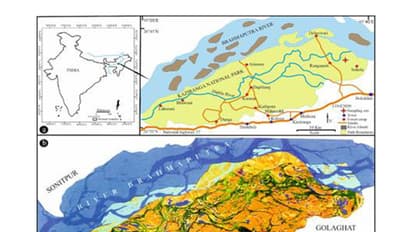
Kaziranga National Park, a UNESCO World Heritage Site, is a stronghold of megaherbivores, notably the Indian one-horned rhinoceros. Scientists from the Birbal Sahni Institute of Palaeosciences (BSIP), an autonomous institute of the Department of Science and Technology (DST), used pollen samples from mud beneath wetlands in KNP to establish the first long-term palaeoecological records of palaeoherbivory in KNP.
The researchers extracted a sediment core of just over a metre from the Sohola swamp within Kaziranga National Park. Layer by layer, this mud acts like a natural archive, preserving microscopic traces of the past. Among these traces are pollen grains from plants and fungal spores that thrive on animal dung.
Findings on Rhinoceros Migration
The study, published in journal 'Catena' (Elsevier), highlights that Kaziranga's present landscape differs markedly from its past and documents the regional extinction of megaherbivores, including the Indian rhinoceros, from northwestern India due to climatic amelioration during the late Holocene, especially during the Little Ice Age and increasing human activities. In contrast, northeastern India remained relatively climatically stable, facilitating eastward migration and the eventual concentration of rhinoceroses in Kaziranga.
According to the Ministry of Science & Technology, the study, which examined the reasons behind the decline and present confinement of megaherbivores, especially the Indian one-horned rhinoceros, to Kaziranga National Park, shows through fossil evidence that the species was once widely distributed across the Indian subcontinent, but this distribution greatly reduced since the Holocene. Over the last ~3300 years, northeastern India remained relatively climatically stable with lower human pressure, while habitat loss, climate deterioration, and overhunting in northwestern regions forced rhinoceroses to migrate eastward and eventually concentrate in Kaziranga.
Implications for Future Conservation
The study demonstrates how long-term vegetation and climate changes have shaped wildlife survival, migration, and extinction, providing long-term ecological knowledge to guide more effective conservation and wildlife management under present and future climate change. (ANI)
Stay updated with the Breaking News Today and Latest News from across India and around the world. Get real-time updates, in-depth analysis, and comprehensive coverage of India News, World News, Indian Defence News, Kerala News, and Karnataka News. From politics to current affairs, follow every major story as it unfolds. IMD cities weather forecastsRain Cyclone Asianet News Official App