'Rang Birangi Duniya': The Hindi Phrase Prince William Used To Rethink The World's Future (WATCH)
Synopsis
Prince William invoked Hindi phrase 'Rang Birangi Duniya', meaning a world full of colour, at 2026 Earthshot Prize Impact Assembly in Mumbai. He urged the world to move beyond the idea that economic growth and environmental protection cannot coexist.
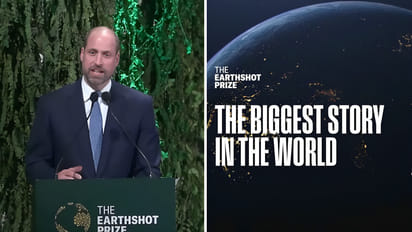
Britain's Prince William brought a Hindi phrase into the global conversation on climate change and environmental protection when he described the future as a 'Rang Birangi Duniya' i.e. a world full of colour. Addressing the 2026 Earthshot Prize Impact Assembly in Mumbai on Monday, November 16, the Prince of Wales used the expression to make a larger point: the world must stop treating economic growth and environmental protection as opposing goals. Instead, countries should recognise that prosperity and a healthy planet can support each other.
#WATCH | Britain’s Prince William highlights the vision of a “Rang Birangi Duniya” (a world full of colour), calling for a future that balances prosperity, nature and people. He urges support for the Earthshot Prize finalists, emphasising the need to identify, back and scale innovative solutions to build a sustainable future.
#EarthshotPrize2026 #PrinceWilliam #Sustainability #ClimateAction @KensingtonRoyal
— DD News (@DDNewslive) November 16, 2026
His choice of words gave a distinctly Indian touch to his message. Rather than presenting the future in black and white, he asked business leaders, investors, philanthropists and environmental innovators to imagine it in all its colours, with solutions emerging from different countries and communities.
"There is a phrase in Hindi: 'Rang Birangi Duniya'. A world full of colour. Perhaps that is how we should see the future. Not in black and white, and not presented as a series of false choices between people and the planet, prosperity and nature, but in all its colours. A world in which solutions can come from anywhere," Prince William said.
The phrase, which translates to a colourful or many-coloured world, became the central idea of his address. It also reflected the message he wanted the Earthshot Prize to carry: environmental progress does not have to come at the cost of people's livelihoods or economic development.
'Rang Birangi Duniya' is a Hindi expression that describes a world filled with different colours. It can also suggest variety, diversity and the many possibilities that life offers.
Prince William used the phrase as more than a cultural reference. He connected it to the need to look beyond simple divisions when discussing the environment.
For years, developing economies have often faced the argument that they must choose between creating jobs, expanding industries and protecting nature. The Prince challenged this way of thinking, saying that the future should not be reduced to a choice between people and the planet or between prosperity and the environment.
His message was that environmental solutions can improve everyday life while also creating economic opportunities. The challenge is to identify ideas that work, give their creators the support they need and make those solutions available on a much larger scale.
Why Prince William pointed to India
Prince William said India offered an important example of how economic growth and environmental sustainability could move forward together.
He referred to India's achievement of reaching its target of 50 per cent of installed electricity capacity from non-fossil fuel sources five years ahead of schedule. He also highlighted the country's rapid expansion of solar energy, with solar capacity growing more than 50-fold in little over a decade.
"India shows us a different picture. A picture full of colour, complexity and possibility," he said.
The Prince argued that this transformation was not only about changing the sources of energy. It was also about improving the way people live.
His remarks placed India's experience at the centre of a wider international discussion on climate action. For emerging economies, the task is not simply to reduce environmental damage but also to meet the needs of growing populations, expand access to energy and improve living standards.
India's progress, he suggested, showed why the two ambitions should not be treated as mutually exclusive.
India has a strong presence at the Earthshot Prize
The Prince also recognised India's contribution to the Earthshot Prize, noting that the country has produced more winners and finalists than any other.
He recalled that Takachar became the initiative's first-ever winner in the Clean Our Air category in 2021.
This year, he highlighted the work of two Indian finalists: Mahila Housing Trust and Mahindra Last Mile Mobility.
Mahila Housing Trust is helping women from low-income communities deal with extreme heat. Its work includes practical measures such as cooler roofs and affordable insurance, which can help vulnerable households cope with rising temperatures.
Mahindra Last Mile Mobility, meanwhile, is working to make electric rickshaws an affordable transport option. The shift towards electric vehicles can help reduce pollution from everyday travel, particularly in crowded cities.
Prince William described these efforts as examples of environmental action that directly improves people's lives.
The projects also reflected his wider argument about the importance of local solutions. Environmental innovation does not always have to begin with large-scale technology or expensive infrastructure. Practical ideas that address the needs of communities can also make a meaningful difference.
'Find them, back them and help them scale'
A major part of Prince William's address was a call for greater support for environmental innovators.
He said the six-year journey of the Earthshot Prize had shown him that people with solutions to some of the world's biggest environmental problems were already working on the ground. What they needed was the backing to develop and expand their ideas.
"Our task is to find them, back them and help them scale," he said.
He urged those attending the assembly to support the finalists through their ideas, influence and investment, and help take their work to a global audience.
The Prince also stressed that no single country, company or community had all the answers. Innovations in cleaner transport, agricultural insurance, renewable energy and efforts to tackle dangerous chemicals showed why countries needed to learn from one another.
"When a solution works, others must follow," he said.
His appeal was directed not only at governments but also at businesses, investors and philanthropists who can help promising projects move beyond the early stages and reach more people.
What is the Earthshot Prize?
Prince William founded the Earthshot Prize in 2020 with a 10-year mission to accelerate environmental recovery. The initiative identifies and supports solutions to five major challenges: Protect and Restore Nature, Clean Our Air, Revive Our Oceans, Build a Waste-free World and Fix Our Climate.
Each year, 15 finalists are selected across these five categories. Five winners are then chosen, with each receiving £1 million to help develop and expand their solutions.
The 2026 edition is particularly significant as it marks the first time the Earthshot Prize is being held in India. The Mumbai gathering has brought together environmental innovators, business leaders, investors, philanthropists and other partners working to advance sustainable solutions.
According to the British High Commission, Prince William and Princess Kate are scheduled to attend the 2026 Earthshot Prize ceremony on November 17 and 18. Their programme will also include engagements focused on climate action, sustainability, innovation and youth leadership.
The visit is the royal couple's second official trip to India.
(With inputs from agencies)
Stay updated with the Breaking News Today and Latest News from across India and around the world. Get real-time updates, in-depth analysis, and comprehensive coverage of India News, World News, Indian Defence News, Kerala News, and Karnataka News. From politics to current affairs, follow every major story as it unfolds. IMD cities weather forecastsRain Cyclone Asianet News Official App