PM Modi Ranked Asia's Second-Most Effective Leader After Xi Jinping in 2026 Asia Power Index
Synopsis
PM Modi was credited for balancing ties with the US and Russia while managing border tensions with China. In overall national power across 27 countries and territories, India retained third place, trailing Us and China as diplomatic influence surged.
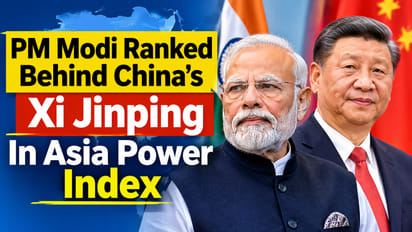
Prime Minister Narendra Modi has been ranked Asia's second-most effective regional leader, behind Chinese President Xi Jinping, in the 2026 Asia Power Index released by Australia's Lowy Institute. The report credits Modi's handling of relations with major powers, particularly China, and India's ability to balance competing international interests.
However, the leadership assessment is different from the ranking of the most powerful countries in Asia. In the overall 2026 Asia Power Index, the United States (US) holds the first position, China is second and India ranks third.
India has strengthened its position as a major power, scoring 40.5 points out of 100, an improvement of 0.5 points from 2025. The report also found that the gap between India and China had narrowed to its smallest level since the index began in 2018.
The findings are part of the eighth edition of the annual index, which examines the economic, military and diplomatic strength of 27 countries and territories across Asia.
Which are the top 10 powers in the 2026 Asia Power Index?
The US remains most powerful country, with 78.9 points. China follows with 73.6 points, while India is third with 40.5 points. The top five are unchanged in terms of their order in the 2026 ranking. The top 10 countries and their scores are:
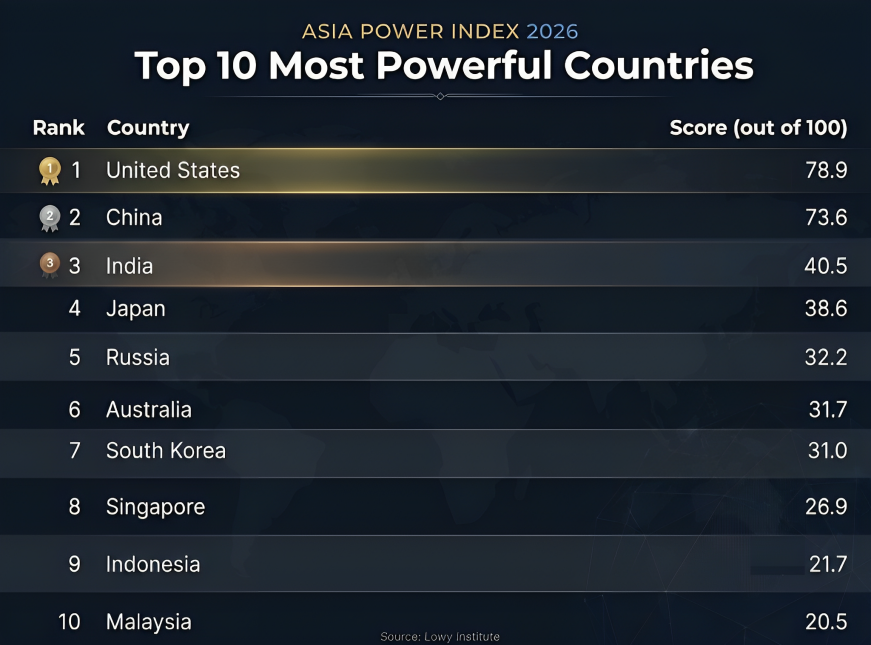
The scores show that the US and China remain far ahead of other countries. However, the gap between the two has narrowed to just 5.3 points, its smallest since the index was first published in 2018.
India has also strengthened its position, moving further ahead as a major power in Asia.
What is Lowy Institute Asia Power Index?
The Asia Power Index is an annual study published by the Lowy Institute, an independent international affairs think tank based in Australia. First launched in 2018, it measures how much influence countries have over other nations and international events.
The 2026 edition is the eighth report. It covers 27 countries and territories, including the US, China, India, Russia, Japan, Australia and countries across South and Southeast Asia.
The index uses 131 indicators grouped into 30 sub-measures and eight main categories. More than half of the indicators are based on the Lowy Institute's own research, while the remaining data comes from national and international sources. The eight categories are:
Economic capability: The size of an economy, its technology, trade and financial strength.
Military capability: Defence spending, armed forces, weapons and military readiness.
Resilience: A country's ability to deal with internal and external threats.
Future resources: Expected economic, military and population resources in the coming years.
Economic relationships: Trade, investment and economic links with other countries.
Defence networks: Military partnerships, defence agreements and arms sales.
Diplomatic influence: International relations, diplomatic networks and foreign policy.
Cultural influence: A country's ability to influence others through its culture, media and people
The institute gives different weight to each category. Economic and military capability carry the highest weight at 17.5% each, followed by economic relationships at 15%. The remaining five categories carry 10% each.
Countries are then given an overall score out of 100.
Why is PM Modi ranked second among regional leaders?
The report says expert assessments of PM Modi's regional leadership improved considerably, moving India up three places in this measure. He is now behind only Chinese President Xi Jinping.
Speaking to ANI, Hunter Marston said PM Modi's ability to manage pressure from major world powers was an important reason for the assessment.
He pointed to India's relationship with China, which has long been affected by tensions along their shared border.
Marston said India had managed to restore some stability along the border while continuing trade with China. He described this as a sign of India's diplomatic ability and its capacity to deter a much larger military power.
He also referred to India's difficult relationships with neighbouring countries such as Pakistan and Myanmar. Despite these geographical and political challenges, India has continued to attract international investment and manage competing global interests.
Another important factor is India's relationship with both the US and Russia. Both countries have different expectations from New Delhi, particularly over the Russia-Ukraine conflict. Marston said India had managed these competing pressures while maintaining its non-aligned foreign policy position.
Top 10 political leaders in the 2026 Asia Power Index
The Lowy Institute’s 2026 global political-leadership assessment ranks Xi Jinping first and Narendra Modi second, followed by leaders from Singapore, Japan, Australia and other regional powers across its 27-country-and-territory index.

India's strongest and weakest areas in the index
Diplomatic influence is India's strongest area, with a score of 70.3. However, its overall position in this category is fourth.
Marston explained that diplomatic influence is measured through a country's network of embassies and diplomatic missions, its role in international groups and the effectiveness of its foreign policy.
He said India's membership of international groups such as BRICS and other multilateral organisations had strengthened its diplomatic position.
India also made progress in defence networks, moving up two places to ninth. Its score increased to 18.6 points. Marston linked this improvement to India's growing security ties with Southeast Asian countries and the sale of BrahMos missiles to Indonesia, Vietnam and the Philippines.
However, defence networks remain India's weakest category among the eight measures.
The report also highlighted some areas of concern. India's economic capability score fell by 0.7 points to 26.4. The institute linked this to a weaker rupee, changes in the International Monetary Fund's economic measurements and a fall of nearly $20 billion in India's overseas investment.
On the positive side, India recorded its biggest improvement in cultural influence, gaining 2.3 points to reach 43.8. Its future resources score also increased by 1.2 points to 56.2, reflecting its economic and demographic potential.
Marston believes India's growing defence engagement and diplomatic reach could help it gain more influence in Asia in the coming years.
The 2026 index therefore presents a mixed picture: India still has a considerable gap to bridge with China in overall power, but its growing regional influence and stronger diplomatic position have helped it consolidate its place among Asia's leading powers.
(With inputs from agencies)
Stay updated with the Breaking News Today and Latest News from across India and around the world. Get real-time updates, in-depth analysis, and comprehensive coverage of India News, World News, Indian Defence News, Kerala News, and Karnataka News. From politics to current affairs, follow every major story as it unfolds. IMD cities weather forecastsRain Cyclone Asianet News Official App