Modi Meets Tokayev At BRICS: Connectivity, Critical Minerals, Energy On Agenda
Synopsis
At the 18th BRICS Summit in New Delhi, PM Modi meets Kazakhstan President Kassym-Jomart Tokayev to push practical cooperation on connectivity, critical minerals, energy, investment and trade, with INSTC–Chabahar links and the Trans-Caspian route under focus.
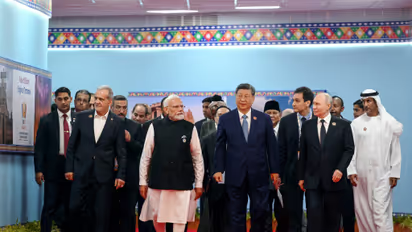
Prime Minister Narendra Modi meets Kazakhstan President Kassym-Jomart Tokayev in New Delhi on Sunday on the sidelines of the 18th BRICS Summit, with a practical agenda that spans transport connectivity, critical minerals, energy, investment and trade. The objective is clear: translate years of political outreach between New Delhi and Astana into projects that move goods, capital and resources efficiently.
Kazakhstan, a BRICS partner since 2025, views the New Delhi summit as a chance to widen ties with major economies. The Astana Times cited analyst Aidar Kurmashev noting that BRICS opens doors to countries including India, Brazil, South Africa, the UAE, Indonesia and Egypt. For India, the near-term prize could be Kazakhstan itself.
India has long described Central Asia as its extended neighbourhood, yet geography and blocked overland access through Pakistan have constrained trade. As PM Modi said at the first India-Central Asia Summit in 2022, “Central Asia is central to India’s vision of an integrated and stable extended neighbourhood.”
Kazakhstan’s Geography, India’s Route Choices
Policy has turned to routes. The International North-South Transport Corridor (INSTC) via Iran, with Chabahar as a key gateway, offers a Pakistan-bypassing path into Central Asia. Kazakhstan’s transit role is growing through the Trans-Caspian International Transport Route, or Middle Corridor, linking China, Russia, the Caspian and Europe.
A proposal aired ahead of BRICS envisions an India–Iran–Turkmenistan–Kazakhstan chain, feeding Aktau and Kuryk into the Trans-Caspian network. A pilot container move by Indian, Iranian, Turkmen and Kazakh operators could reveal real transit times, tariffs and bottlenecks. Payments, insurance, sanctions risks around Iran, multiple transshipments and steady cargo volumes will decide if the route is bankable.
“Political presence should be assessed by the continuation,” argued Kazakh expert Aidar Kurmashev, calling for agreements to be matched by accountable operators and timelines.
Critical Minerals, Energy And The BRICS Frame
Connectivity is paired with resources. India and Kazakhstan are exploring critical minerals, rare earths and natural uranium cooperation; Kazakhstan has been an important uranium supplier for India’s nuclear plans. Ambassador Azamat Eskarayev underlined Kazakhstan’s potential in traditional and renewable energy and in critical minerals processing.
Under India’s 2026 BRICS chairship, PM Modi urged the Global South to become a “rule-shaper” and pressed for the “pyramid of privilege” in global governance to become a “platform of partnership.” The New Delhi Declaration stresses resilient supply chains, energy security, cross-border infrastructure and critical minerals.
Delivering commerce remains the test. India–Kazakhstan trade was $924.3 million in 2025, The Economic Times reported, and both sides see the need to ease logistical and tariff barriers and diversify trade. If pilot cargo, mineral projects, investment and functioning links follow this summit, an economically viable India–Kazakhstan route into Eurasia moves from promise to practice.
Stay updated with the Breaking News Today and Latest News from across India and around the world. Get real-time updates, in-depth analysis, and comprehensive coverage of India News, World News, Indian Defence News, Kerala News, and Karnataka News. From politics to current affairs, follow every major story as it unfolds. IMD cities weather forecastsRain Cyclone Asianet News Official App