People in Delhi can live nearly 10 years more if air pollution reduced, says study
Synopsis
Due to air pollution in the country, Indians tend to live less, as per a study. Air pollution across the nation has reduced the life expectancy of Indians by 5.2 years
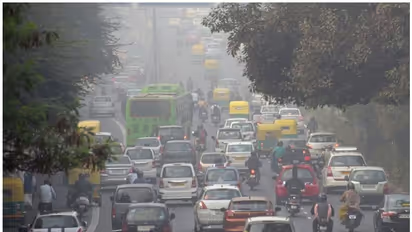
New Delhi: Increasing air pollution has cut the average life expectancy of the Indians by 5.2 years. If air pollution is reduced according to the parameters prescribed by the World Health Organization (WHO) then the life expectancy in people living in Delhi can increase by 9.4 years, according to a study.
According to WHO guidelines, the level of pollutant element (PM) 2.5 present as fine particles in the air should not exceed 10 microns per cubic meter. PM10 levels should not exceed 20 microns per cubic meter. In 2018, the average level of PM 2.5 in India was 63 microns per cubic meter.
According to the new air quality life expectancy list prepared by the Energy Policy Institute at the University of Chicago, if the level of pollution across India is reduced as per WHO standards, the age of Indians can increase up to 5.2 years.
The report states that with time, pollution related to fine particulate matter has increased significantly. Since 1998, pollution related to fine particulate matter has increased by 42% annually, which has reduced the average age of the people by 1.8 years in that period. The report states that 25% of India’s population lives in such conditions of air pollution which is not seen in any other country.
If the level of pollution remains constant, then the age of 24 crore and 80 lakh people living in north India can decrease by more than eight years. The report states that if the pollution in Delhi is reduced as per the WHO standards, then the people’s age of the national capital may increase by 9.4 years.
“Though the threat of coronavirus is grave and deserves every bit of the attention it is receiving—perhaps more in some places—embracing the seriousness of air pollution with a similar vigor would allow billions of people around the world to lead longer and healthier lives,” said Michael Greenstone, the Milton Friedman Distinguished Service Professor in Economics and creator of the AQLI along with colleagues at the Energy Policy Institute at the University of Chicago (EPIC).
“The reality is, no shot in the arm will alleviate air pollution. The solution lies in robust public policy. The AQLI (Air Quality Life Index) tells citizens and policymakers how particulate pollution is affecting them and their communities and can be used to measure the benefits of policies to reduce pollution,” he added.
According to the report, if the pollution is reduced as per the WHO guidelines, then in states like Bihar and West Bengal, people’s age can increase by seven years and for the people of Haryana, the people’s age can increase by eight years.
It is mentioned in the report that India, Pakistan, Bangladesh, and Nepal where around 25% of the world’s population resides are listed as the most polluted countries of the world. Uttar Pradesh is emerging as the most polluted area of South Asia.
Find out more in #TheNewsableDecipher
Stay updated with the Breaking News Today and Latest News from across India and around the world. Get real-time updates, in-depth analysis, and comprehensive coverage of India News, World News, Indian Defence News, Kerala News, and Karnataka News. From politics to current affairs, follow every major story as it unfolds. IMD cities weather forecastsRain Cyclone Asianet News Official App