Mumbai Tops India’s Traffic CO₂ Emissions/Km As Dense Roads Choke City. Where Do Delhi, Bengaluru Stand?
Synopsis
Driven by high vehicle density, Mumbai recorded the highest road traffic carbon dioxide (CO₂) emissions per km of road length among major Indian cities, according to a new high-resolution emissions dataset published in Scientific Data.
Mumbai has recorded the highest road traffic carbon dioxide (CO₂) emissions per kilometre of road among major Indian cities, driven squarely by its high vehicle density, according to a new high-resolution emissions dataset published in Scientific Data. The findings place Mumbai at the top of India’s urban transport pollution crisis, while other metros — Delhi, Bengaluru, Chennai, Hyderabad and Pune — also emerge as significant contributors, particularly for nitrogen oxides (NOx) and carbon monoxide (CO) emissions from road transport.
The study was led by researchers from France’s Laboratoire des Sciences du Climat et de l’Environnement and Universite Paris-Saclay, with key contributions from IIT Bombay and Paris-based urban mobility data firm NEXQT SAS. Using cutting-edge modelling, the team mapped daily road traffic CO₂ and air pollutant emissions at an unprecedented 500-metre resolution across 15 Indian cities for 2021.
This research forms part of the ambitious CHETNA project — a nationwide effort aimed at tracking city-wise, high-resolution carbon emissions across more than 100 Indian cities.
Mumbai tops road traffic CO₂ emissions/km; Delhi, Bengaluru among nation's top 3
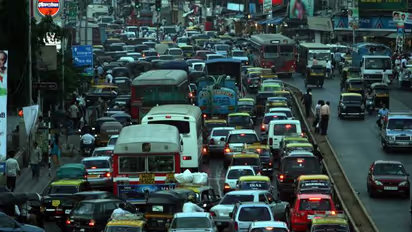
A city-wise comparison revealed denser traffic translated directly into higher CO₂ emissions per kilometre of road. Mumbai stood at the top, in terms of both vehicle density and per-kilometre emissions. Cities such as Chandigarh, Chennai, Pune and Bengaluru clustered in the high-density, high-emissions bracket, though still trailing Mumbai. Delhi occupied a mid-high position, registering lower per-kilometre emissions than some similarly congested cities, while Guwahati, Indore and Jaipur showed relatively lighter traffic loads and lower emissions.
Interestingly, while Delhi ranked only mid-range in per-kilometre emissions, it joined Mumbai and Bengaluru as one of the top three cities for total CO₂ emissions from road traffic, underlining the sheer scale of its transport network. On a per capita basis, however, the picture evened out: nearly all 15 cities recorded less than 0.2 tonnes of CO₂ per person annually, suggesting broadly similar vehicle usage patterns across urban India.
NOx and CO emerged as the dominant emissions from road transport across all cities studied. A comparative heatmap showed that major metros — Mumbai, Delhi, Bengaluru, Chennai, Hyderabad and Pune — consistently logged higher NOx and CO emissions than smaller cities such as Guwahati, Mangaluru and Tiruppur. Traffic-related particulate pollutants, including PM₁₀, PM₂.₅ and black carbon, were also detected at moderate levels in large cities, though their overall magnitude remained lower than NOx and CO.
CO₂, the study noted, is a potent greenhouse gas. When released in large quantities — primarily from vehicles, power plants and industry — it traps heat in the atmosphere, accelerating global warming and fuelling heatwaves, erratic rainfall, floods, droughts and rising sea levels.
Health impacts
Explaining the health impacts, Dr Sundeep Salvi, director of the Pulmocare Research and Education Foundation and president of the India Chest Society, warned that among vehicular pollutants, carbon monoxide poses a particularly serious threat. "This can damage the lungs and lead to several health issues."
Carbon dioxide, he added, acts differently. It is mainly a climate pollutant and does not cause direct health effects when inhaled at normal ambient levels.
Dr Salvi said, "All vehicular pollutants are harmful, but particulate matter is of greatest concern, as it can enter the bloodstream and affect multiple organs. Nitrogen oxides are also harmful to the lungs and, in the presence of sunlight, form ozone, which is a secondary pollutant and further damages lung tissue. Nitrogen oxides also increase the risk of respiratory and viral infections."
Harish C Phuleria, associate professor at IIT Bombay’s Centre for Environmental Science and Engineering and a contributor to the study, said the CHETNA project is only just beginning. "As part of the CHETNA project, we aim to develop high spatial and temporal resolution data for carbon and air pollutant emissions for about 100 cities across India. The methodology presented here will be scaled up for the rest of the cities and additionally emissions are being estimated for residential, power, heavy industries, MSMEs and aviation sectors. The data will be made handy through a web portal and dashboard and city-specific dashboards will be made available and handed over to the urban civic bodies."
Phuleria added that a major workshop is planned for February 2026 in Mumbai, bringing together stakeholders from participating cities to review the findings, provide feedback and shape future policy responses.
Stay updated with the Breaking News Today and Latest News from across India and around the world. Get real-time updates, in-depth analysis, and comprehensive coverage of India News, World News, Indian Defence News, Kerala News, and Karnataka News. From politics to current affairs, follow every major story as it unfolds. IMD cities weather forecastsRain Cyclone Asianet News Official App