Maratha Activist Manoj Jarange Ends Hunger Strike After Maharashtra Government Accepts Key Demands
Synopsis
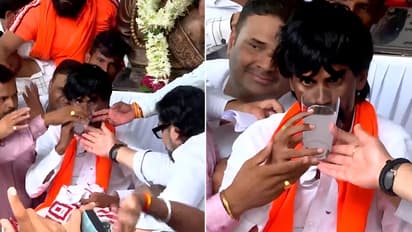
Maratha activist Manoj Jarange ended his 5-day hunger strike after Maharashtra government agreed to key demands, including Kunbi status for Marathas, withdrawal of cases against protesters and compensation for families of those killed in agitation.
Maratha activist Manoj Jarange ended his indefinite hunger strike on the fifth day after reaching a breakthrough with the Maharashtra government on two major demands linked to the Maratha quota agitation. Calling it a 'victory for the agitators', Jarange said that the government had agreed to accord Kunbi status, an OBC category, to Marathas from the Marathwada region. A government resolution (GR) implementing the historic Hyderabad Gazette, which allows distribution of Kunbi caste certificates after verification, was issued later in the day.
Jarange also said the government assured that cases against protesters would be withdrawn by the end of September. Families of those who lost their lives during the protests will receive compensation and government jobs within a week.
Legal options to recognise Marathas as Kunbis
A Cabinet sub-committee led by minister Radhakrishna Vikhe Patil met Jarange and conveyed that the government was also exploring legal measures to issue a GR declaring that Kunbis and Marathas are the same community. Cabinet head Radhakrishana Vikhe Patil thanked Manoj Jarange for accepting the government’s proposal and breaking his fast.. Officials informed Jarange that this process could take around two months.
Massive protests and court intervention
The agitation began on August 29 at Mumbai’s Azad Maidan, with nearly 4,000 protesters joining Jarange to demand a 10% reservation for Marathas in government jobs and education under the OBC category.
The large protest caused severe congestion in south Mumbai, prompting the Bombay High Court to intervene. On Monday, the court said the quota stir had “literally paralysed” Mumbai and ordered that Azad Maidan be cleared by 3 pm Tuesday.
In the morning, a tense standoff unfolded as police attempted to vacate the site. However, by afternoon, the court allowed Jarange and his supporters to continue at Azad Maidan until September 3 morning.
Jarange declares victory
After his meeting with the Cabinet sub-committee, Jarange told supporters: 'We have won'. The withdrawal of the hunger strike was met with relief by protesters, who had been camping at the site since last week. Manoj Jarange Patil began his hunger strike at Azad Maidan in Mumbai on August 29, a symbolic protest site with historical significance. By Tuesday, his strike entered the fifth consecutive day, with a large number of supporters rallying behind him.
Despite health risks, Patil vowed not to end his fast until the government implements the Hyderabad Gazette, which relates to Maratha quota recognition. He stated, "Even if I die, I will not leave Azad Maidan. We are peacefully protesting. Justice will prevail."
His core committee and supporters echoed his resolve, saying they would not leave Mumbai until their demands were met.
Why were the Marathas protesting?
The Maratha community, one of the largest and most influential in Maharashtra, has been demanding reservation benefits in government jobs and educational institutions for years. They have been seeking a 10 percent quota under the OBC category. The issue intensified after repeated attempts to secure reservation faced legal and political challenges. Over the past two years, peaceful protests have been held across the state, but the movement escalated after Jarange Patil launched his indefinite hunger strike, making it a statewide concern.
Bombay High Court hearing and adjournment
On Monday, the Bombay High Court held an urgent hearing on the ongoing agitation. The court noted that permission for the protest was given under certain conditions, which protestors had allegedly violated, including exceeding the gathering limit of 5,000 people and disrupting public order. However, on Tuesday, the HC adjourned the case till Wednesday, saying it expected 'some development by then'. The judges also admonished the Attorney General, Birender Saraf, who argued that the protestors should vacate Mumbai:
- The court told Saraf that authorities should have acted earlier if the crowd exceeded permitted numbers.
- The bench warned that it might also pass an order against the government for breaching its own orders.
Advocate Satish Maneshinde, representing Jarange Patil, defended the protest and reiterated that his client had appealed to supporters to avoid traffic disruptions and keep gatherings within permitted limits.
Historical context of Maratha Reservation
The Maratha quota has been a long-standing demand in Maharashtra. In 2018, the state government granted 16% reservation to Marathas under the SEBC (Socially and Educationally Backward Classes) category. However, in 2021, the Supreme Court struck it down, ruling that it breached the 50% cap on reservations. Since then, activists like Patil continued their demand, pressing for recognition under the OBC category.
(With ANI inputs)
Stay updated with the Breaking News Today and Latest News from across India and around the world. Get real-time updates, in-depth analysis, and comprehensive coverage of India News, World News, Indian Defence News, Kerala News, and Karnataka News. From politics to current affairs, follow every major story as it unfolds. IMD cities weather forecastsRain Cyclone Asianet News Official App