JNU hunger strike: John Brittas seeks President Murmu's intervention
Synopsis
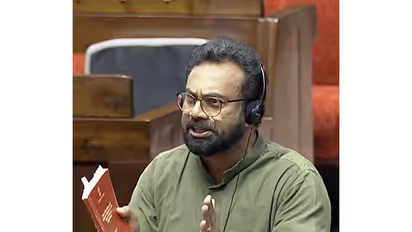
CPI(M) MP John Brittas wrote to President Murmu seeking intervention in the JNU students' hunger strike, now on its 16th day. He urged revoking rustication orders and withdrawing contentious provisions from the Chief Proctor’s Office (CPO) manual.
Concerns over rustication and CPO manual
In his letter dated October 18, addressed to the President, Brittas expressed concern over the students’ deteriorating health and the university administration’s failure to address their grievances. “I write to your good self with deep concern regarding the indefinite hunger strike undertaken by the representatives of the Jawaharlal Nehru University Students’ Union (JNUSU) and other students since 3rd October, 2026, marking today as the sixteenth day of an extreme form of peaceful protest. The failure of the university administration to address the genuine and longstanding concerns of the student community has led to this continuing protest and contributed to the deteriorating health of the participating students, giving rise to a situation warranting urgent intervention,” he wrote.Brittas raised concerns over the rustication of elected Students’ Union representatives, including the former JNUSU president, for nearly eight months. He said their exclusion affected the functioning of the Students’ Union and weakened students’ ability to collectively raise their grievances. He also objected to provisions of the CPO Manual relating to fines and disciplinary measures for protests and assemblies. “The rustication of elected Students’ Union representatives, including the former JNUSU President, for nearly eight months has raised serious concerns. The exclusion of elected representatives from the University directly affects the functioning of the Students’ Union and weakens the mechanism through which students collectively articulate their grievances. Similarly, the continued enforcement of the Chief Proctor’s Office (CPO) Manual, which provides for exorbitant fines and stringent disciplinary measures in connection with several forms of protest and assembly, further raises serious concerns regarding the space available for legitimate democratic expression within the University,” he wrote.
'Preserve democratic expression'
Recalling his own years as a JNU student, Brittas stressed the importance of preserving an environment where students could express their views, question decisions and collectively raise concerns. “I am therefore particularly conscious of the importance of preserving an environment where students can freely express their views, question arbitrary decisions and collectively raise their concerns. It is, therefore, deeply concerning that such disproportionate disciplinary measures could diminish this space, discouraging students from raising legitimate grievances for fear of punitive action. Such an atmosphere has implications extending well beyond those directly affected, particularly when concerns relating to gender justice, equal opportunity, admissions and basic campus facilities remain unresolved. The prolonged impasse has now assumed serious proportions, particularly in view of the risks posed to the health and well-being of the hunger strike participating students,” he wrote.
Brittas invokes JNU Act, seeks intervention
Brittas also highlighted the principles underpinning JNU’s establishment under the Jawaharlal Nehru University Act, 1966, and referred to the President’s role as Visitor of the university. “It is pertinent to highlight that Jawaharlal Nehru University was established under the Jawaharlal Nehru University Act, 1966, enacted by Parliament. The Act itself identifies social justice, secularism and a democratic way of life among the foundational principles of the University. Further, it designates the Hon’ble President of India as the Visitor of the University and confers powers to review its functioning and issue appropriate directions in accordance with the provisions of the Act,” he wrote.
Seeking the President’s intervention under Section 8 of the Act, Brittas urged her to take up the matter with the university administration and ensure that the students’ concerns were addressed. “In these circumstances, I earnestly request your good self to kindly intervene in exercise of the powers vested in the Visitor under Section 8 of the Jawaharlal Nehru University Act, 1966, and take appropriate steps towards revocation of the rustication orders against the Students’ Union representatives, withdrawal of the objectionable provisions of the CPO Manual and an expeditious resolution of the students’ outstanding grievances,” he wrote. (ANI)
Stay updated with the Breaking News Today and Latest News from across India and around the world. Get real-time updates, in-depth analysis, and comprehensive coverage of India News, World News, Indian Defence News, Kerala News, and Karnataka News. From politics to current affairs, follow every major story as it unfolds. IMD cities weather forecastsRain Cyclone Asianet News Official App